-
ABOUT US
-
ACADEMICS
Curriculum Program
Departments
- English
- High School Chinese
- Primary and Junior School Chinese.
- High School Mathematics
- Middle School Mathematics
- Primary School Mathematics
- Music and Fine Arts
- Physical Education
- Physics
- Chemistry
- History and Geography
- Physical Science and Optional courses Department
- Middle School Biology
- High School Biology
- Social Sciences
- Computer Science
- Courses in Primary School
Achievements and Matriculations
College Counseling
Science & Technology Innovation Contest
Subject Competition
-
ARTS
-
ATHLETICS
-
AT SHSID
SHSID ∣ TIMES
PTSA
Club Exhibition
- 龙吟社
- Live 2 Drama
- Choir
- Hip-pop Dance Club
- The Primary School Dance Troupe
- Symposiums Club
- Biology Workshop
- You Shan
- VEX Robotic
- Peking Opera Club
- Baseball Club
- Model United Nations
- The World Scholar’s Cup
- Future Problem Solving Club
- OM Club
- AMC Club
- Music for Patients
- Smile Charity
- Stem Doge Alliance
- Chinese Debate Club
- IAA
- Mock Trial Club
- Zhengming Club
- Furry Friends
- GT-Racing
- Village Radio
- IMMC Club
- Creative Design and Intelligent Fabrication
- Future City Research Project
- ECOCAP
- AdvocaSEA
- SPDC
- Floorball Club
- Animusic MTC
- Wings Up
- Cyano
- Birding Community
Health and Wellness
Campus Safety
Cafeteria Service
-
ADMINISTRATION
-
ADMISSIONS
-
ALUMNI
Alumni Information
Honors Students
- Class of 2026
- Class of 2025
- Class of 2024
- Class of 2023
- Class of 2022
- Class of 2021
- Class of 2020
- Class of 2019
- Class of 2018
- Class of 2017
- Class of 2016
- Class of 2015
- Class of 2014
- Class of 2013
- Class of 2012
- Class of 2011
- Class of 2010
- Class of 2009
- Class of 2008
- Class of 2007
- Class of 2006
Who Studied at SHSID
SHS Foundation
-
DOCUMENTS
High School Science Fair Lecture - Unveiling the Frontiers of Brain-Computer Interfaces
On October 19, Professor Yun Wang of the Institute of Brain Science at Fudan University joined the "Pursue · Excel" lecture series of the Science Fair at SHSID, delivering an accessible talk on the frontiers of science titled "Brain-Computer Interfaces: An Organic Bridge Between Brain Science and Artificial Intelligence" to students and teachers in the B1 Threater, Zhongxing Building.
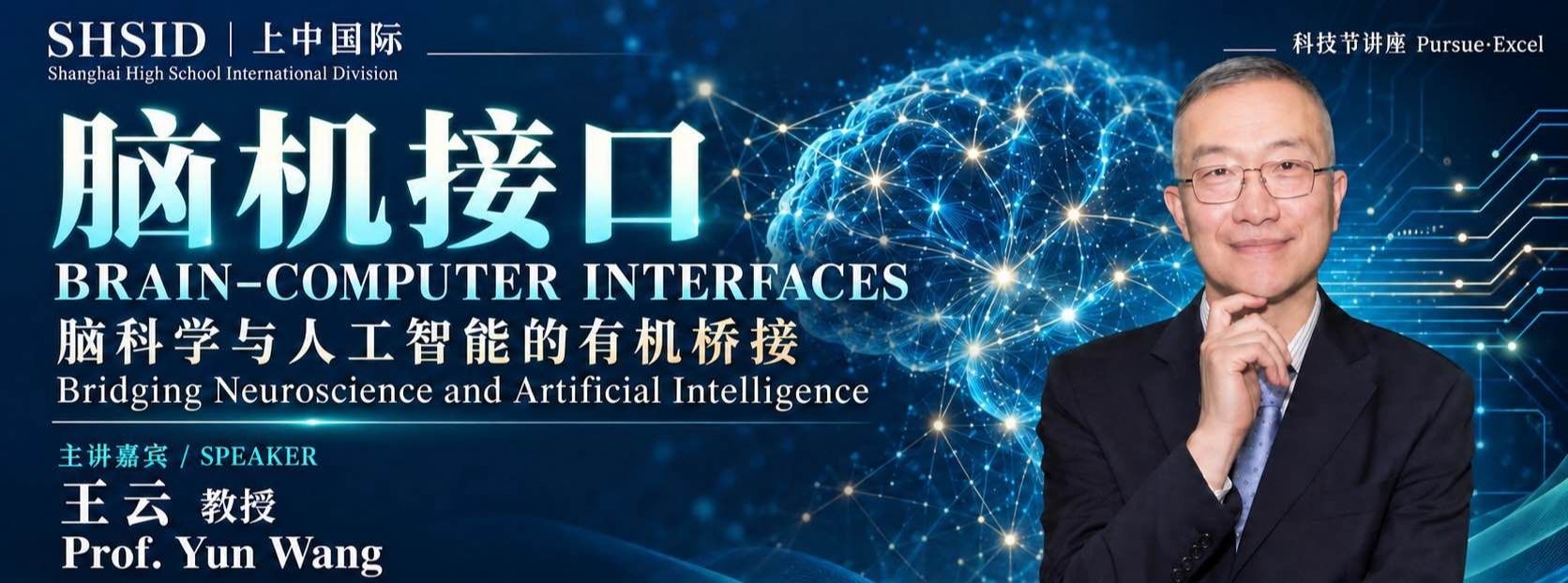
Professor Wang began with the core functions of the brain: Our ability to perceive the world and to interact with it in real time rests on the nervous system, and everything from everyday physiological activity to higher mental processes such as thought and memory is supported by the brain. A set of striking figures brought the sophistication of biological intelligence into focus: roughly 100 billion neurons of remarkably diverse function, 3 million kilometers of neural connections in total, a capacity for more than 2 quadrillion distinct states, all running on less than 30 watts.
He then unpacked how the brain works. Neurons transmit electrical signals as action potentials and communicate chemically across synapses through neurotransmitters, and information is processed through spatial and temporal integration. Through serial, feedback, and other connection patterns, different neurons form neural circuits and networks that underpin the brain's complex functions.
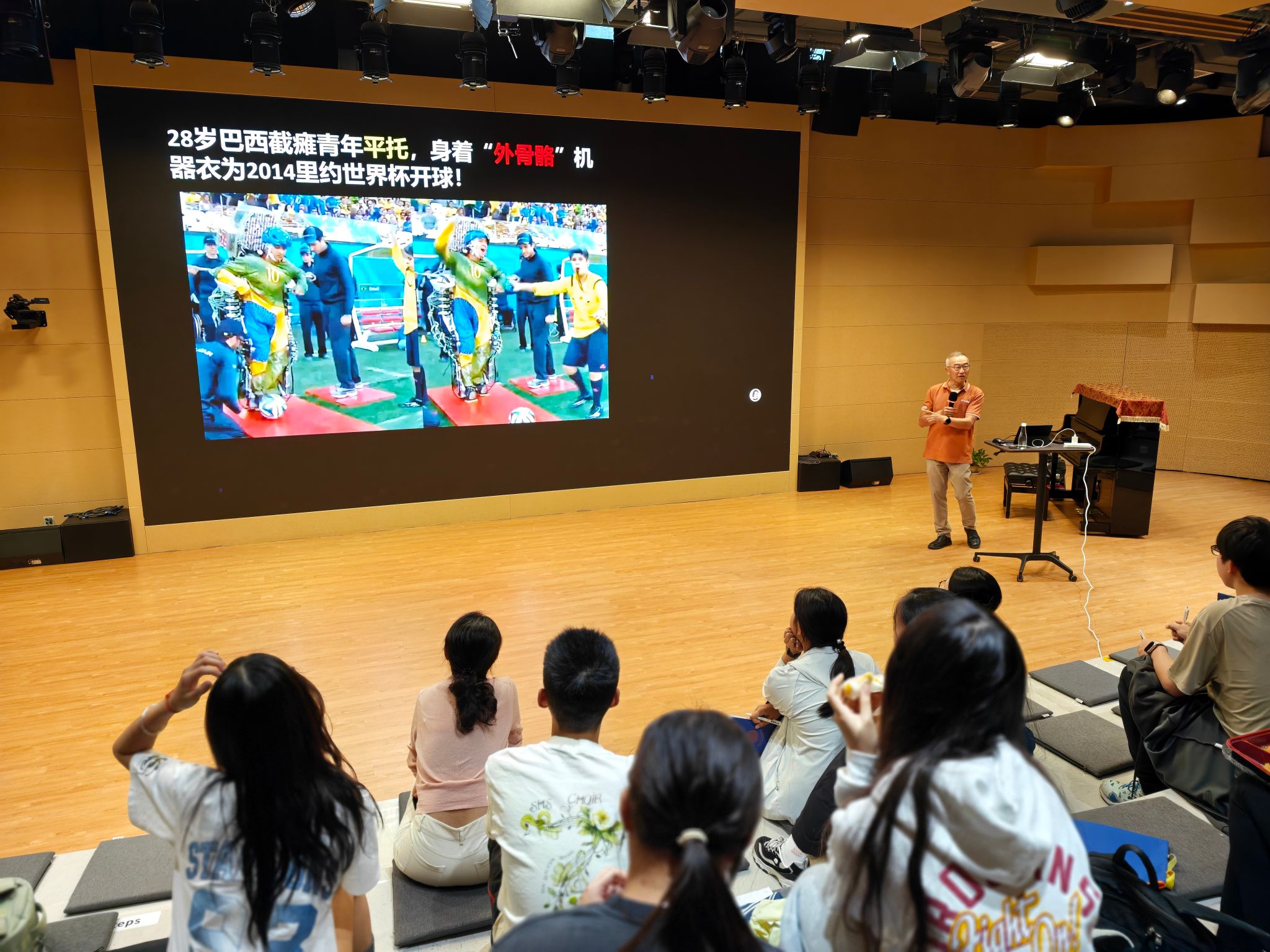
Building on this foundation, Professor Wang explained the technical core of brain-computer interfaces (BCI): Establishing a direct channel of information between the brain and external devices, and achieving direct brain-machine interaction through a complete loop of "signal acquisition; decoding and analysis; device control; neurofeedback." Drawing on four decades of research in neuroscience, he made this interdisciplinary frontier accessible, giving students a clear grasp of its technical logic and application value.
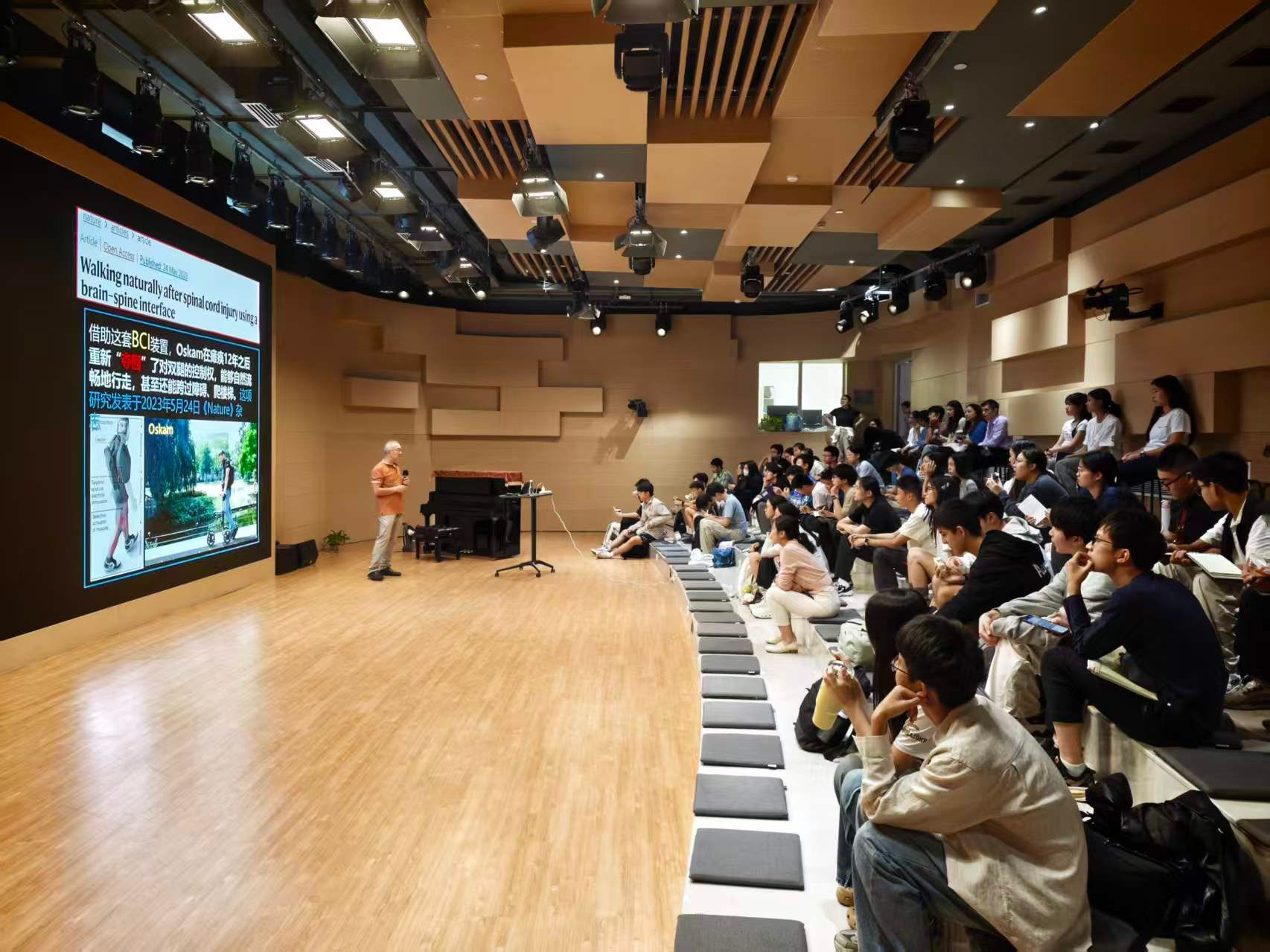
The lecture opened the doors of brain science and interdisciplinary technology for our students, enriching the Festival's academic program and sparking their curiosity about the mysteries of life and the science of intelligence. SHSID has long upheld the principle of nurturing students through science and innovation, bringing frontier scientific resources into everyday learning, and encouraging scientific thinking and a spirit of inquiry through public science exchange. We will continue to build diverse, high-caliber academic platforms, opening a direct pathway between basic education and world-class research, and helping students grow into outstanding individuals with global vision and the ability to innovate.
(Written and Pictures by High School STEAMS Advisors Office Reviewed by Hui Liao, Qian Zuo)