-
ABOUT US
-
ACADEMICS
Curriculum Program
Departments
- English
- High School Chinese
- Primary and Junior School Chinese.
- High School Mathematics
- Middle School Mathematics
- Primary School Mathematics
- Music and Fine Arts
- Physical Education
- Physics
- Chemistry
- History and Geography
- Physical Science and Optional courses Department
- Middle School Biology
- High School Biology
- Social Sciences
- Computer Science
- Courses in Primary School
Achievements and Matriculations
College Counseling
Science & Technology Innovation Contest
Subject Competition
-
ARTS
-
ATHLETICS
-
AT SHSID
SHSID ∣ TIMES
PTSA
Club Exhibition
- 龙吟社
- Live 2 Drama
- Choir
- Hip-pop Dance Club
- The Primary School Dance Troupe
- Symposiums Club
- Biology Workshop
- You Shan
- VEX Robotic
- Peking Opera Club
- Baseball Club
- Model United Nations
- The World Scholar’s Cup
- Future Problem Solving Club
- OM Club
- AMC Club
- Music for Patients
- Smile Charity
- Stem Doge Alliance
- Chinese Debate Club
- IAA
- Mock Trial Club
- Zhengming Club
- Furry Friends
- GT-Racing
- Village Radio
- IMMC Club
- Creative Design and Intelligent Fabrication
- Future City Research Project
- ECOCAP
- AdvocaSEA
- SPDC
- Floorball Club
- Animusic MTC
- Wings Up
- Cyano
- Birding Community
Health and Wellness
Campus Safety
Cafeteria Service
-
ADMINISTRATION
-
ADMISSIONS
-
ALUMNI
Alumni Information
Honors Students
- Class of 2026
- Class of 2025
- Class of 2024
- Class of 2023
- Class of 2022
- Class of 2021
- Class of 2020
- Class of 2019
- Class of 2018
- Class of 2017
- Class of 2016
- Class of 2015
- Class of 2014
- Class of 2013
- Class of 2012
- Class of 2011
- Class of 2010
- Class of 2009
- Class of 2008
- Class of 2007
- Class of 2006
Who Studied at SHSID
SHS Foundation
-
DOCUMENTS
“Mendeleev Is a Bit Busy: Fun Facts about the Periodic Table” Chemistry Lecture
At noon of October 23, 2026, a Chemistry PA lecture was held in Room 308 of Zhongxing Building. The lecture was delivered by Mr. Ma Kaicheng, with the theme "Mendeleev Is a Bit Busy: Fun Facts About the Periodic Table." The lecture not only guided students through the fascinating world of the periodic table but also provided an accessible analysis of two different naming systems for elements in Chinese and English, transforming chemical symbols into engaging stories of culture and science and greatly inspiring students' enthusiasm for exploring the subject of chemistry.
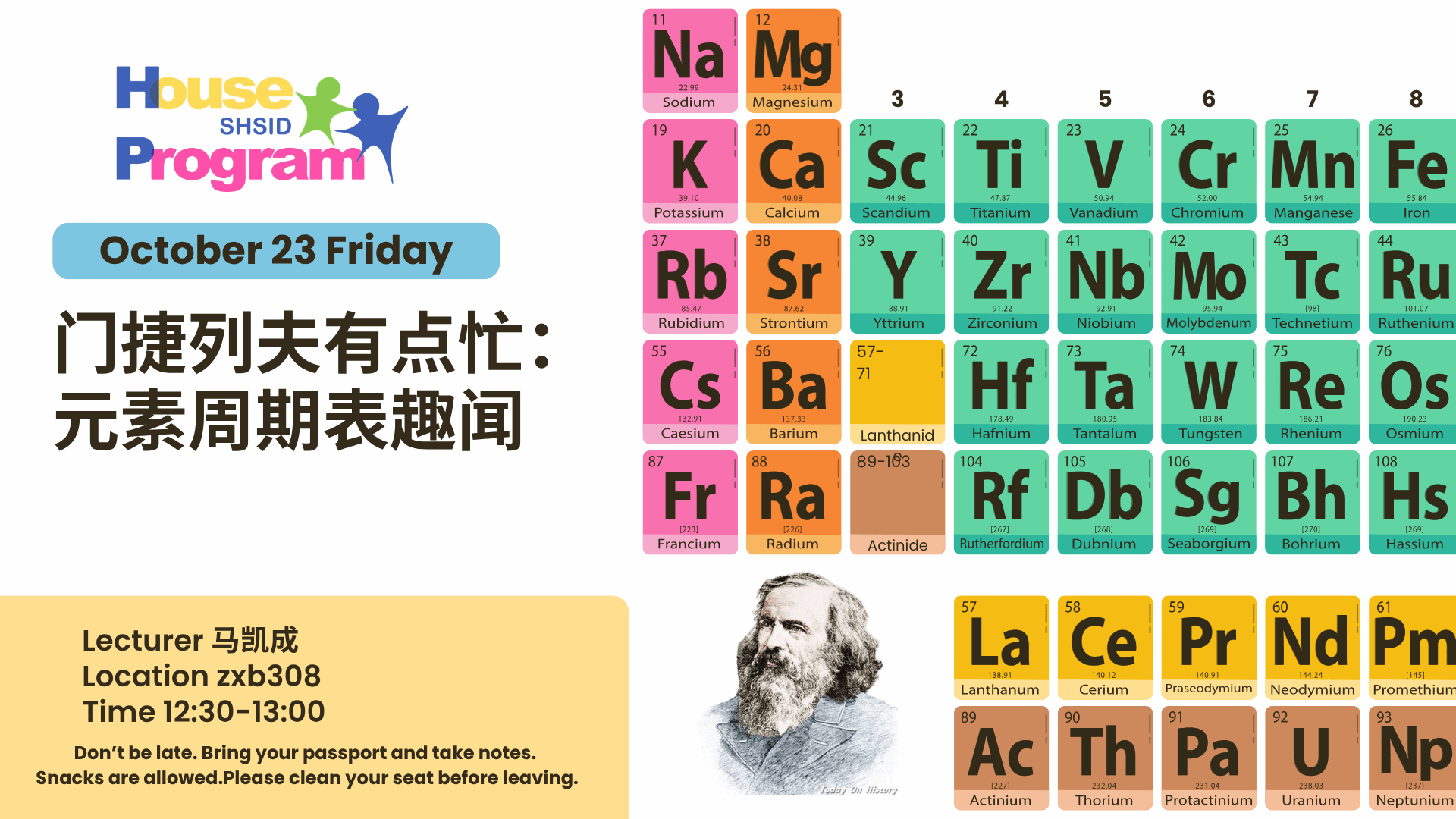
Mr. Ma began with the familiar periodic table, highlighting Chinese naming wisdom. Unlike English spellings, Chinese element names follow a clear pattern: "the character reveals the substance." Radicals reflect physical states—gases like hydrogen and oxygen use "气," liquids like bromine and mercury use "氵," solid metals like sodium and calcium use "钅," and solid nonmetals like carbon and silicon use "石." This "one character, one state" method reflects keen observation and shows the scientific and artistic nature of Chinese characters.
Mr. Ma then turned to English-speaking periodic table systems, noting the distinction between the "American system" (Roman numerals plus letters: IA, IIA, IIIB…VIIIA) and the "European system" (Arabic numerals 1–18). He explained their origins: "A" means main groups and "B" subgroups, tied to electron configuration; the 1–18 system is more convenient for international exchange and modern teaching. Students realized the same chart can differ across regional academic traditions.
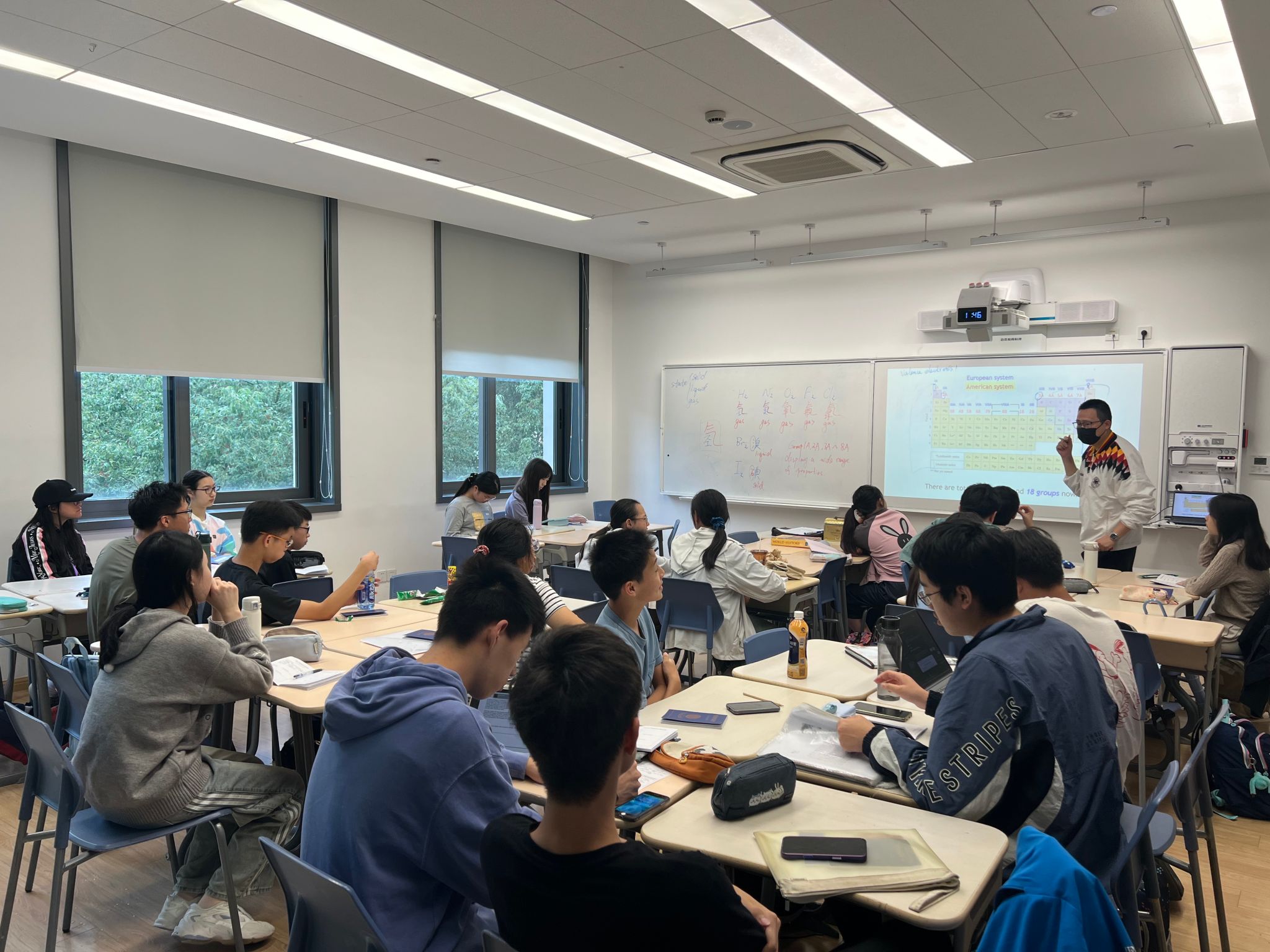
Students were most interested in "unnamed elements." For superheavy elements without official Chinese or English names, Mr. Ma explained designations like "Uub" and "Uuu," based on IUPAC's Systematic Element Name convention combining Latin numerical roots (nil, un, bi, tri, quad, pent, hex, sept, oct, enn). For example, Uub (Ununbium) is element 112 (now Copernicium, 鎶). This ensures rigorous global communication before official naming.
The lecture ended pleasantly. It helped students master core element-naming rules in Chinese and English and appreciate chemistry's logic and cultural depth, enabling a broader perspective in future studies.
(Written/Pictures by Tian Xuejiao Reviewed by Sun Hao, Zuo Qian)