-
ABOUT US
-
ACADEMICS
Curriculum Program
Departments
- English
- High School Chinese
- Primary and Junior School Chinese.
- High School Mathematics
- Middle School Mathematics
- Primary School Mathematics
- Music and Fine Arts
- Physical Education
- Physics
- Chemistry
- History and Geography
- Physical Science and Optional courses Department
- Middle School Biology
- High School Biology
- Social Sciences
- Computer Science
- Courses in Primary School
Achievements and Matriculations
College Counseling
Science & Technology Innovation Contest
Subject Competition
-
ARTS
-
ATHLETICS
-
AT SHSID
SHSID ∣ TIMES
PTSA
Club Exhibition
- 龙吟社
- Live 2 Drama
- Choir
- Hip-pop Dance Club
- The Primary School Dance Troupe
- Symposiums Club
- Biology Workshop
- You Shan
- VEX Robotic
- Peking Opera Club
- Baseball Club
- Model United Nations
- The World Scholar’s Cup
- Future Problem Solving Club
- OM Club
- AMC Club
- Music for Patients
- Smile Charity
- Stem Doge Alliance
- Chinese Debate Club
- IAA
- Mock Trial Club
- Zhengming Club
- Furry Friends
- GT-Racing
- Village Radio
- IMMC Club
- Creative Design and Intelligent Fabrication
- Future City Research Project
- ECOCAP
- AdvocaSEA
- SPDC
- Floorball Club
- Animusic MTC
- Wings Up
- Cyano
- Birding Community
Health and Wellness
Campus Safety
Cafeteria Service
-
ADMINISTRATION
-
ADMISSIONS
-
ALUMNI
Alumni Information
Honors Students
- Class of 2026
- Class of 2025
- Class of 2024
- Class of 2023
- Class of 2022
- Class of 2021
- Class of 2020
- Class of 2019
- Class of 2018
- Class of 2017
- Class of 2016
- Class of 2015
- Class of 2014
- Class of 2013
- Class of 2012
- Class of 2011
- Class of 2010
- Class of 2009
- Class of 2008
- Class of 2007
- Class of 2006
Who Studied at SHSID
SHS Foundation
-
DOCUMENTS
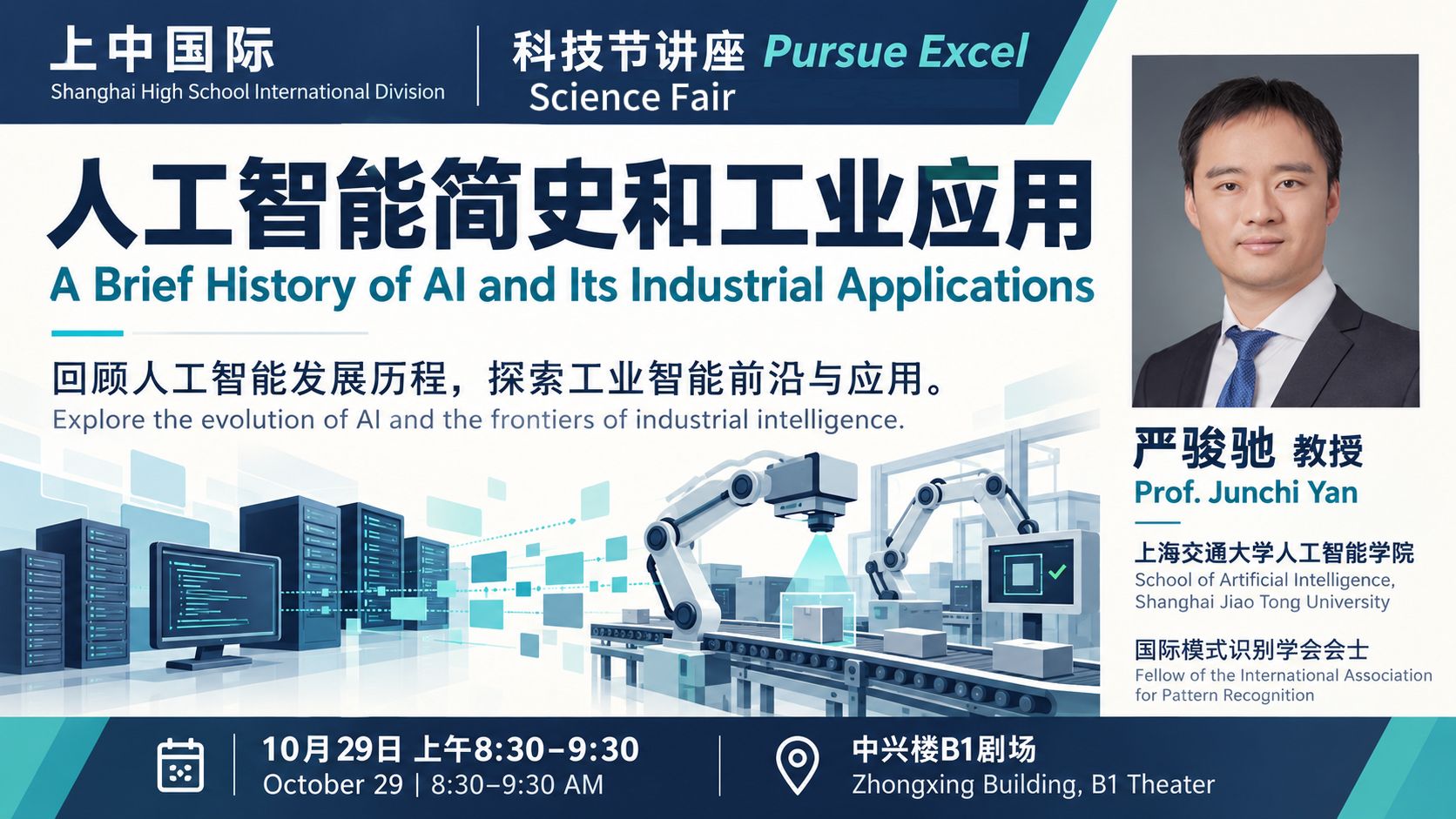
Science Fair Lecture: Seeing Embodied Intelligence Through a Traffic Sandbox
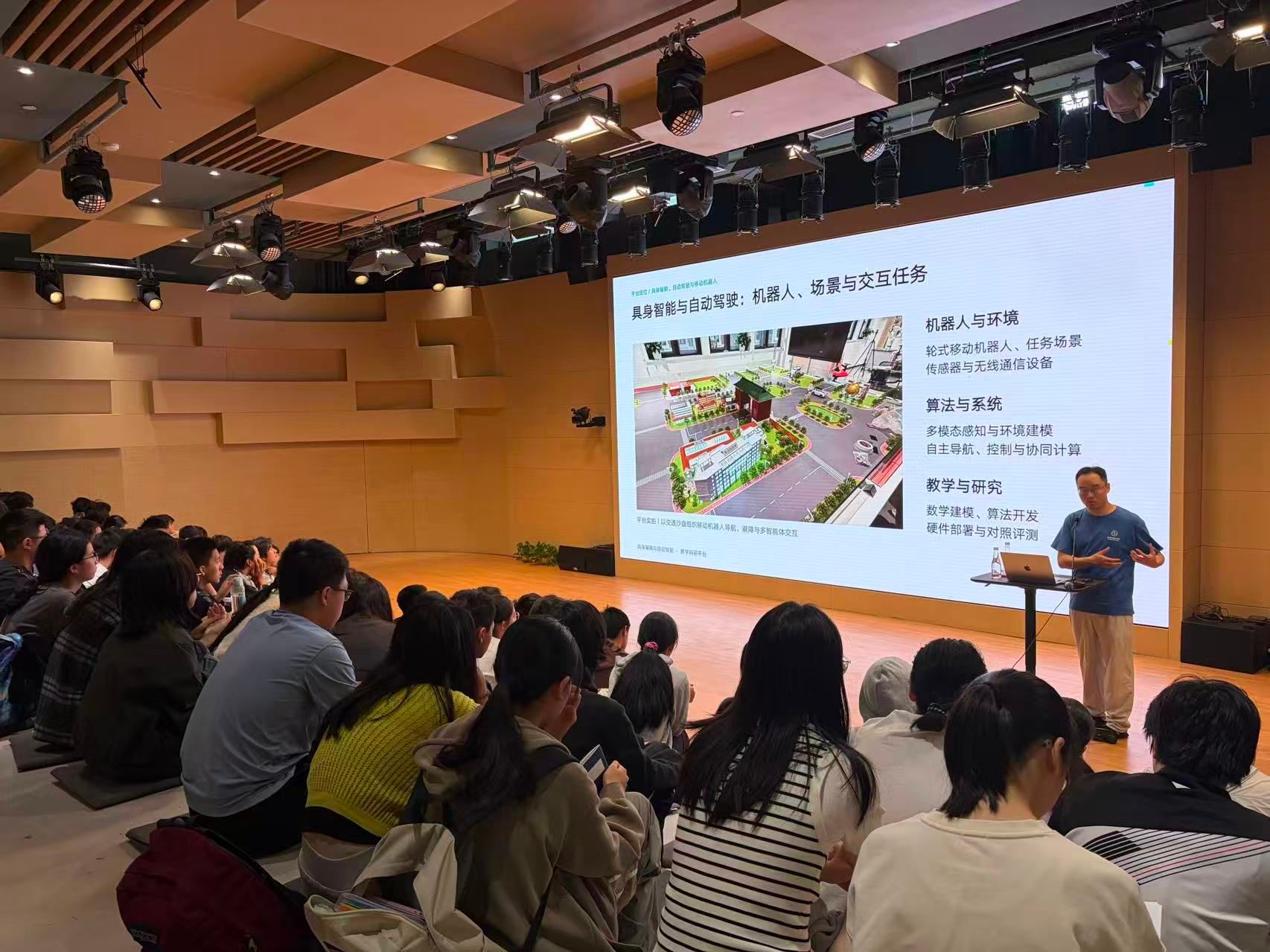
On the morning of October 29, the “Pursue · Excel” lecture series of the Science Fair at SHSID was held in the B1 Theater of the Zhongxing Building. Professor Junichi Yan of the School of Artificial Intelligence at Shanghai Jiao Tong University, a Fellow of the International Association for Pattern Recognition, addressed teachers and students under the title “A Brief History of AI and Its Industrial Applications,” tracing the development of artificial intelligence and presenting the teaching and research platform “Embodied Intelligence and Autonomous Driving Sandbox.” A miniature traffic environment, built to scale, was projected onto the main screen, with wheeled mobile robots navigating it autonomously. The theatre was filled to capacity.
The lecture began with the successive rises and falls of artificial intelligence. From the alternation of winters and booms to the emergence of deep learning, Professor Yan observed that the most profound change in the current wave is that models are moving from “algorithms on a screen” to “actors in the physical world”: embodied intelligence enables machines to perceive, decide and act in real environments, and autonomous driving is its most representative application.
On the screen, miniature roads, intersections, traffic lights and obstacles were clearly visible, and the robots had to complete navigation, obstacle avoidance and multi-agent interaction within a confined space. Taking the sandbox as his example, Professor Yan unpacked the “perception–decision–action” loop of embodied intelligence: cameras and LiDAR supply images, point clouds and poses for object detection and state estimation; the system then predicts the motion of other vehicles and generates a reference path and a target speed; the controller issues steering and driving commands, and the resulting motion produces new observations that feed the next round of decision-making. He stressed that a system cannot be judged by a single output: positioning accuracy, collision rate and task completion, end-to-end latency and trajectory tracking error are the true measures of an algorithm. When the robot passed an intersection smoothly, or a real vehicle completed a dynamic avoidance maneuver on an actual road, soft exclamations rose from the audience.
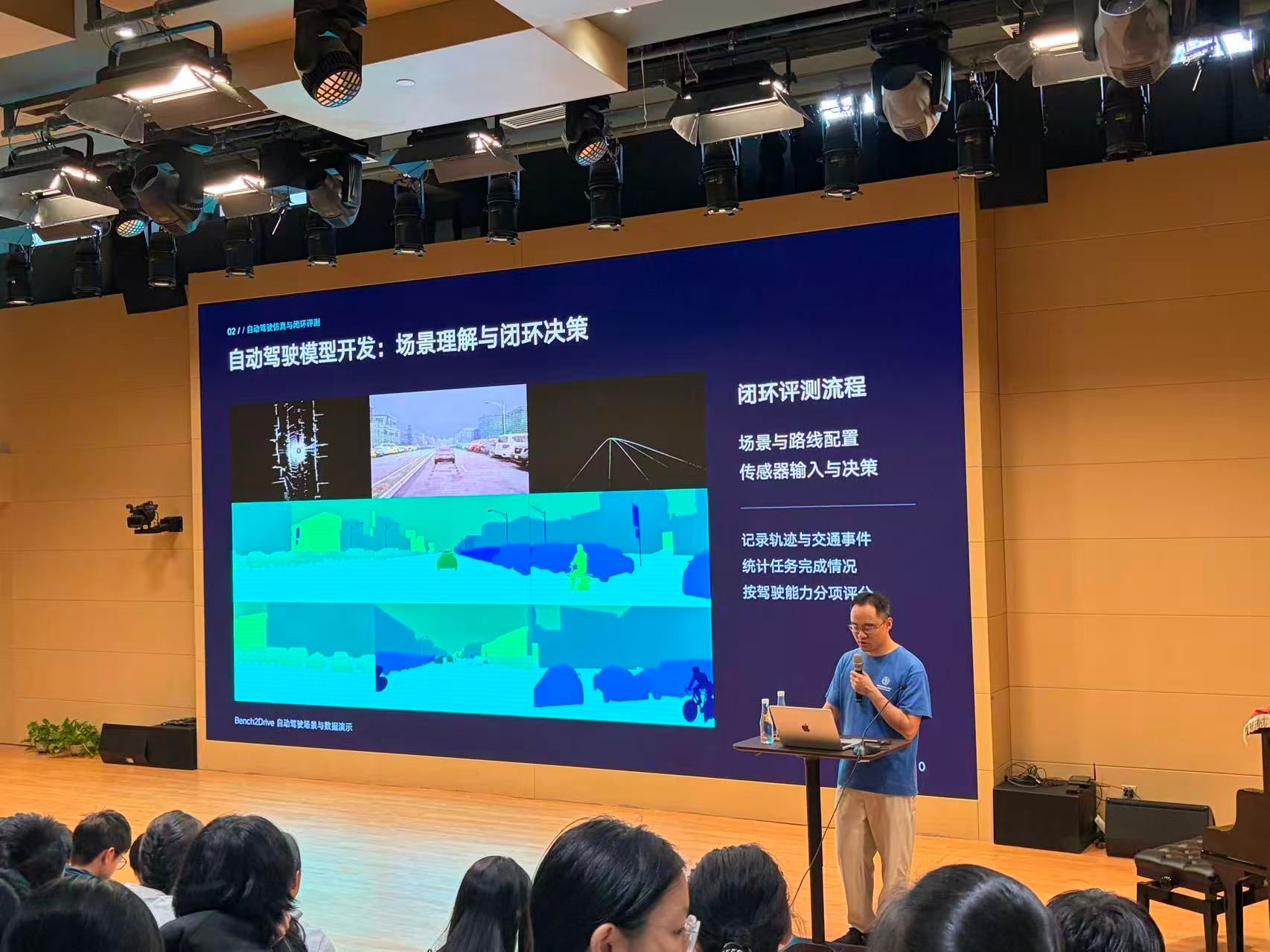
Supporting this loop are the team’s asynchronous multimodal world model and an end–edge–cloud collaborative architecture: the former divides labor according to how quickly information changes, pairing low-frequency keyframes with high-frequency point clouds and incremental reconstruction from a three-dimensional cache, so that continuous imagery can still be generated under limited bandwidth; the latter aggregates perception at the edge and offloads computing tasks as needed, enabling robots with constrained computing power to reason in real time. Whether an algorithm can be trusted is left to reproducible evaluation—closed-loop testing based on the Bench2Drive benchmark covers 44 interactive scenarios, 23 weather conditions and 12 town maps, and from simulation to sandbox and from sandbox to real vehicles, calibration is completed at each stage.
A single lecture cannot exhaust the possibilities of artificial intelligence, yet it made the distance between the frontier and the classroom tangible. SHSID has consistently held that students’ intellectual interests are best cultivated in authentic academic and engineering contexts. Through the Science Fair and other platforms, the school will continue to bring leading scholars and real-world scenarios onto campus, encouraging students to move from asking questions to taking action and from verification to creation—broadening their horizons and strengthening their aspirations in dialogue with the technologies of their time, and growing into outstanding talents equipped with both an innovative spirit and a global perspective.
(Written and Pictures by High School STEAMS Advisors Office Reviewed by Hui Liao, Qian Zuo)