-
ABOUT US
-
ACADEMICS
Curriculum Program
Departments
- English
- High School Chinese
- Primary and Junior School Chinese.
- High School Mathematics
- Middle School Mathematics
- Primary School Mathematics
- Music and Fine Arts
- Physical Education
- Physics
- Chemistry
- History and Geography
- Physical Science and Optional courses Department
- Middle School Biology
- High School Biology
- Social Sciences
- Computer Science
- Courses in Primary School
Achievements and Matriculations
College Counseling
Science & Technology Innovation Contest
Subject Competition
-
ARTS
-
ATHLETICS
-
AT SHSID
SHSID ∣ TIMES
PTSA
Club Exhibition
- 龙吟社
- Live 2 Drama
- Choir
- Hip-pop Dance Club
- The Primary School Dance Troupe
- Symposiums Club
- Biology Workshop
- You Shan
- VEX Robotic
- Peking Opera Club
- Baseball Club
- Model United Nations
- The World Scholar’s Cup
- Future Problem Solving Club
- OM Club
- AMC Club
- Music for Patients
- Smile Charity
- Stem Doge Alliance
- Chinese Debate Club
- IAA
- Mock Trial Club
- Zhengming Club
- Furry Friends
- GT-Racing
- Village Radio
- IMMC Club
- Creative Design and Intelligent Fabrication
- Future City Research Project
- ECOCAP
- AdvocaSEA
- SPDC
- Floorball Club
- Animusic MTC
- Wings Up
- Cyano
- Birding Community
Health and Wellness
Campus Safety
Cafeteria Service
-
ADMINISTRATION
-
ADMISSIONS
-
ALUMNI
Alumni Information
Honors Students
- Class of 2026
- Class of 2025
- Class of 2024
- Class of 2023
- Class of 2022
- Class of 2021
- Class of 2020
- Class of 2019
- Class of 2018
- Class of 2017
- Class of 2016
- Class of 2015
- Class of 2014
- Class of 2013
- Class of 2012
- Class of 2011
- Class of 2010
- Class of 2009
- Class of 2008
- Class of 2007
- Class of 2006
Who Studied at SHSID
SHS Foundation
-
DOCUMENTS
Middle School Science Department: Exploring the Mysteries of Dough, Putting Scientific Inquiry into Practice
When the science classroom meets the warmth of everyday baking, knowledge takes on a sweet and delightful flavor. Recently, after completing their unit on scientific inquiry methods, the sixth-grade students launched a practical project exploring yeast dough fermentation. By integrating their learned methods into bread making, students experienced the joy of interdisciplinary learning through active thinking and hands-on practice, deepening their understanding and application of scientific inquiry through a real-world task.
The project centered around a core question: "Which factors accelerate or slow down dough fermentation?" Stepping into the shoes of scientists, the students embarked on their research following a complete scientific inquiry process. First, they gathered reference materials to learn about yeast, explore the history of bread, and map out various factors affecting fermentation. Next, they independently formulated hypotheses, identified independent and dependent variables, set up control groups and multiple experimental gradient groups, and drafted comprehensive experimental plans. After revising and refining their plans under teacher guidance, students conducted the experiments at home—measuring ingredients, kneading dough, controlling experimental variables, and meticulously recording changes during fermentation. With the assistance of their parents, they baked the experimental dough into bread or steamed it into buns, reaping tangible and delicious results.
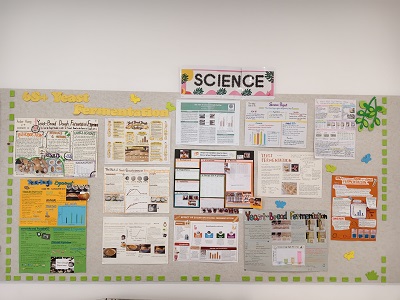
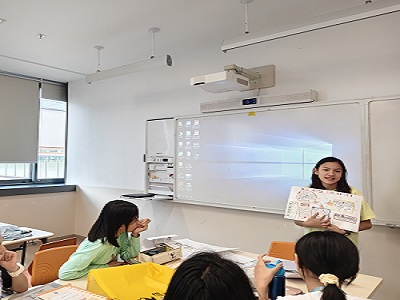
The students also created elaborate science posters that systematically detailed project introductions, materials and procedures, experimental phenomena, data charts, and conclusions, while carefully reflecting on their successes and areas for future improvement. During class presentations, students took turns sharing their findings on stage, sparked lively discussions, and fielded enthusiastic questions from their peers. Ultimately, several outstanding posters stood out and were placed on public display on November 5.
A tiny piece of dough holds profound scientific principles. By translating textbook scientific inquiry methods into real life, students not only gained a solid understanding of the scientific principles behind yeast respiration and dough fermentation, but also mastered core inquiry skills—formulating hypotheses, designing controlled experiments, and analyzing results. Furthermore, they experienced the manual labor of kneading and baking, tasting the joy of creating delicious food through their own efforts.
Bringing knowledge from pages into real life allows critical thinking to accompany hands-on practice. Through exploration and labor, what the students gained was far more than fragrant baked goods—they built a strong scientific literacy rooted in keen observation and a passion for discovery.
(Written by Rongzhang Hu, Stefan Hampson
Pictures by Rongzhang Hu
Reviwed by Jenny Du, Chenli Shen, Shiyu Wu )