-
ABOUT US
-
ACADEMICS
Curriculum Program
Departments
- English
- High School Chinese
- Primary and Junior School Chinese.
- High School Mathematics
- Middle School Mathematics
- Primary School Mathematics
- Music and Fine Arts
- Physical Education
- Physics
- Chemistry
- History and Geography
- Physical Science and Optional courses Department
- Middle School Biology
- High School Biology
- Social Sciences
- Computer Science
- Courses in Primary School
Achievements and Matriculations
College Counseling
Science & Technology Innovation Contest
Subject Competition
-
ARTS
-
ATHLETICS
-
AT SHSID
SHSID ∣ TIMES
PTSA
Club Exhibition
- 龙吟社
- Live 2 Drama
- Choir
- Hip-pop Dance Club
- The Primary School Dance Troupe
- Symposiums Club
- Biology Workshop
- You Shan
- VEX Robotic
- Peking Opera Club
- Baseball Club
- Model United Nations
- The World Scholar’s Cup
- Future Problem Solving Club
- OM Club
- AMC Club
- Music for Patients
- Smile Charity
- Stem Doge Alliance
- Chinese Debate Club
- IAA
- Mock Trial Club
- Zhengming Club
- Furry Friends
- GT-Racing
- Village Radio
- IMMC Club
- Creative Design and Intelligent Fabrication
- Future City Research Project
- ECOCAP
- AdvocaSEA
- SPDC
- Floorball Club
- Animusic MTC
- Wings Up
- Cyano
- Birding Community
Health and Wellness
Campus Safety
Cafeteria Service
-
ADMINISTRATION
-
ADMISSIONS
-
ALUMNI
Alumni Information
Honors Students
- Class of 2026
- Class of 2025
- Class of 2024
- Class of 2023
- Class of 2022
- Class of 2021
- Class of 2020
- Class of 2019
- Class of 2018
- Class of 2017
- Class of 2016
- Class of 2015
- Class of 2014
- Class of 2013
- Class of 2012
- Class of 2011
- Class of 2010
- Class of 2009
- Class of 2008
- Class of 2007
- Class of 2006
Who Studied at SHSID
SHS Foundation
-
DOCUMENTS
When Shang Gao Met Pythagoras The 5th Original Math Drama "An Account Across Time and Space"
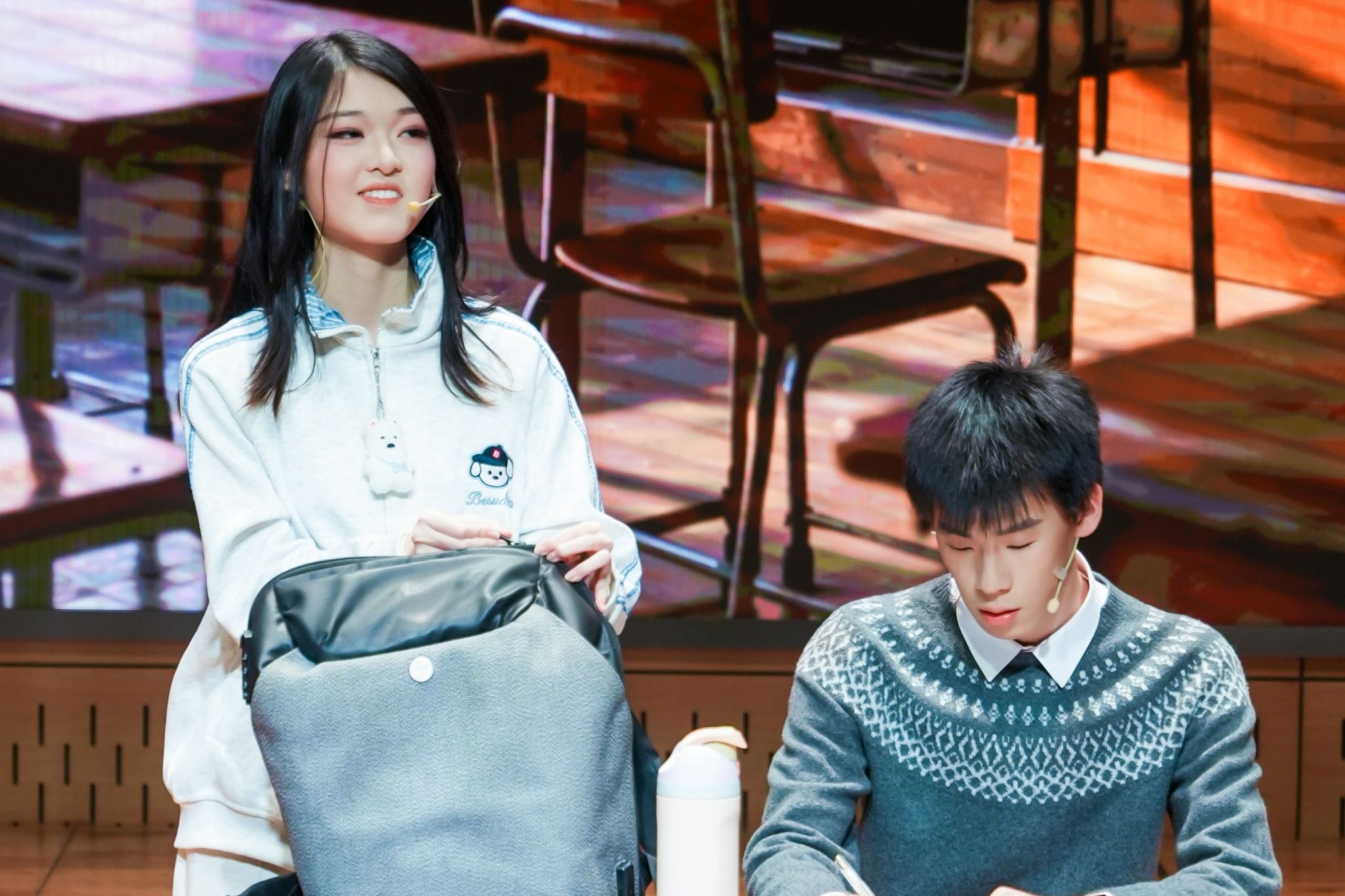
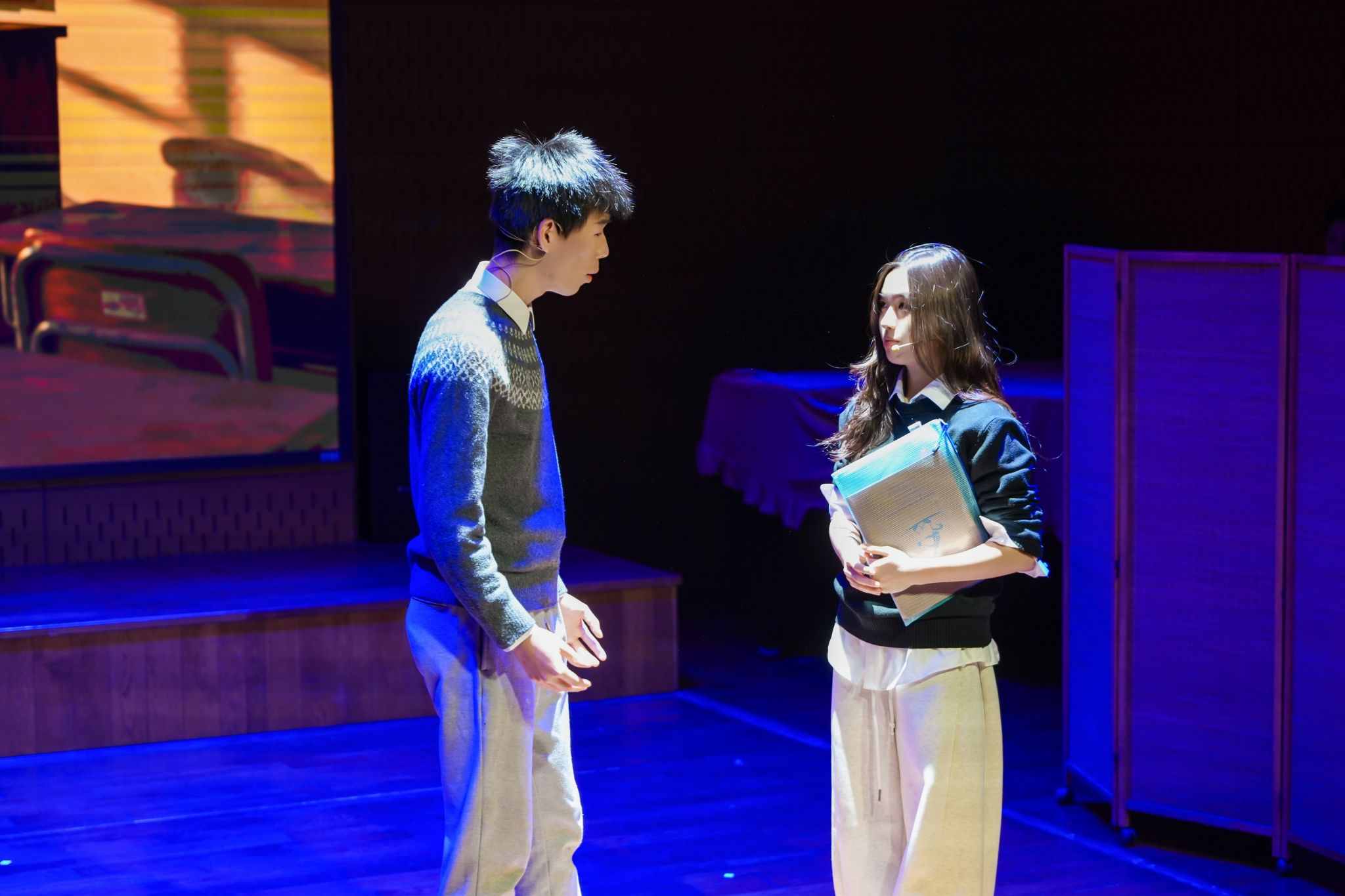
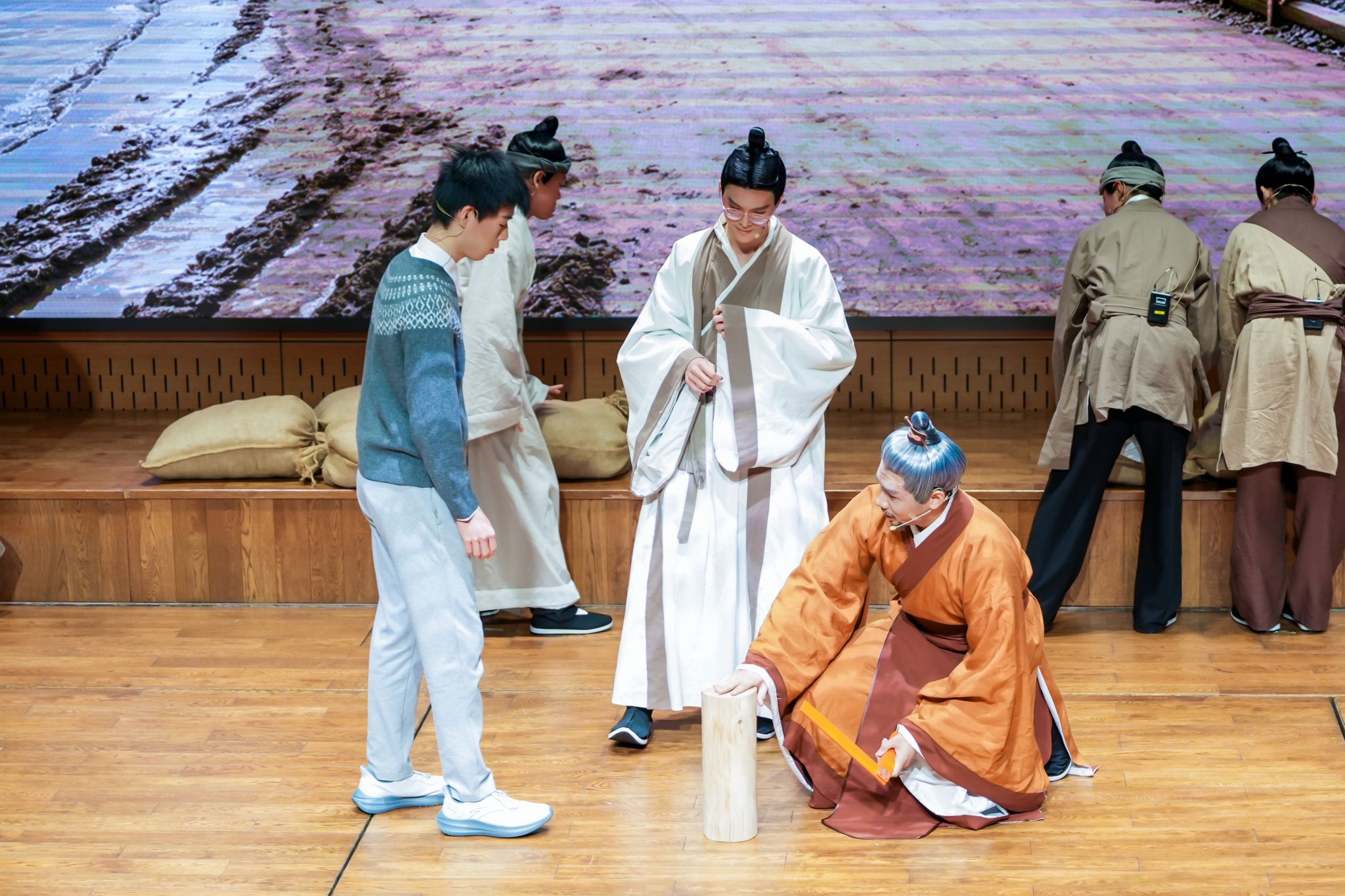
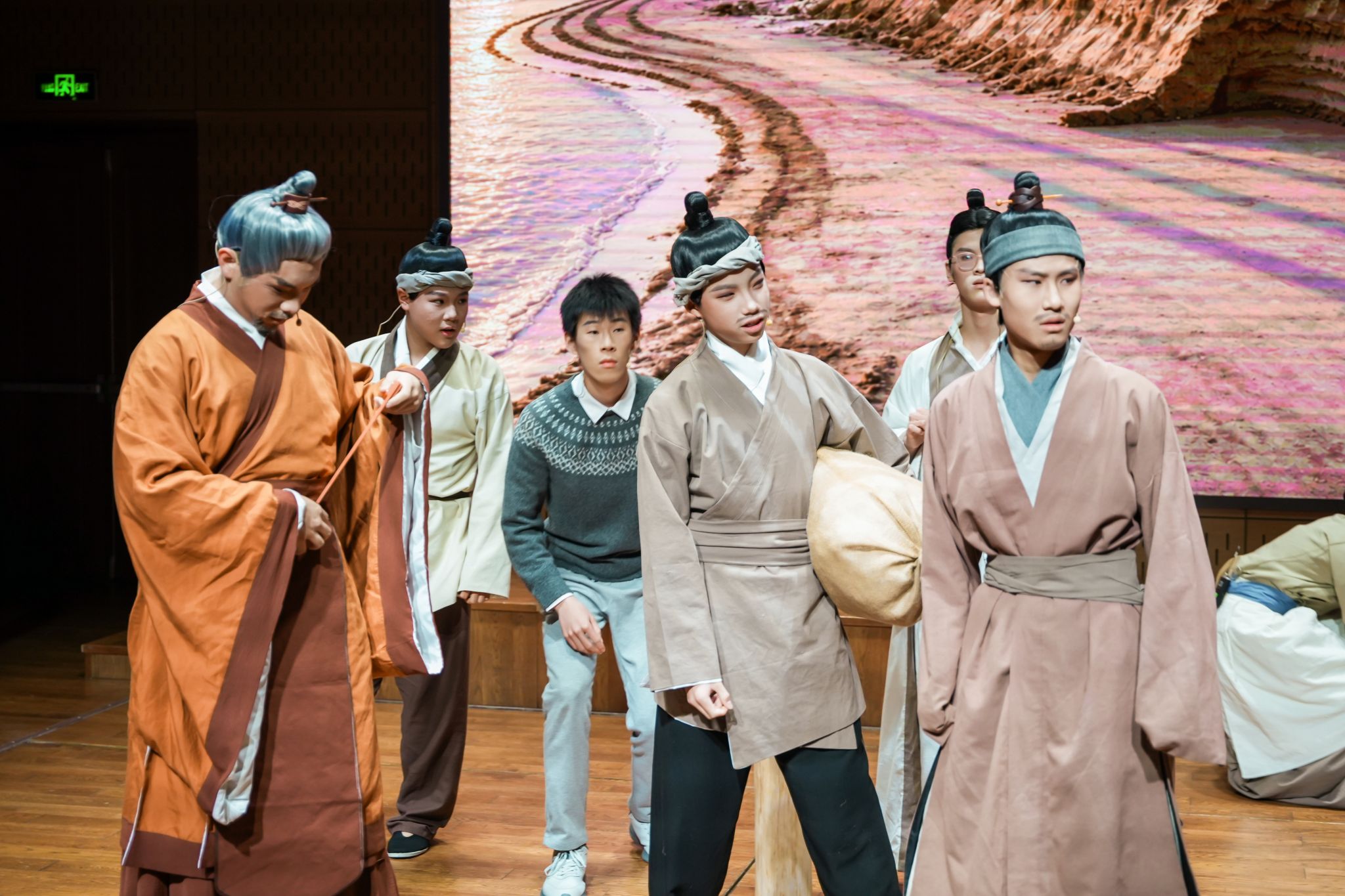
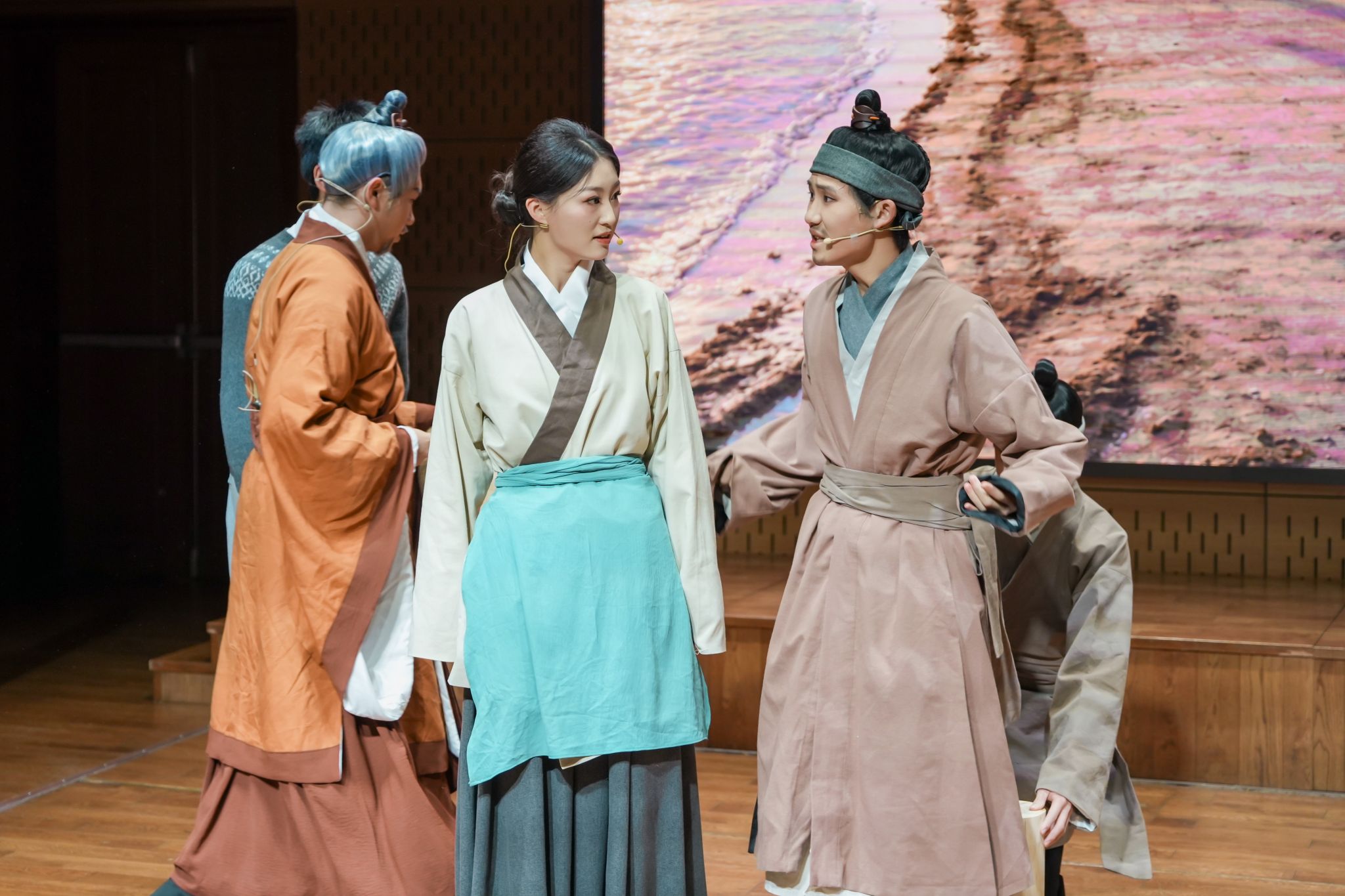
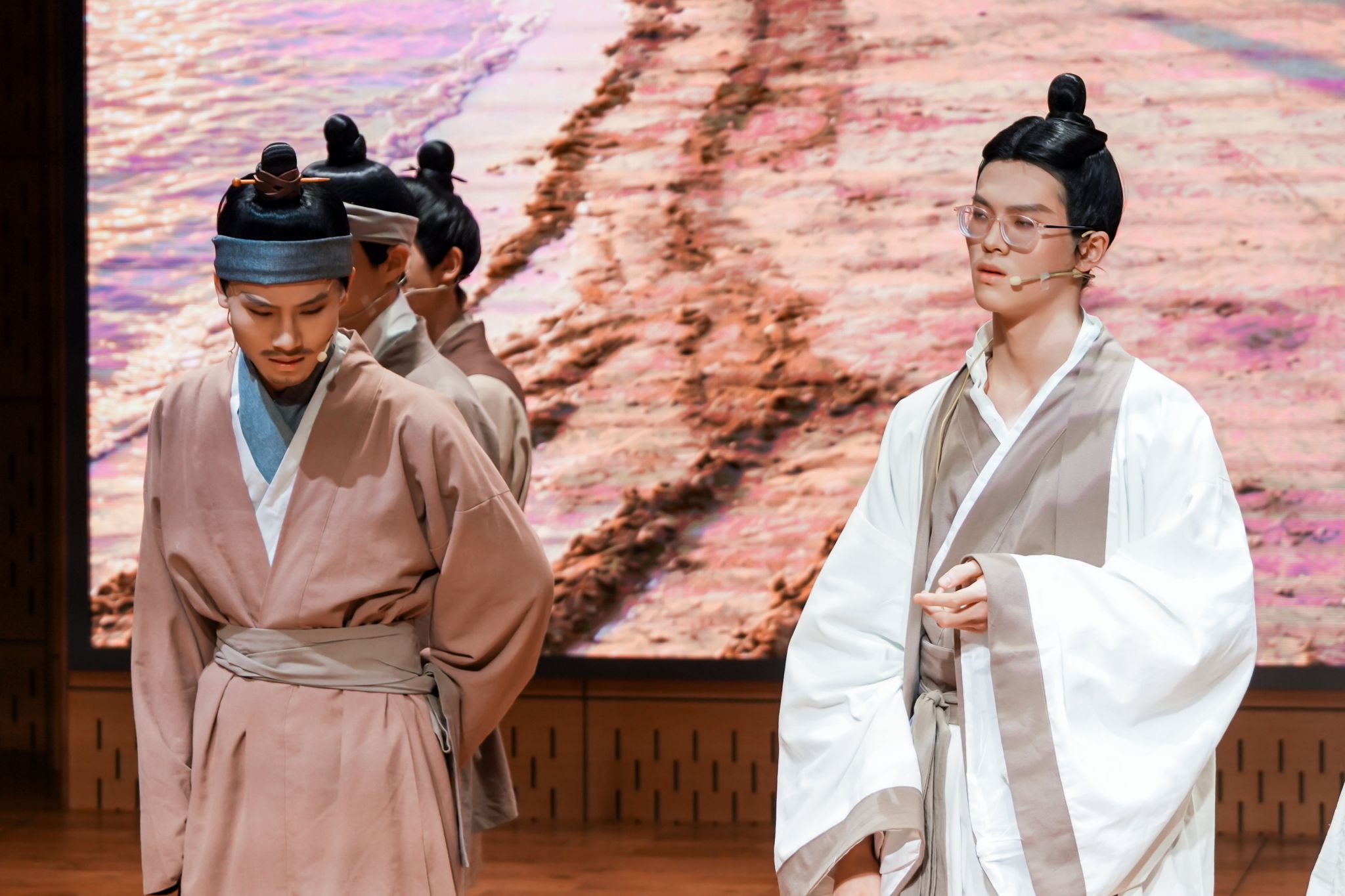
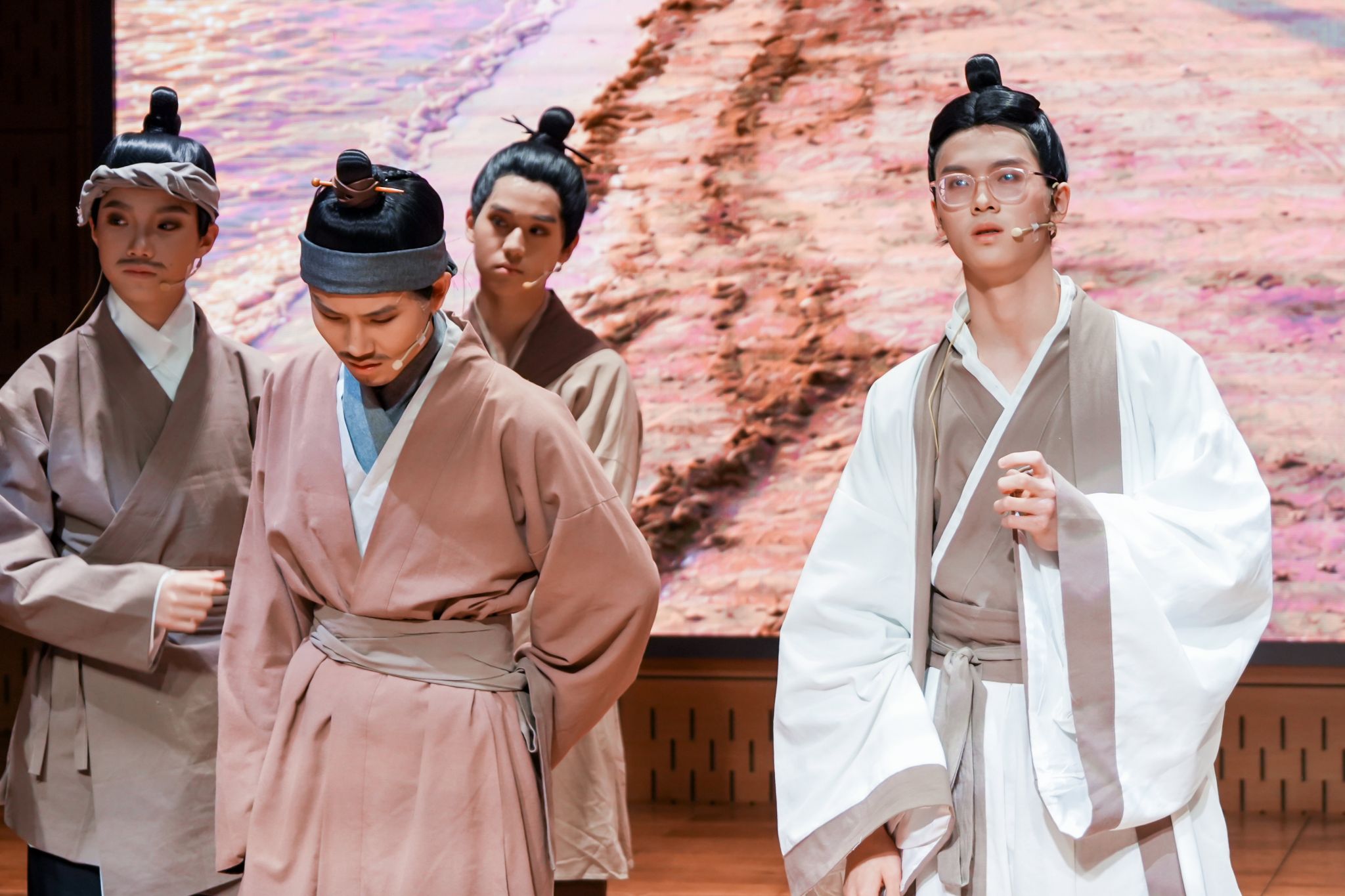
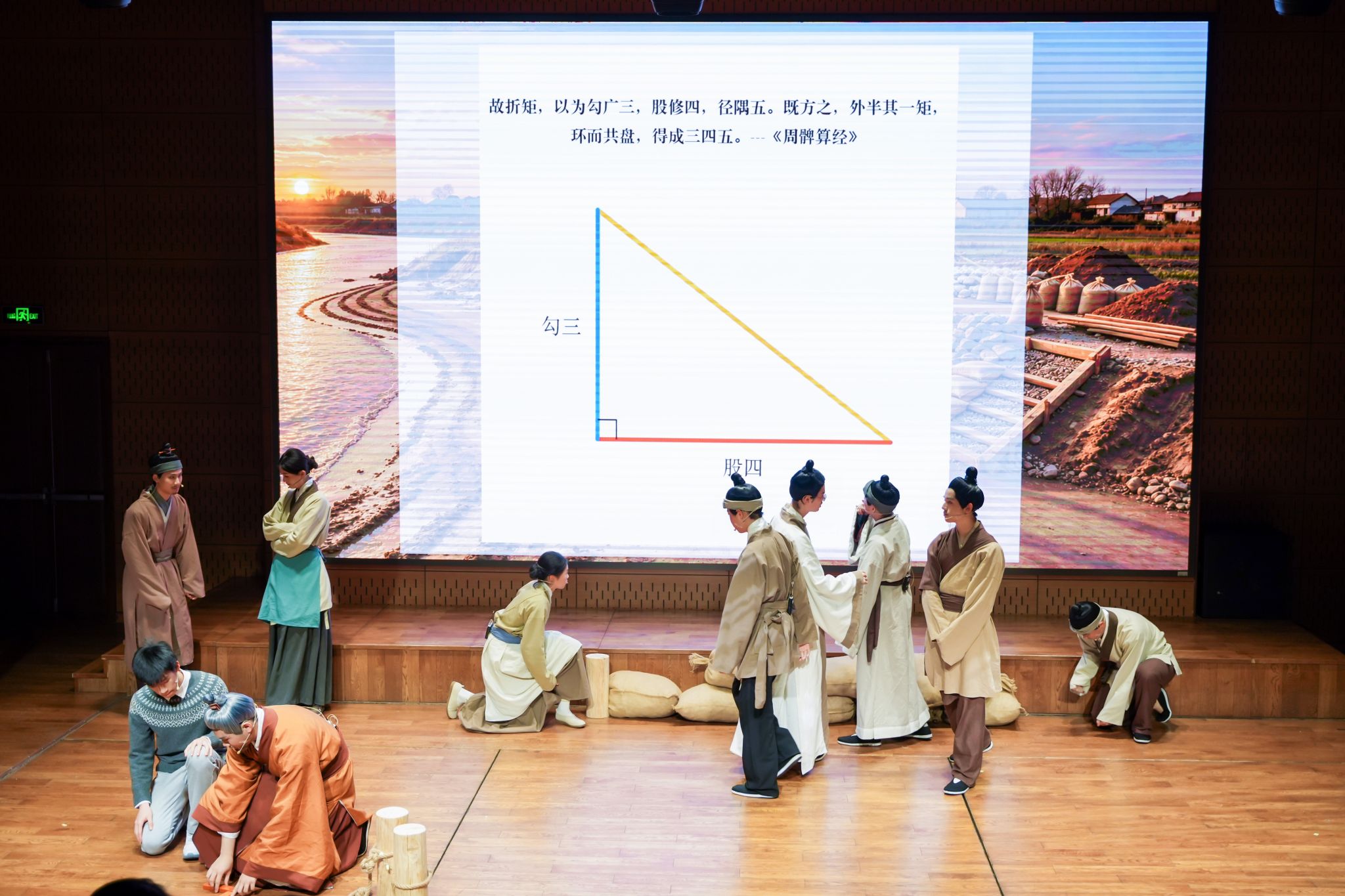
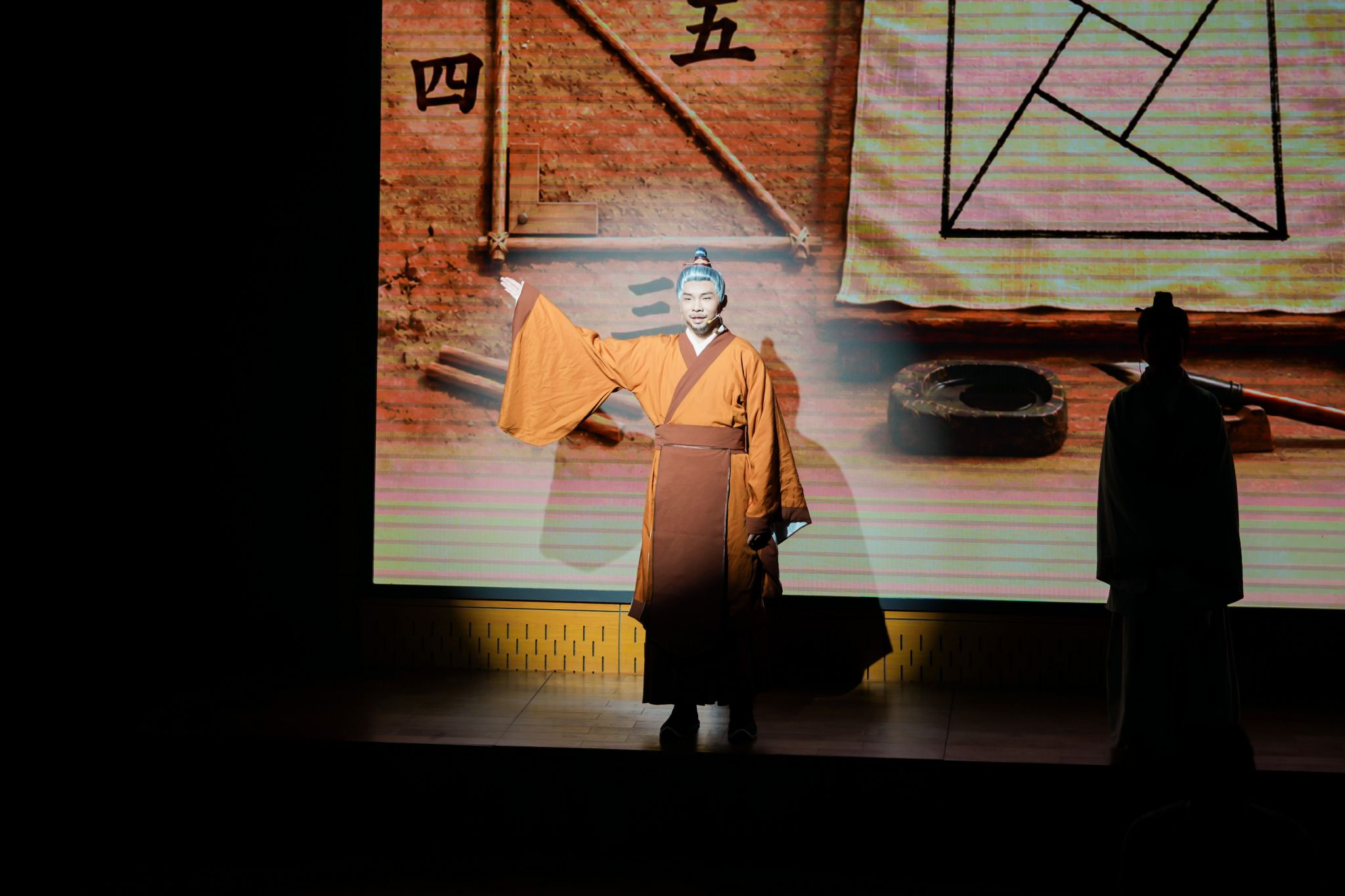
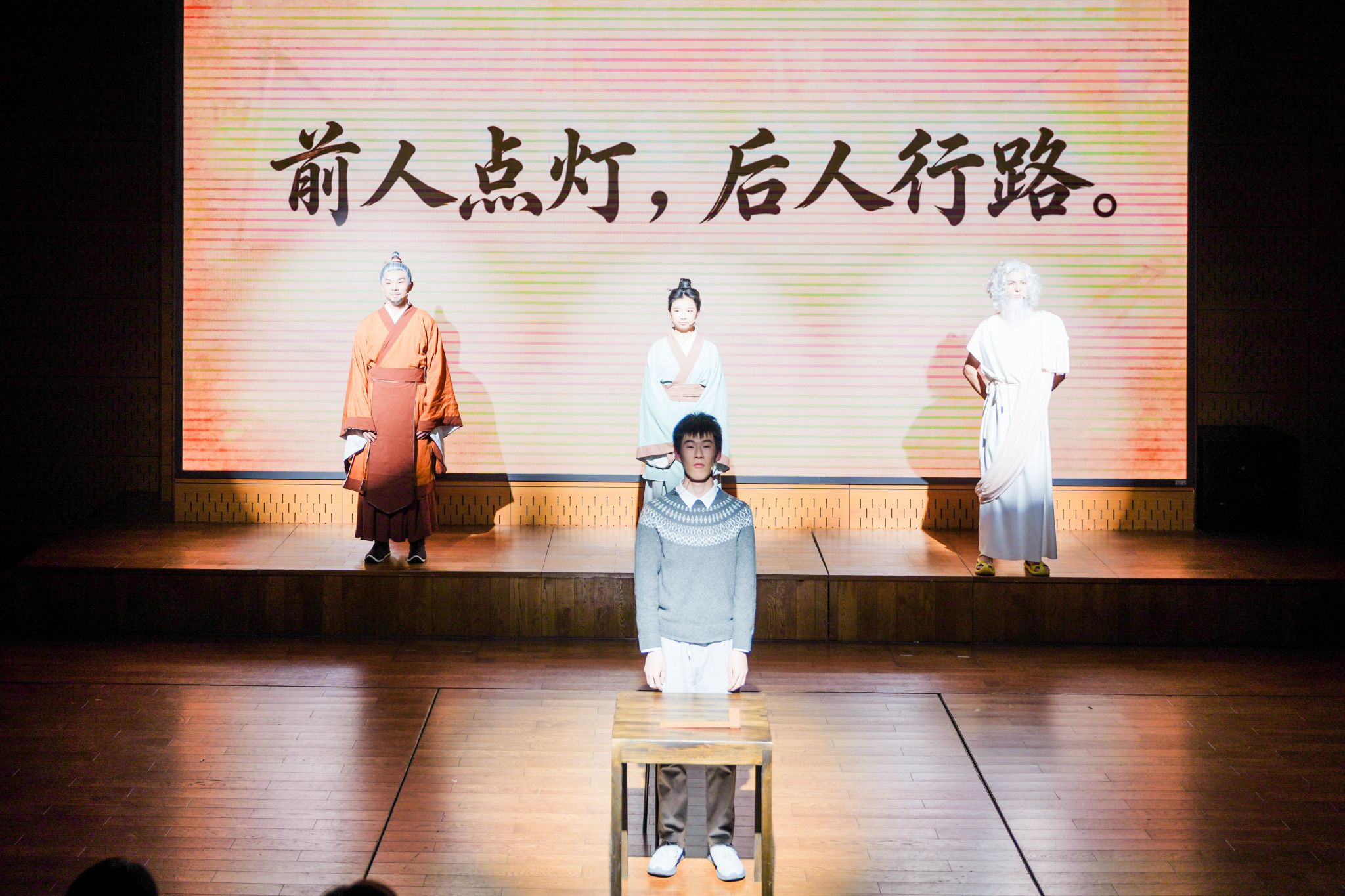
On the afternoon of November 24, 2026, the 5th original math drama, "Verifying Truth Across Time and Space: The Eastern and Western Proofs of the Pythagorean Theorem," was performed in the blackbox: 32 students wrote, directed, and acted in the play themselves, starting from Shang Gao in the Zhoubi Suanjing and Zhao Shuang's hypotenuse diagram, all the way to Pythagoras in ancient Greece, turning an ancient theorem into a dialogue spanning civilizations.
SHSID has consistently valued the inheritance and dissemination of Chinese culture, encouraging all disciplines to integrate Chinese culture into curricula and activities. The math department has always regarded the history of Chinese mathematics as an important source of topics for math dramas, bringing one Chinese mathematical and cultural work after another onto the stage for five years now, so that "telling the Chinese story well" has been truly grounded in practice.
Starting from the Zhoubi Suanjing
This year's math drama opens with the puzzlement of a contemporary middle school student, Cheng Yuan: the Pythagorean theorem has long been repeatedly proved by the sages—why should we prove it again? With this question, he steps into the world of Western Zhou’s embankments, the studies of the Three Kingdoms, and the halls of ancient Greece. Shang Gao employs the 3‑4‑5 right triangle (gou 3, gu 4, xian 5) for land surveying and embankment construction; Zhao Shuang, using the hypotenuse diagram and the principle of “out‑in mutual compensation” (dissection and rearrangement), explores why this underlying mathematical relationship must hold. Pythagoras uses figure rearrangement and deductive reasoning to generalize the conclusion. In the play, Chinese and Western mathematicians advance along their own paths: on one side is the wisdom that grew out of the practical affairs of surveying and construction; on the other is the universal truth established through logical deduction. The two paths illuminate each other—different in direction, yet both exploring the same truth, which also conveys the deeper meaning of East-West integration. At the end of the performance, Cheng Yuan returns to the real classroom and understands: a proof is not merely an answer written for others, but also a confirmation by the seeker of knowledge for himself.
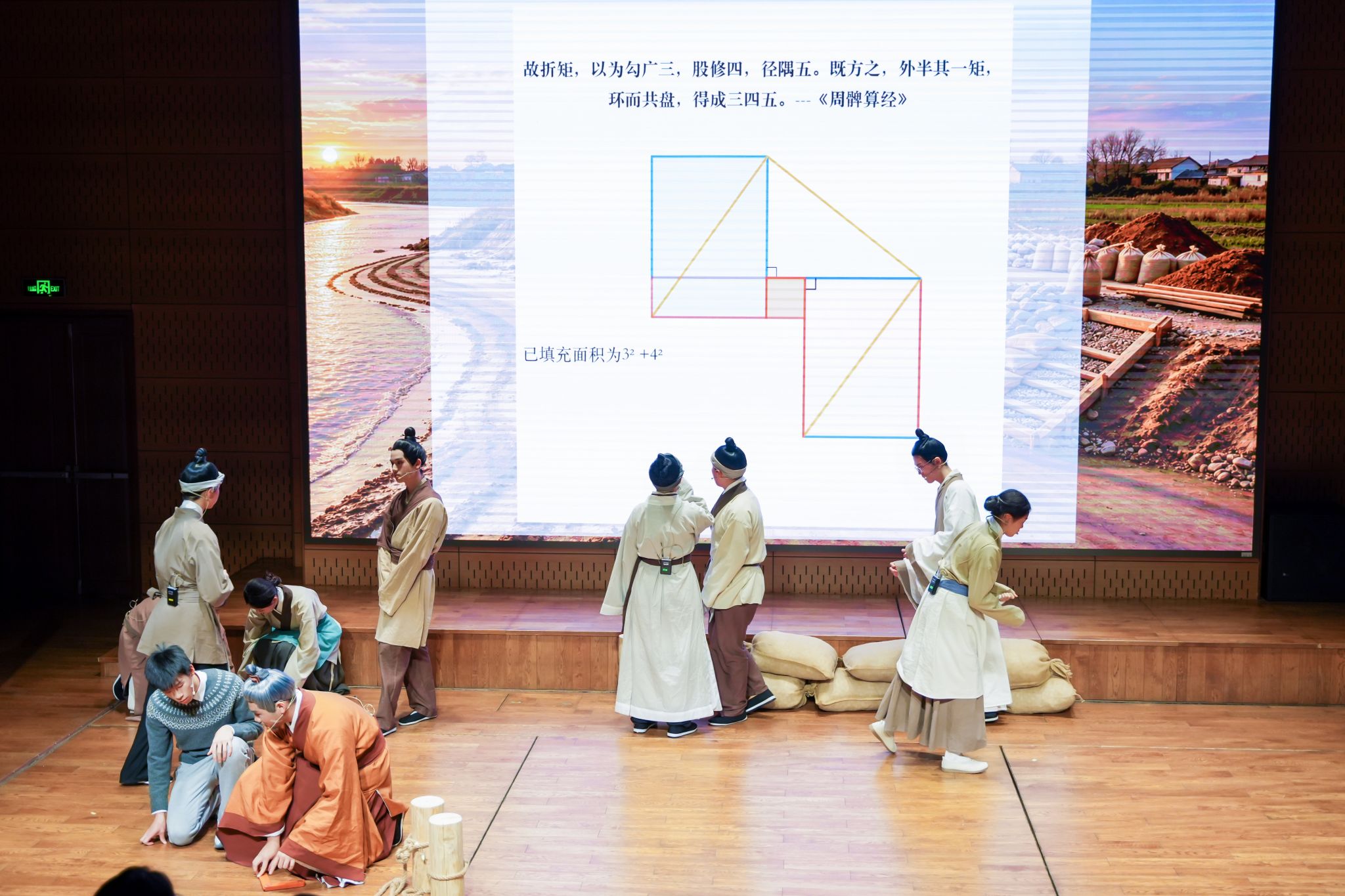
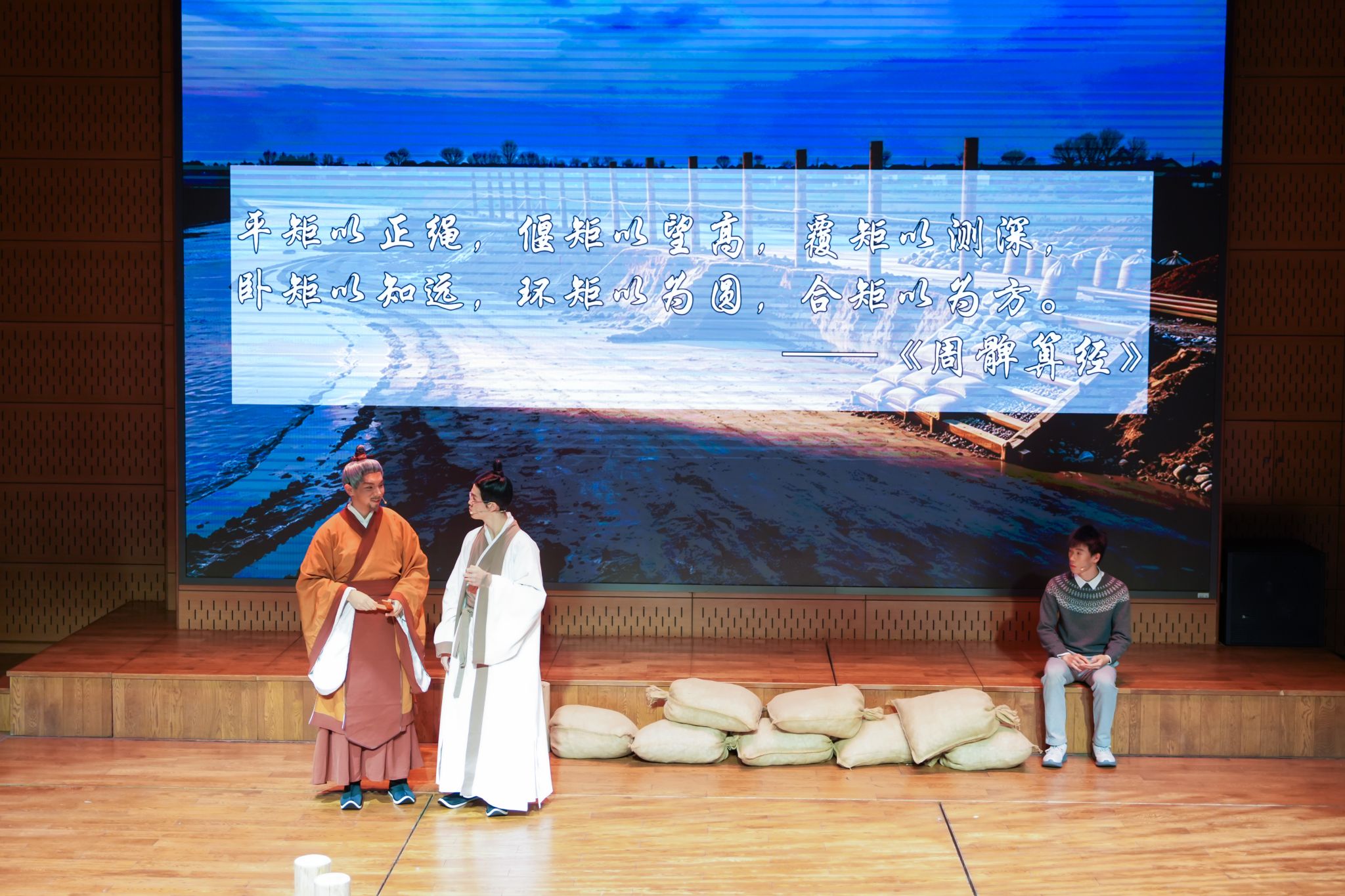
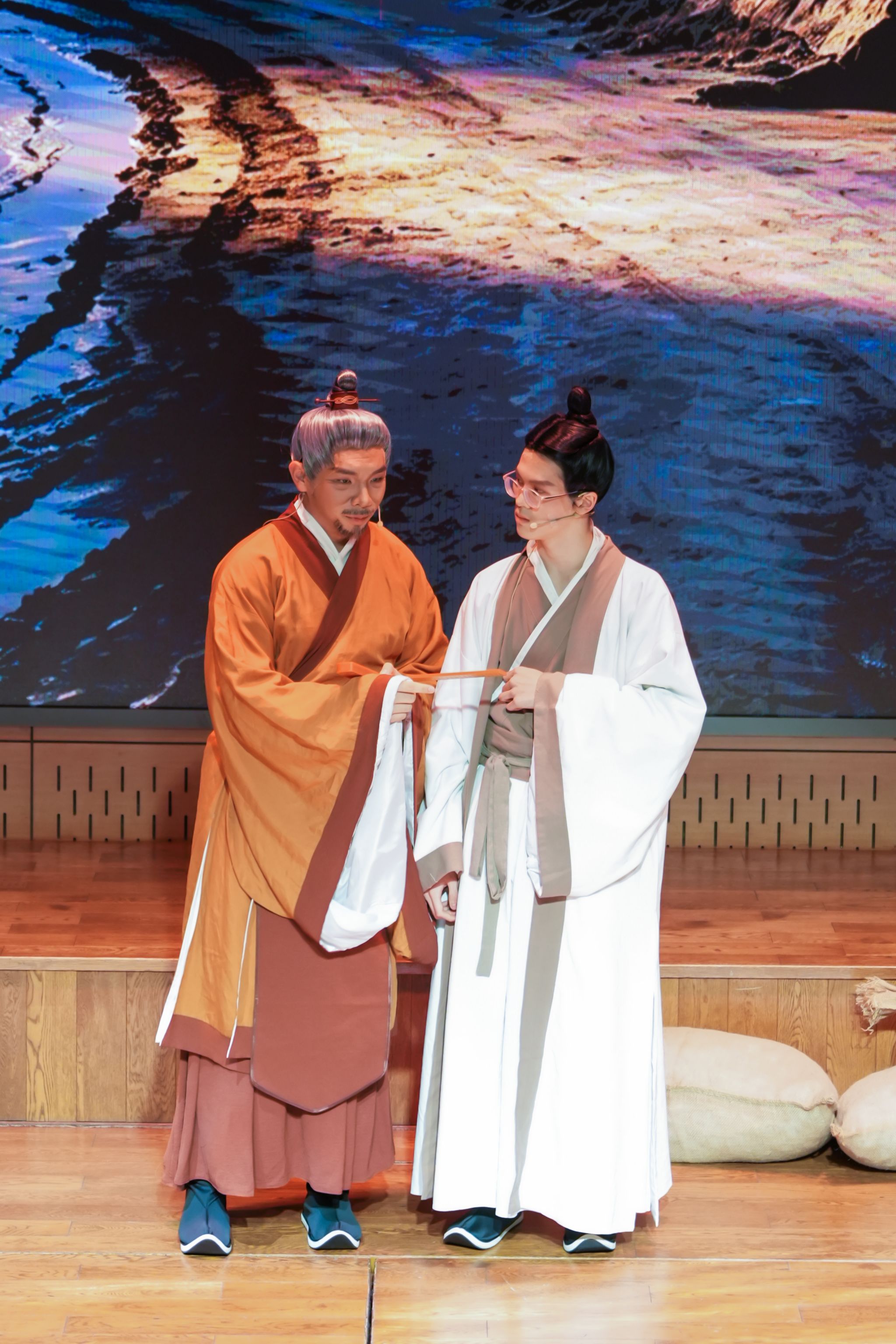
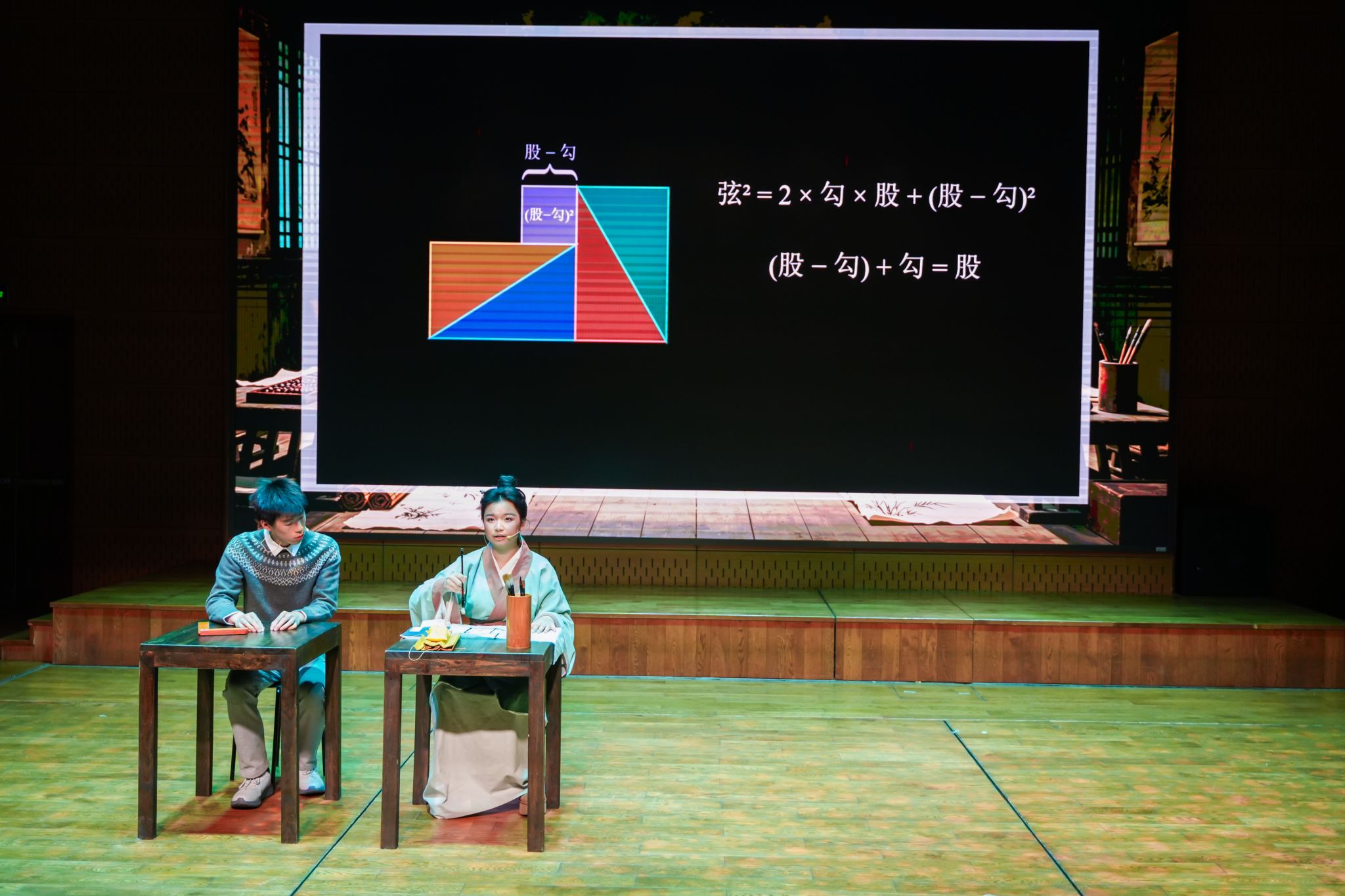
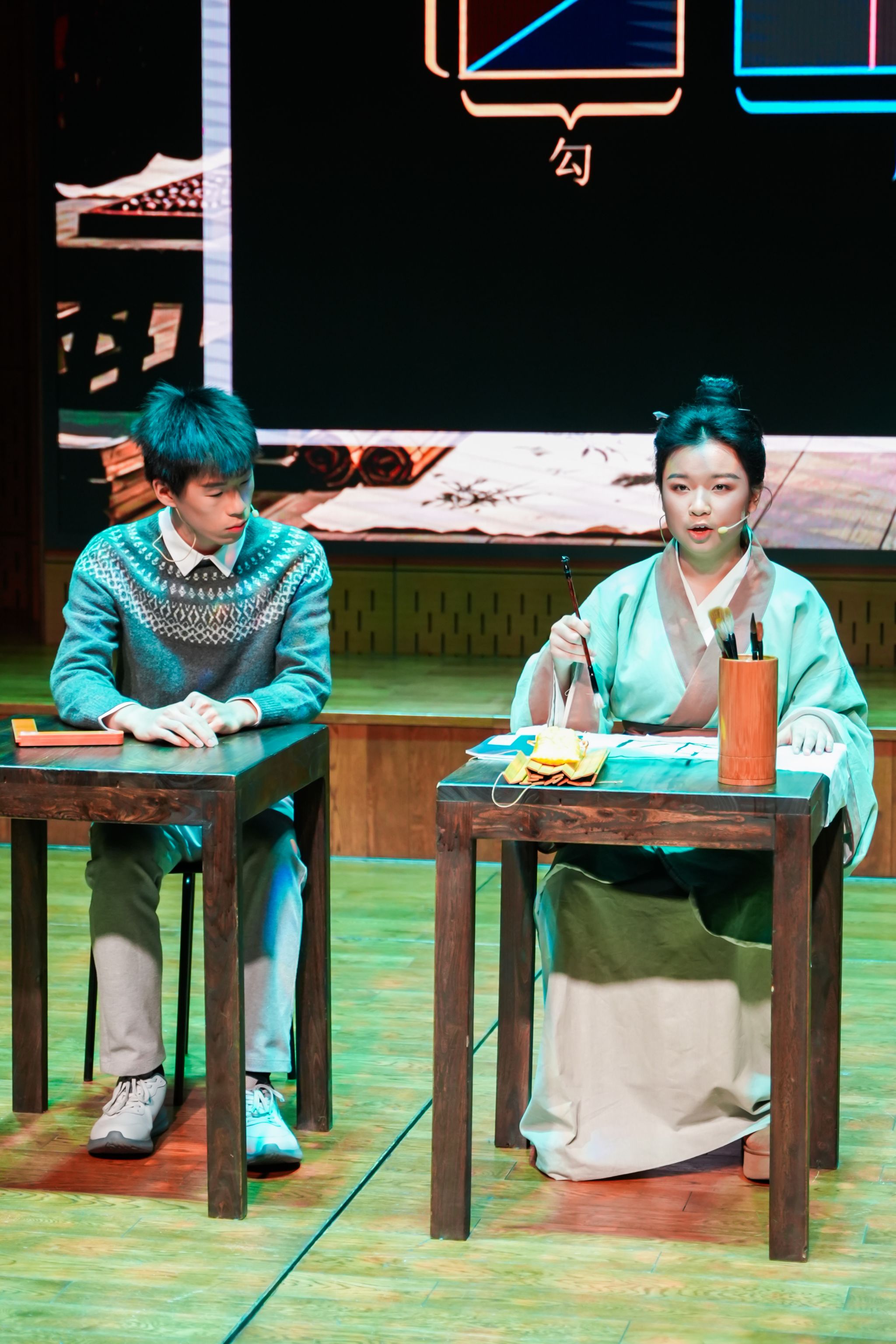
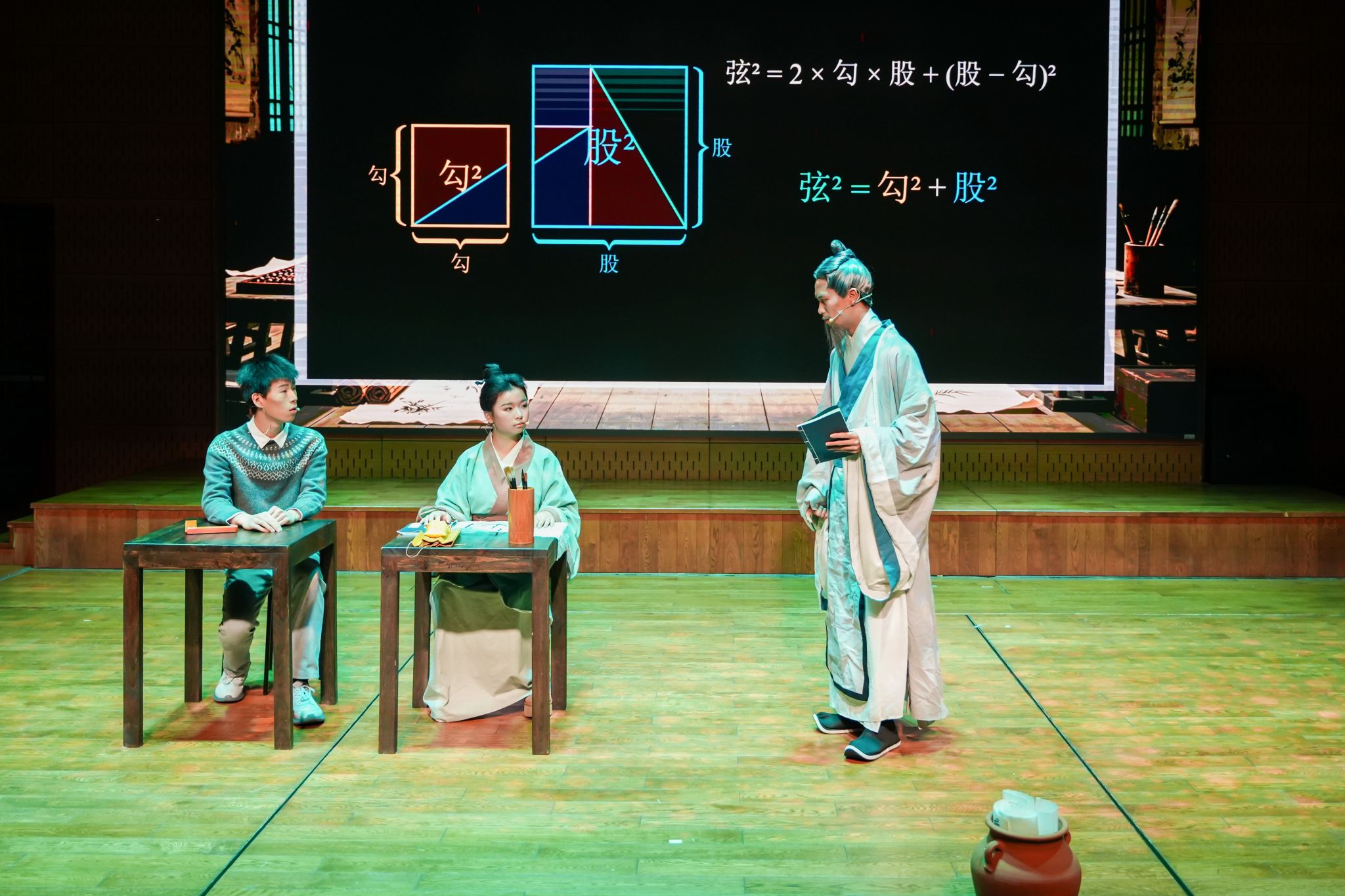
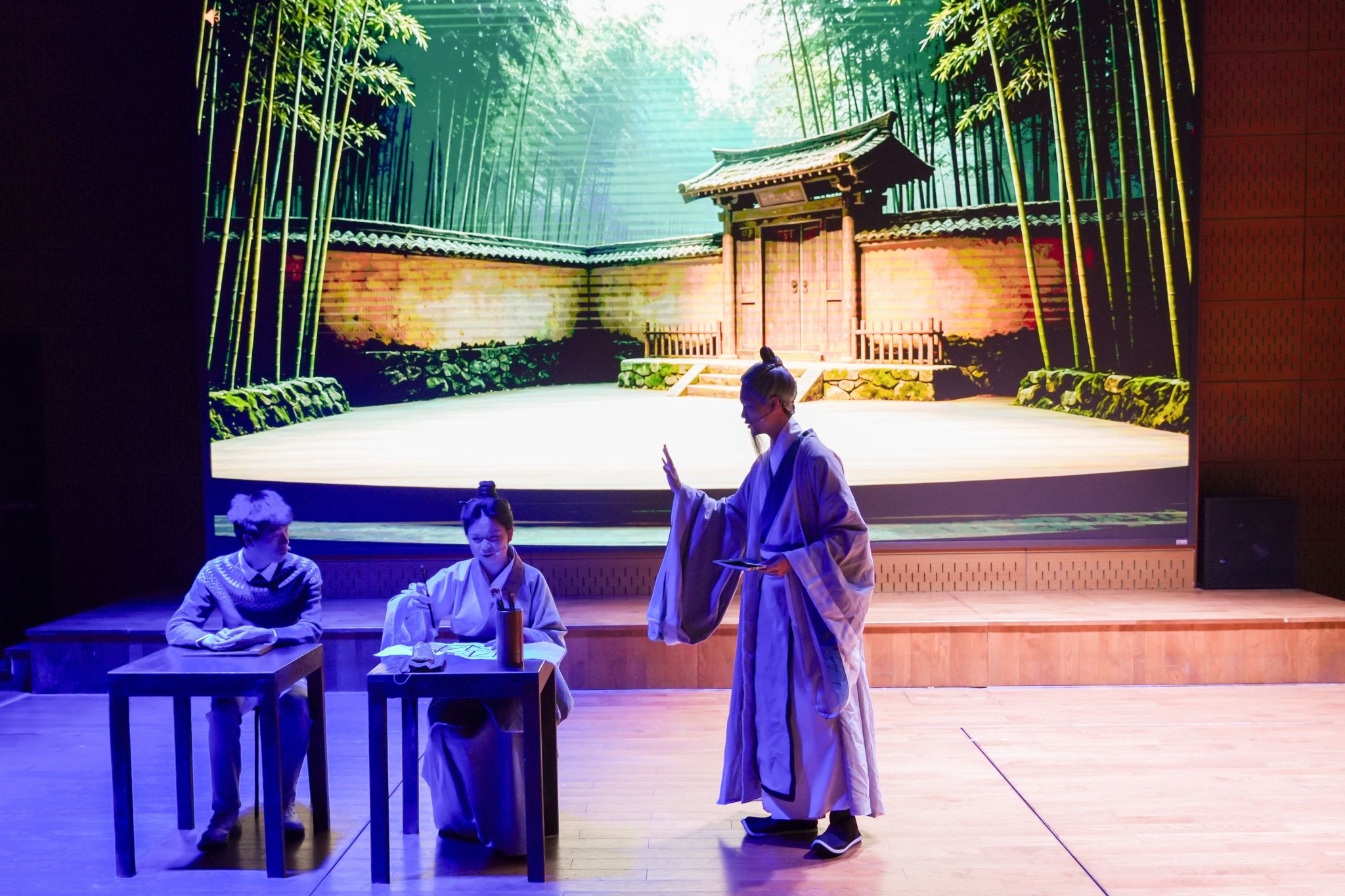
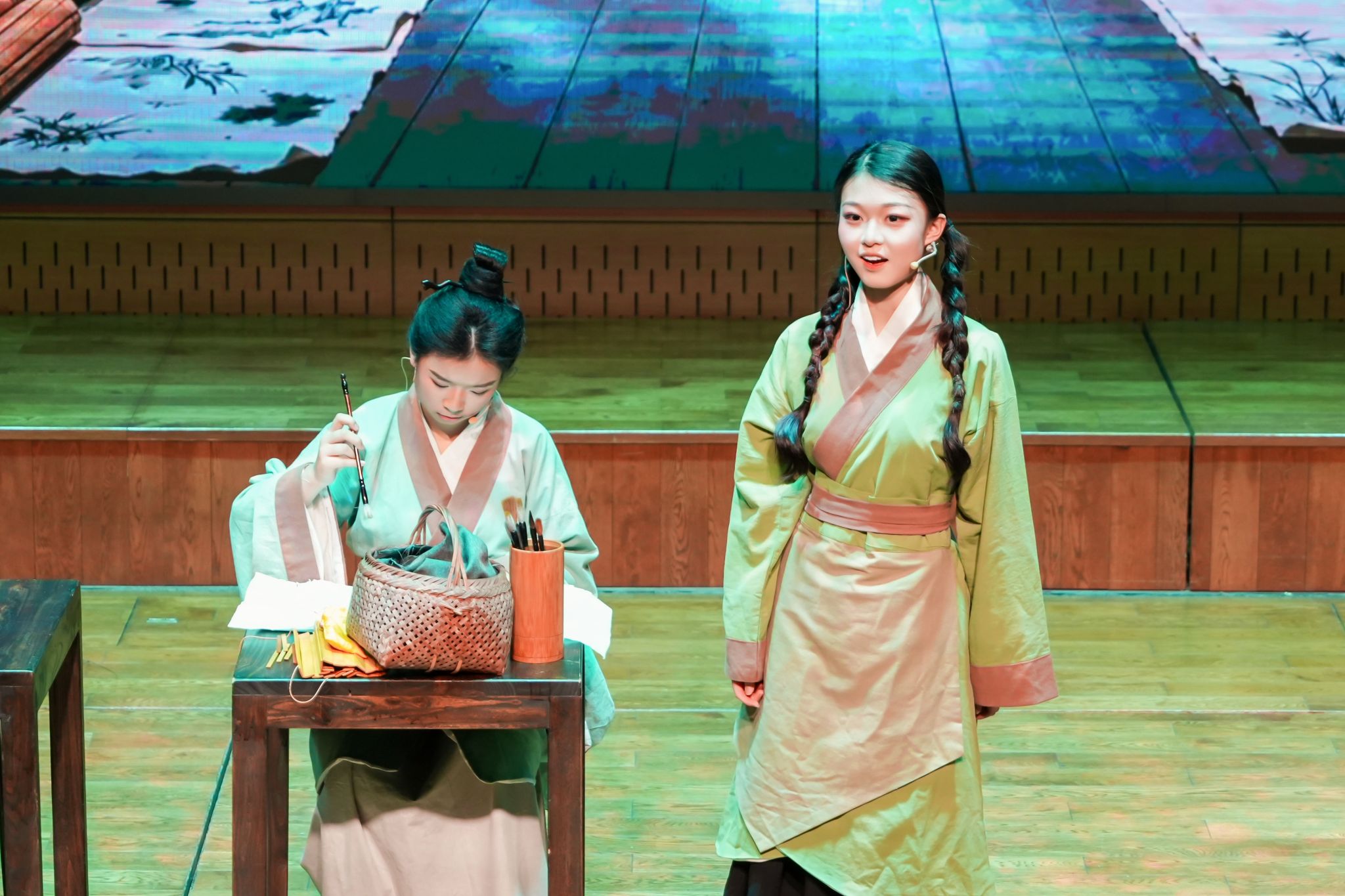
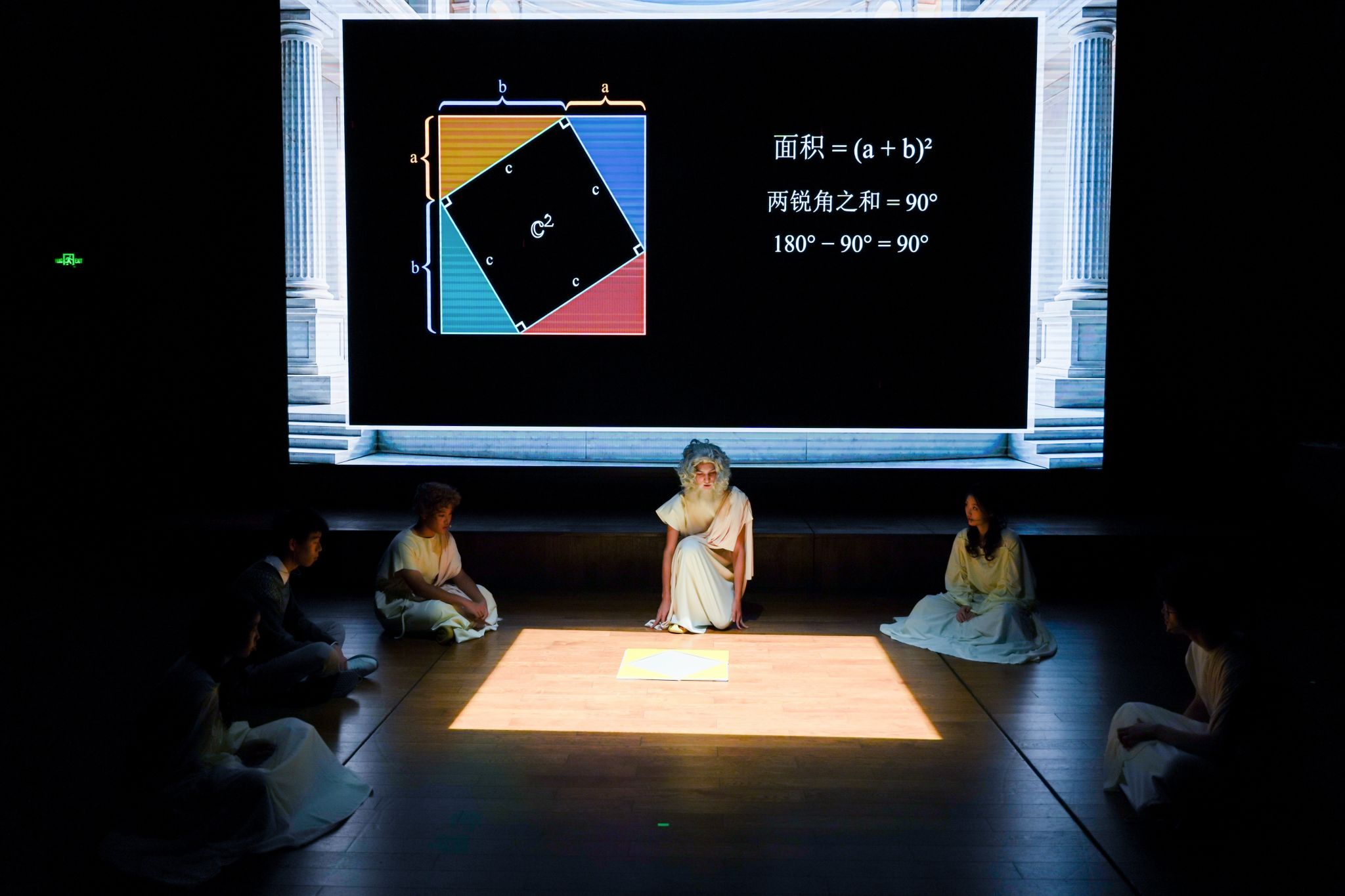
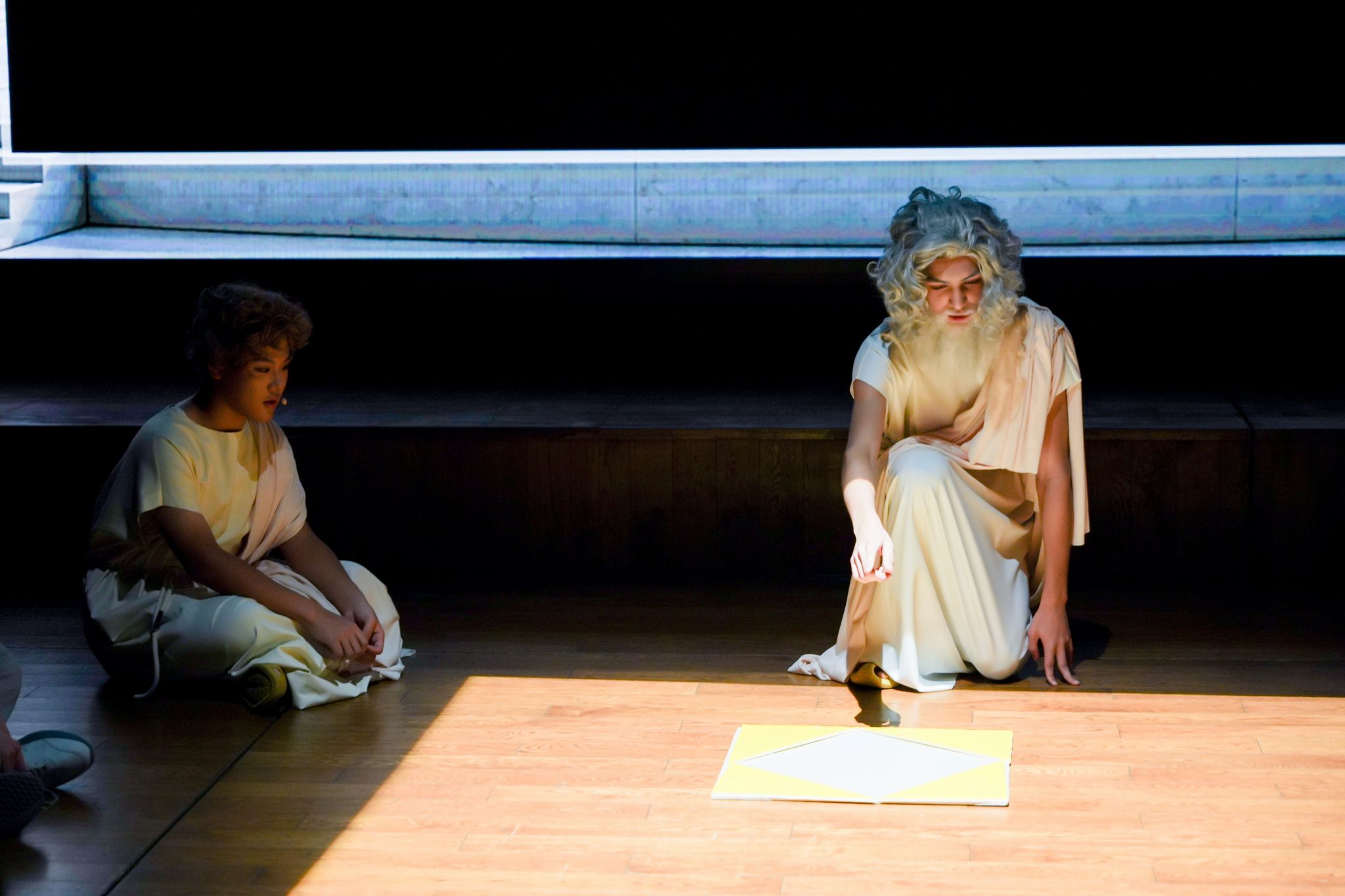
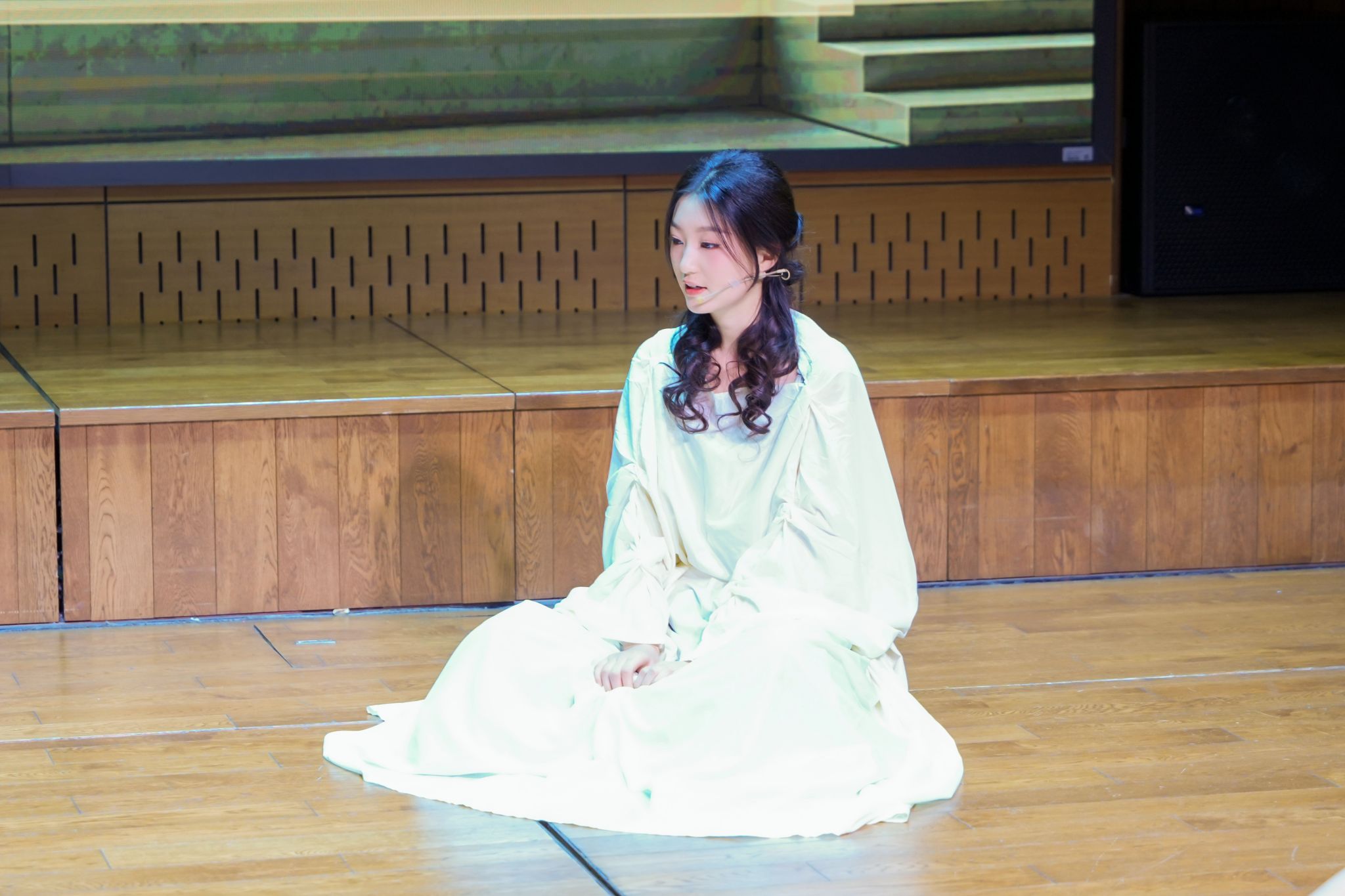
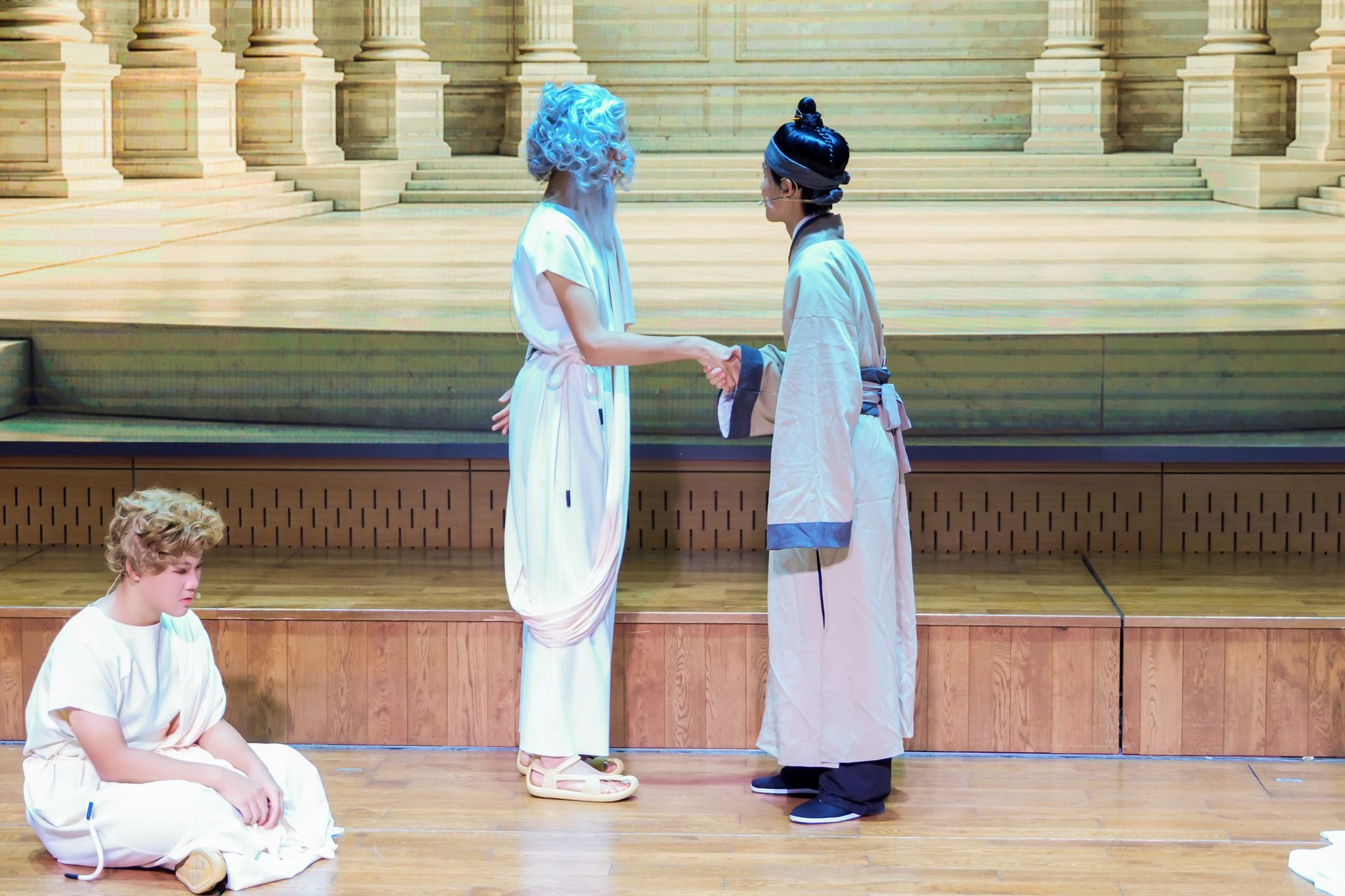
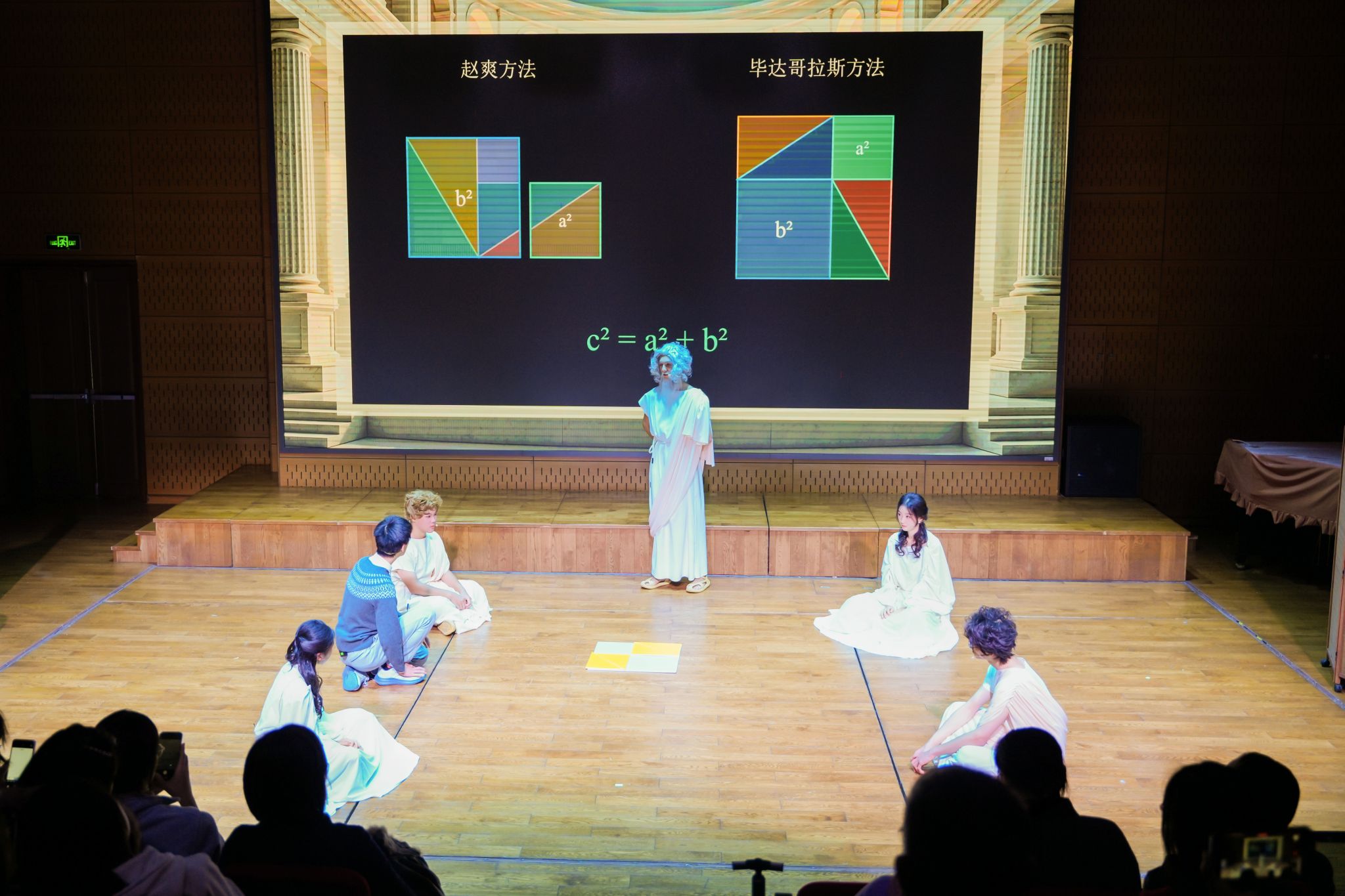
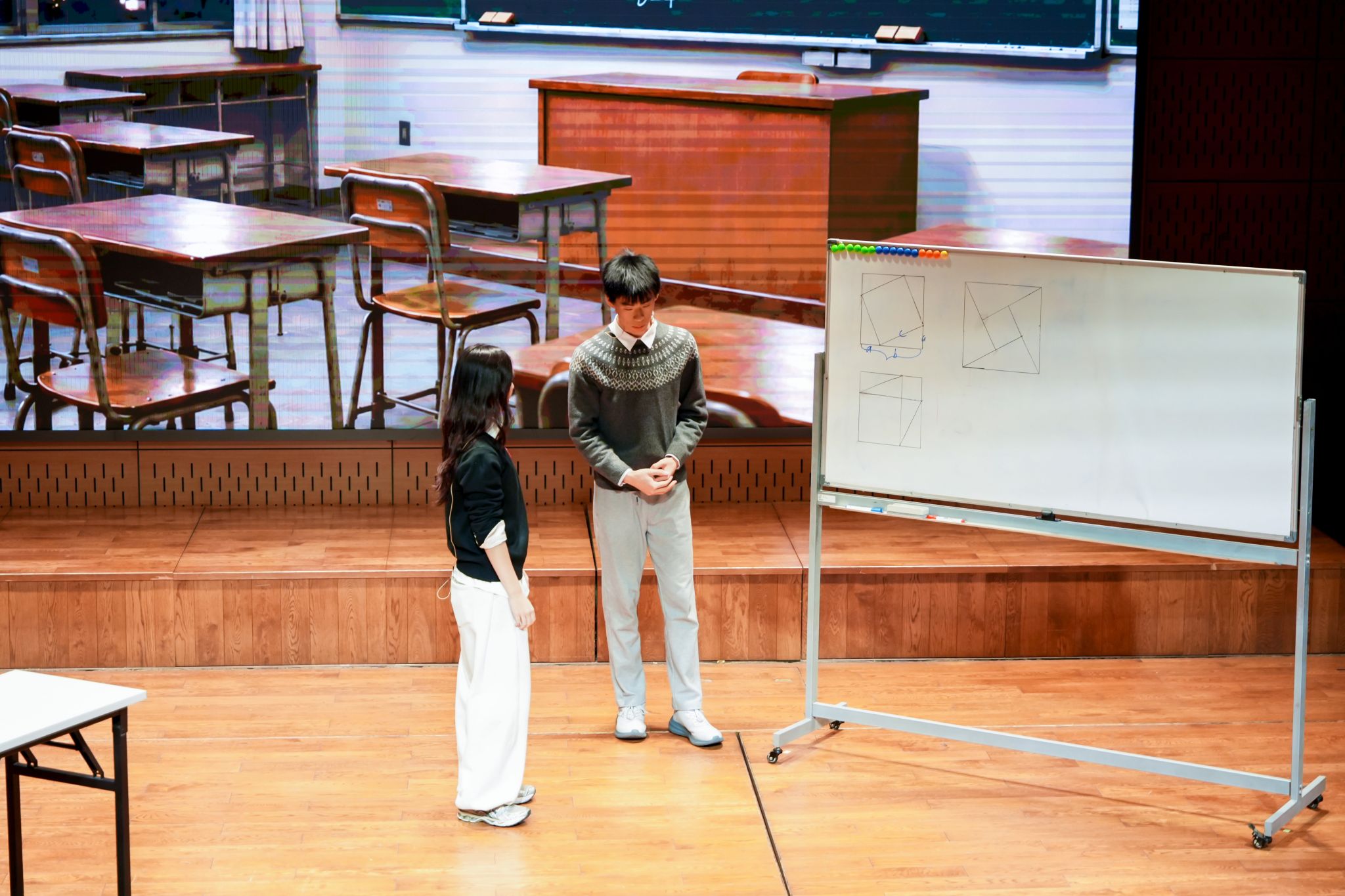
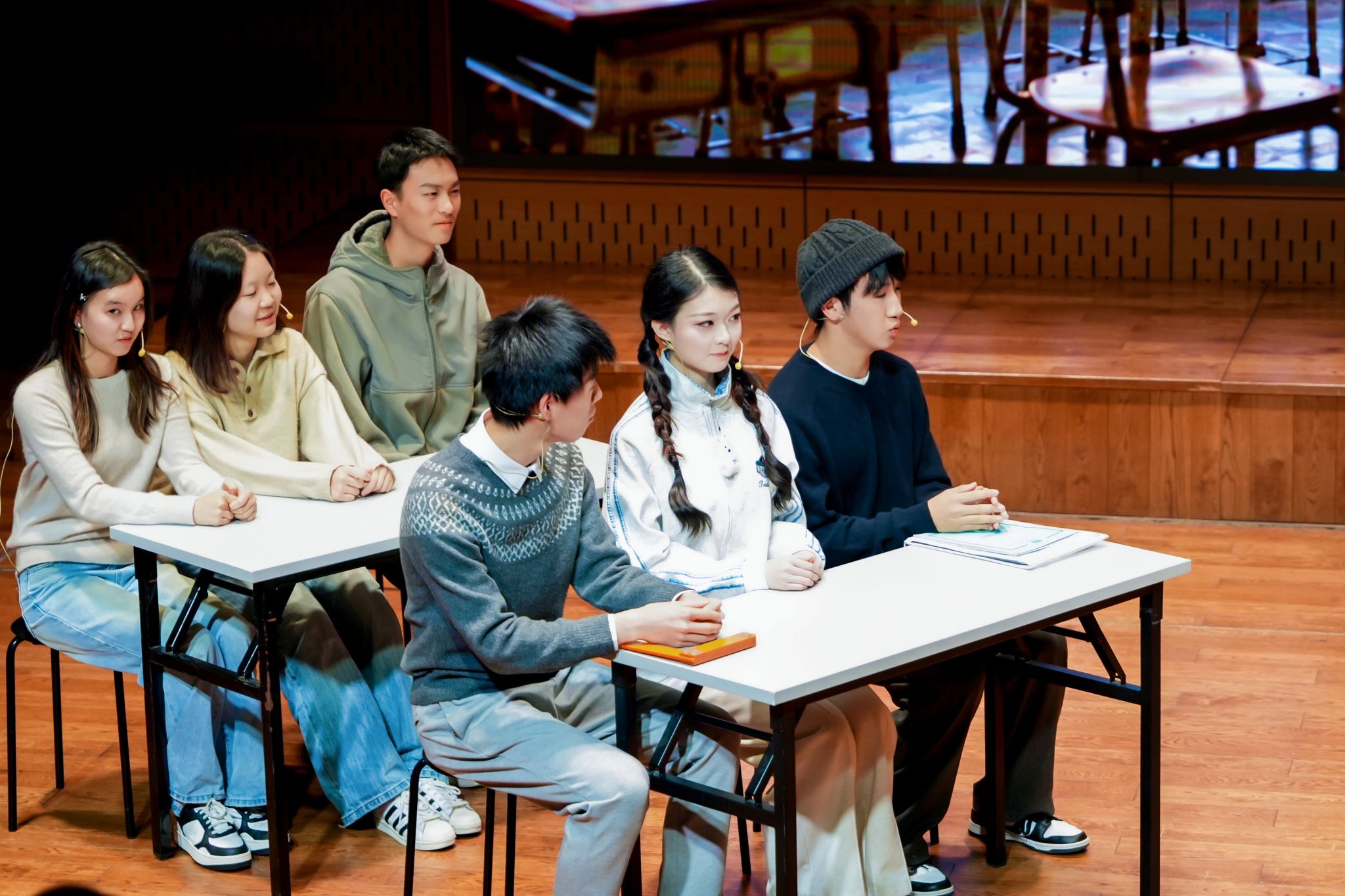
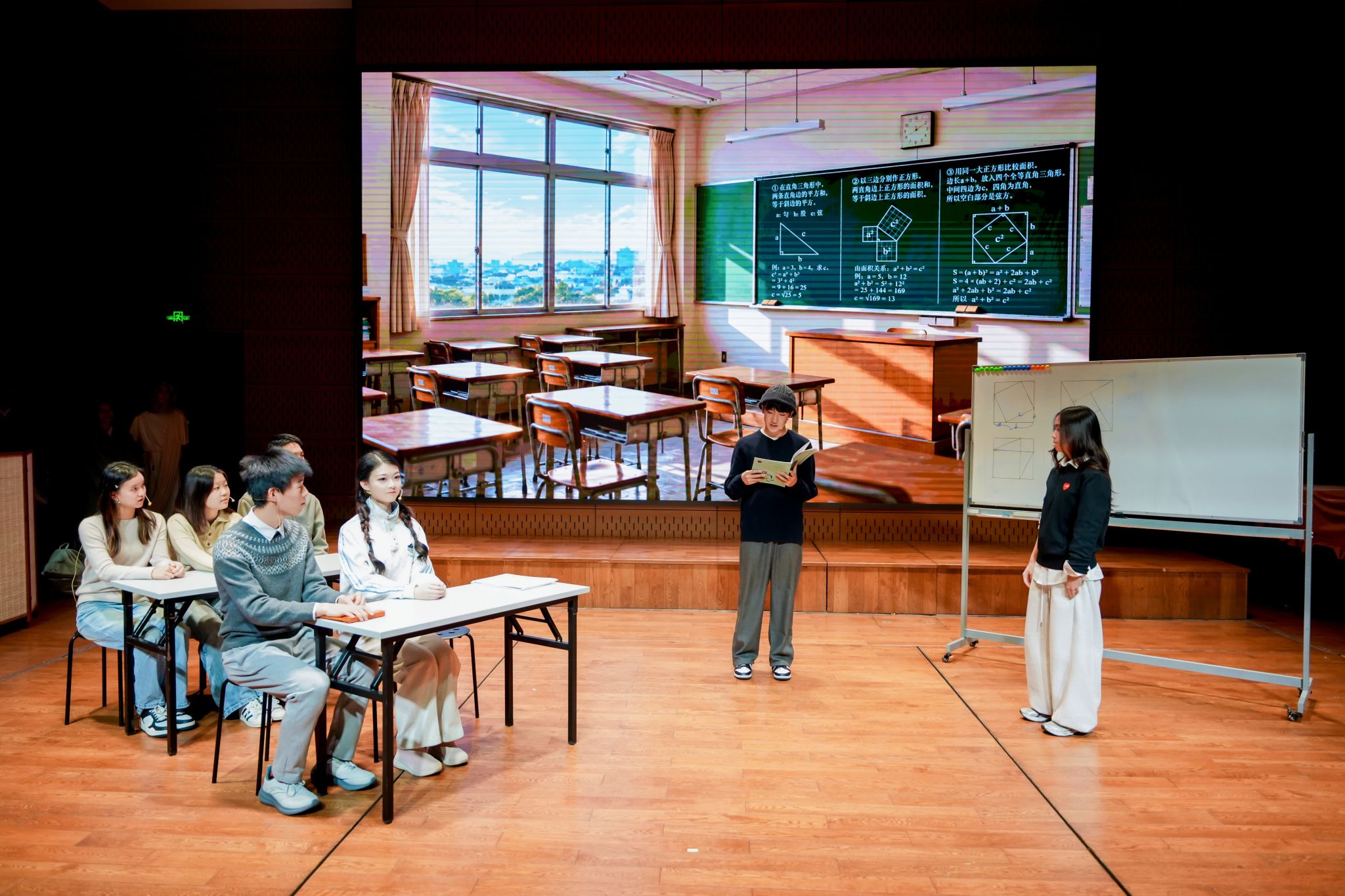
One minute on stage, two thousand years of textual research off stage
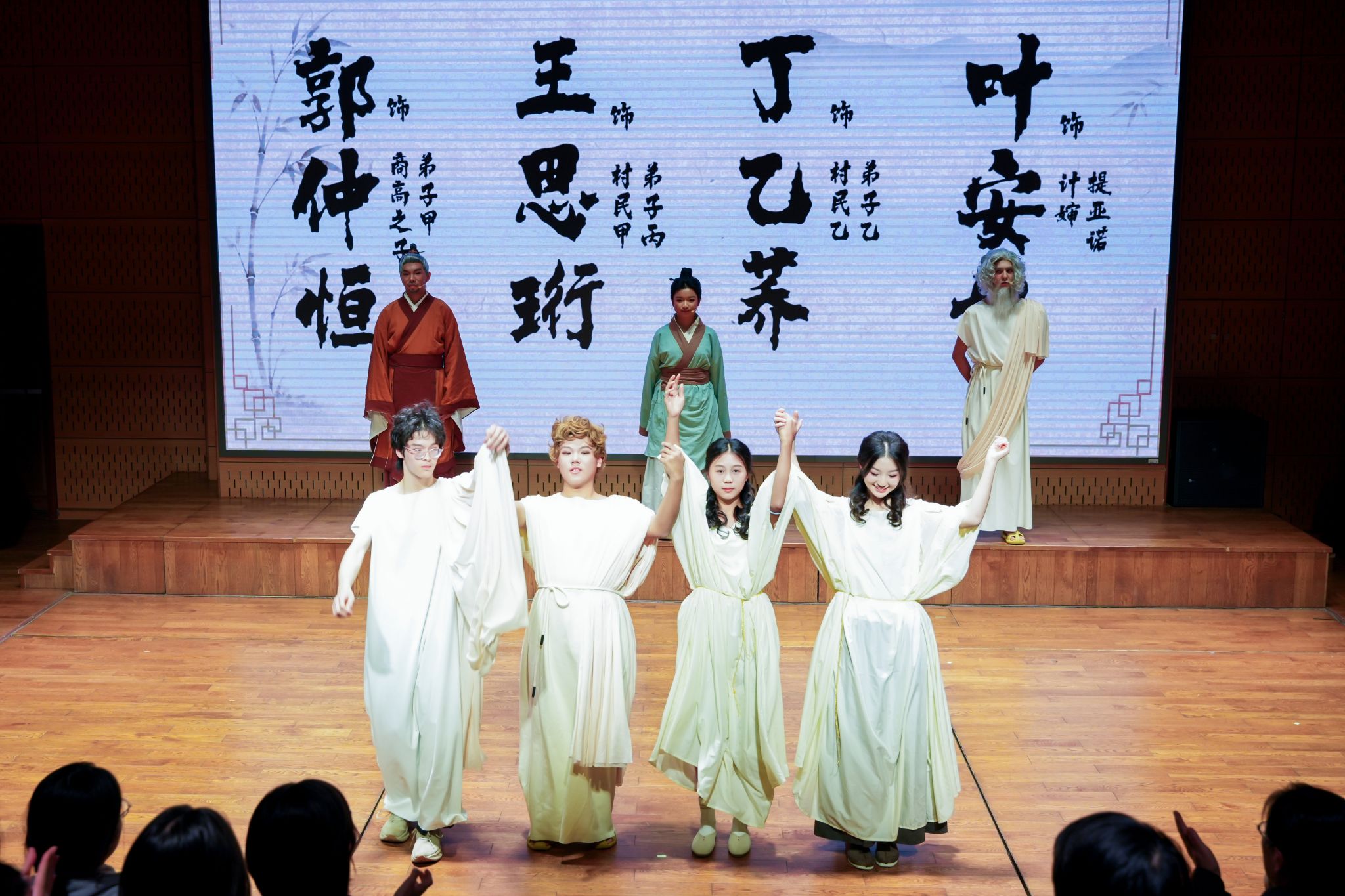
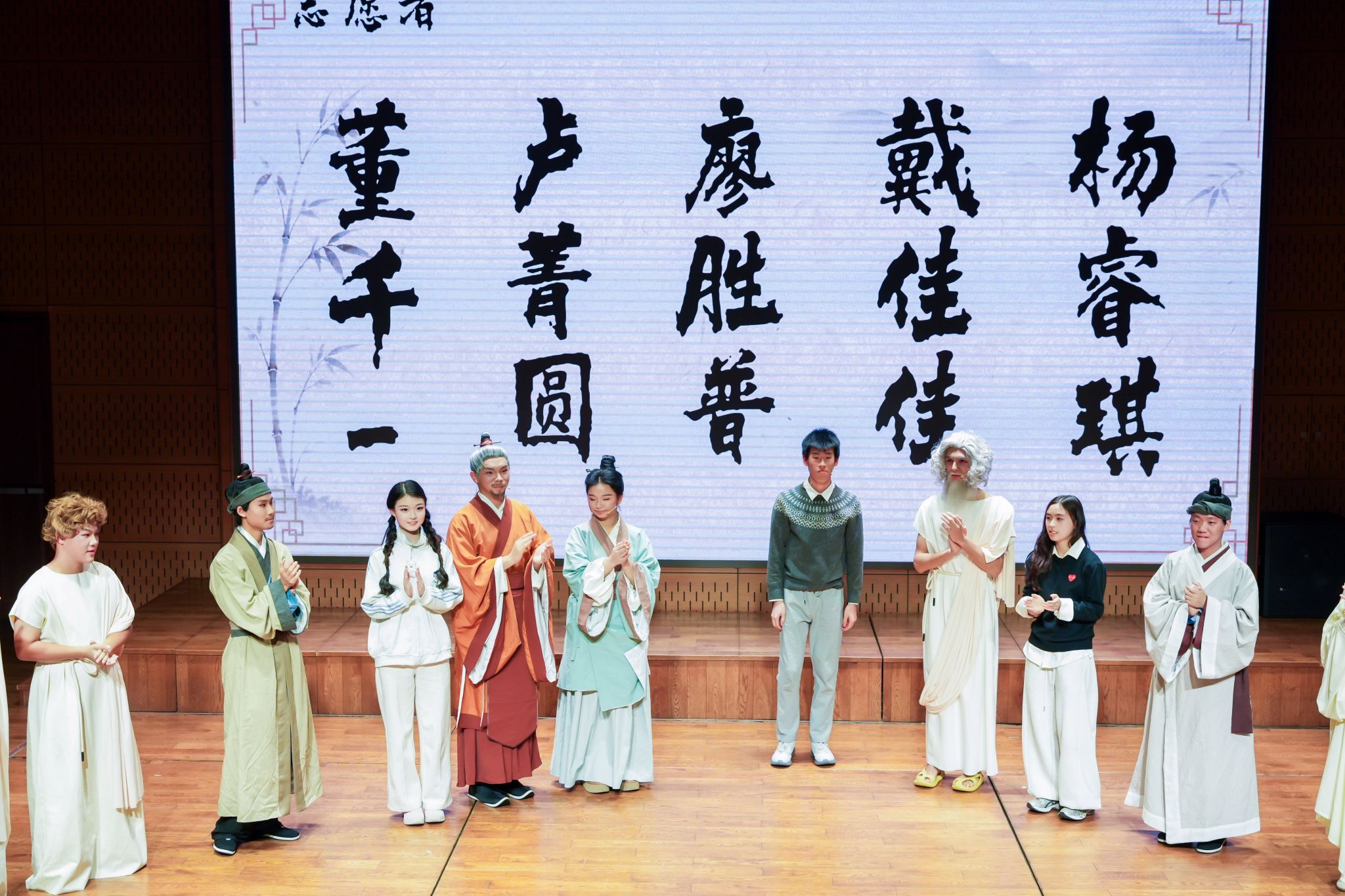
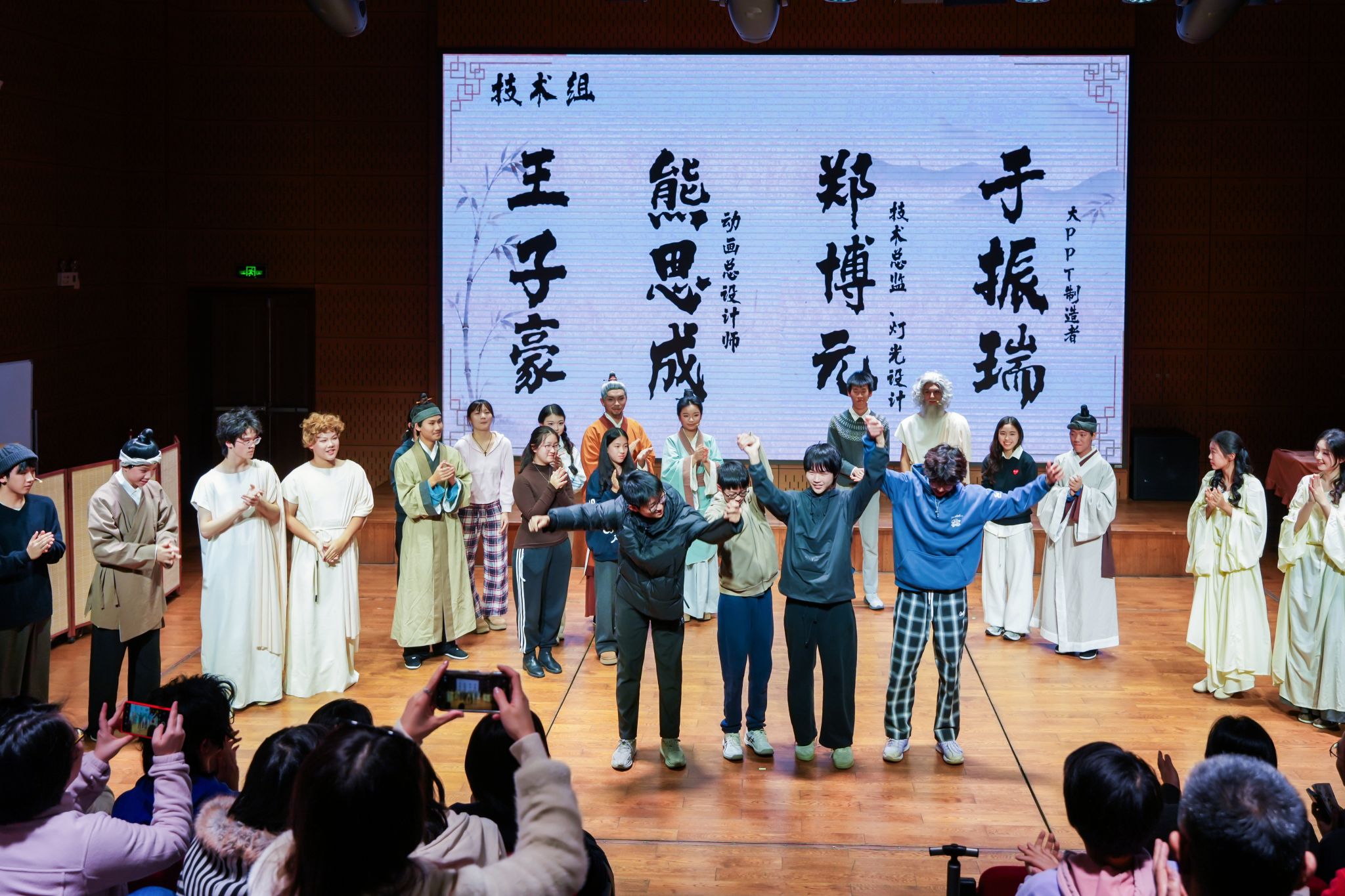
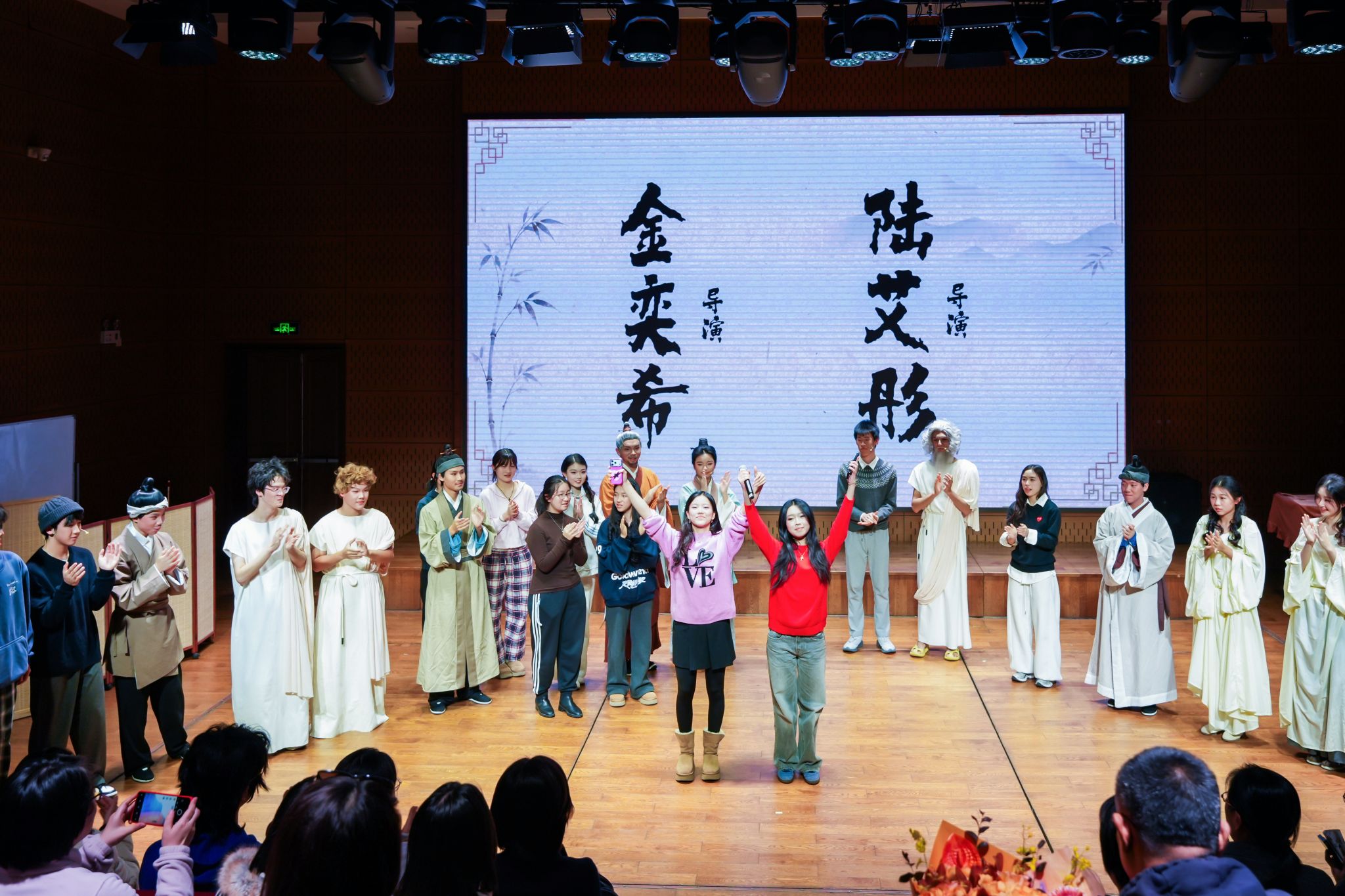
This year, 32 high school students served as scriptwriters, directors, actors, and crew members for lighting, multimedia, and props. From script conception to stage presentation, everything was completed in their spare time—making it the largest number of participants in the history of SHSID's math drama.
To ensure every line in the script can withstand scrutiny, the creators first put in a great deal of "unflashy" hard work: they pored over the original text of the Zhoubi Suanjing to clarify the conversational context in which "gou 3, gu 4, xian 5" appears; they examined Zhao Shuang's commentary on the hypotenuse diagram to understand why "out-in mutual compensation" holds; and they sorted through the historical sources on Pythagoras to distinguish what is authentic history from what is later embellishment. In this process, they discovered that the differences among the three proofs lie not only in method, but also in their different understandings of "what counts as a proof."
After the historical research came another difficult problem: a few minutes of drama cannot accommodate an entire proof. Which steps should be emphasized, and which can be replaced by figures on the screen—all of this had to be carefully weighed. "The whole process of historical research and creation is itself an in-depth, research-based mathematics learning experience," said the student directors. Drama is no longer about reciting ready-made lines, but about actively exploring the origins and evolution of knowledge.
The gains went beyond mathematics. The playwrights had to translate mathematical arguments into lines the characters could naturally speak; the director had to refine the blocking for dozens of performers through repeated rehearsals; lighting and multimedia teams worked to illustrate the geometric figures clearly. Through putting on a play, they gained not only mathematical knowledge, but also the experience of working together to make something meaningful come true.
Making mathematics a visible culture
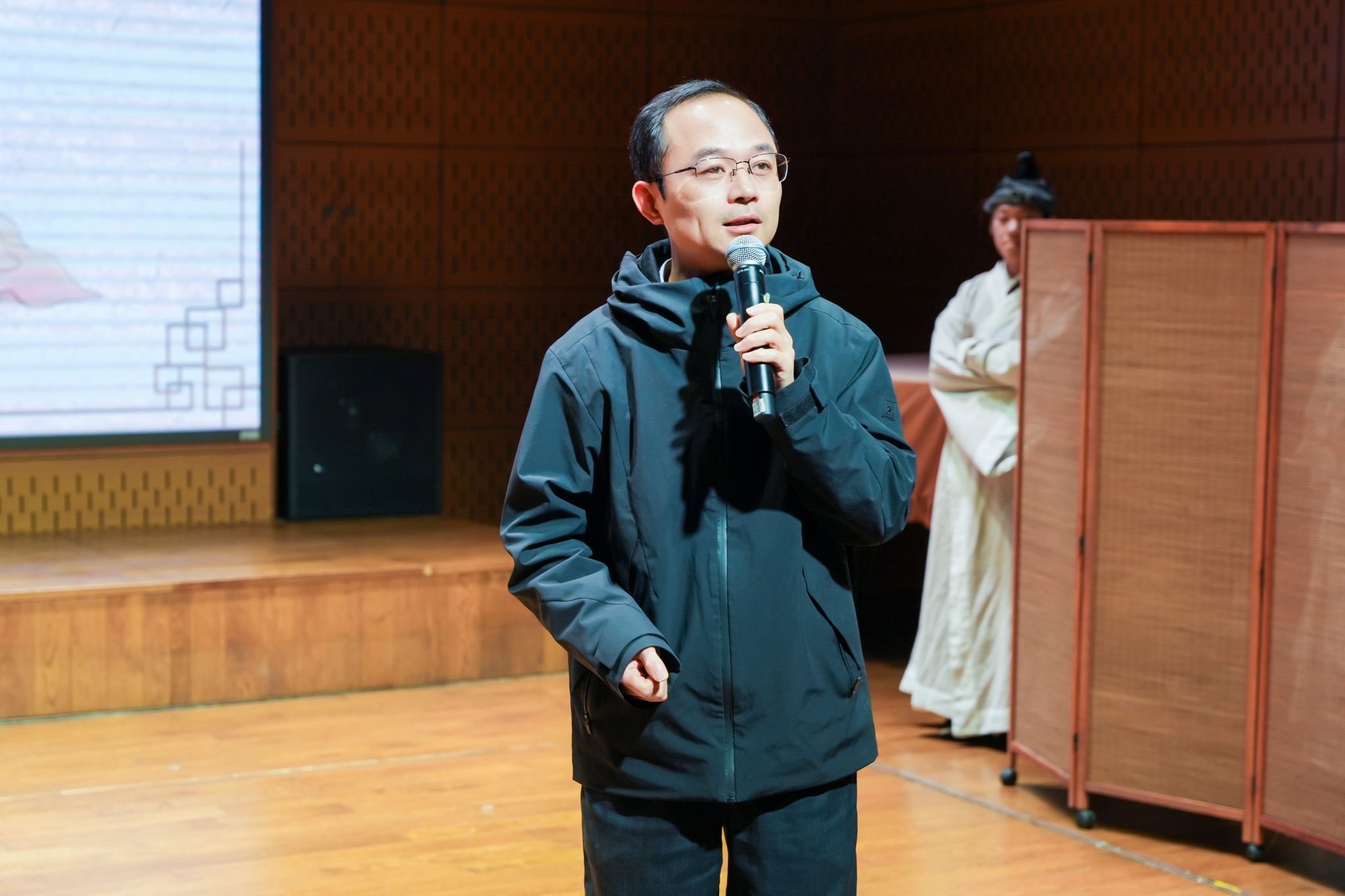
After the performance, Principal Ma said in his remarks that the fifth math drama revealed another side of mathematics—it is not a set of conclusions to be memorized, but a civilizational achievement that generation after generation has repeatedly questioned and mutually verified. He admitted that in the early days of rehearsal, the students could not yet recite their lines and were a bit disorganized on stage,but by today they had presenteda near-perfect answer on stage,which gratified him deeply. He particularly affirmed the questioning spirit the students consistently conveyed throughout their performance: not only to know what it is, but also to know why it is so—a principle that not only defines our school's math classes, but also represents the knowledge and skills needed to face a changing world. He was also delighted to see that some students, drawn by their love of mathematics, revealed artistic talent on stage.He hoped that through such practice, students would find their own way of engaging withmathematics and traditional culture.
Five years: from a single play to a tradition
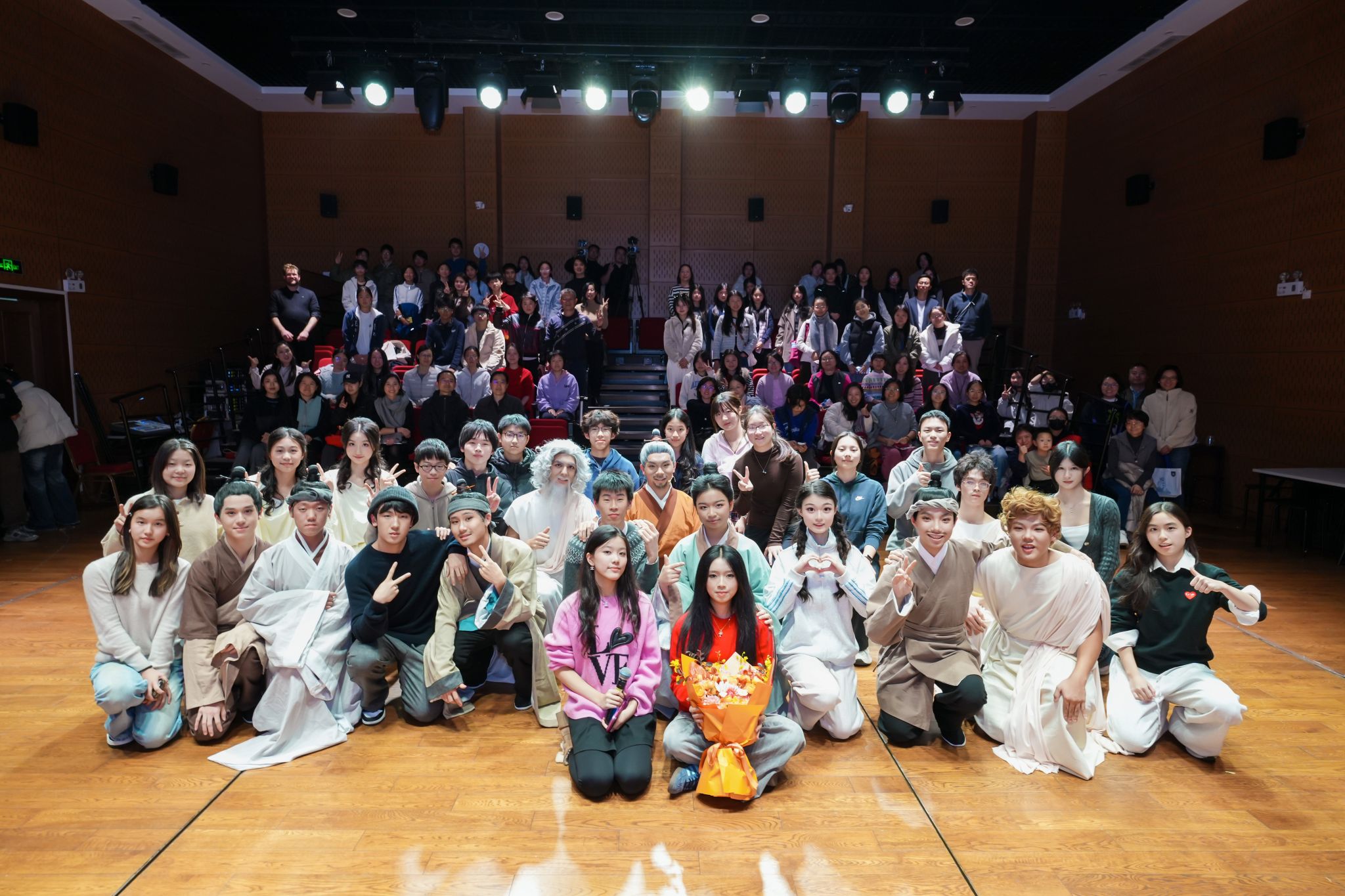
The original math drama at SHSID has run for five consecutive years, becoming a regular interdisciplinary practice and a campus tradition that carries forward Chinese culture.Over the past five years, it has consistently done the same thing: starting from the history of Chinese mathematics, it lets students no longer face only formulas, but see the real people behind the theorems, see the path Chinese culture has traveled, and see its dialogue with the world. On stage, students are both performers and researchers and creators; cohort after cohort of students, in their own way, have truly grounded "telling the Chinese story well" in practice. In the years ahead, the math drama will go on, and more students will take to this stage to share Chinese mathematical culture with wider audiences.
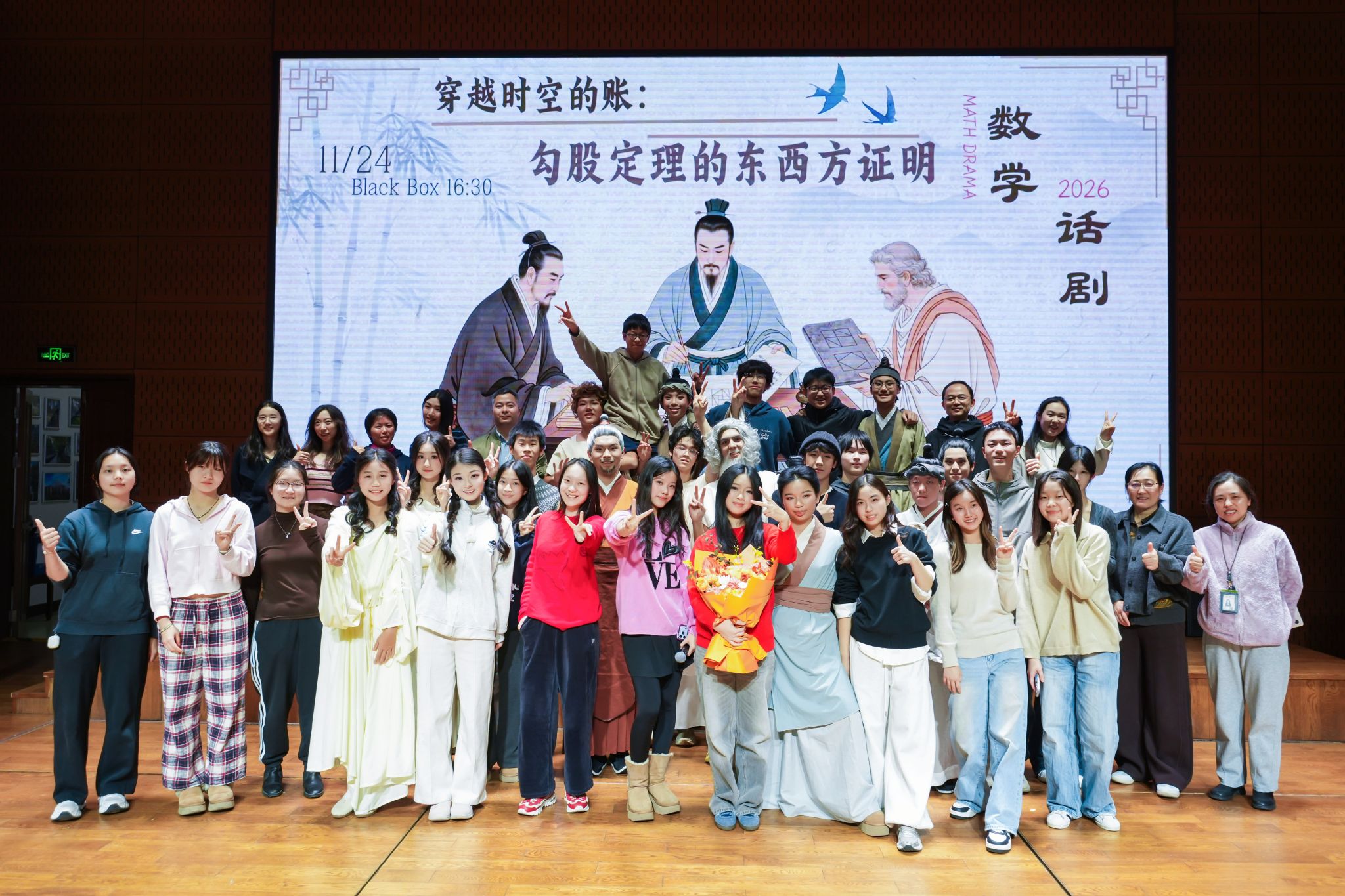
(Written by High School Math Department Pictures by Yuan Quan, SHSID Media Group Reviewed by Shan Liu, Ying Gu, Chenli Shen)