-
ABOUT US
-
ACADEMICS
Curriculum Program
Departments
- English
- High School Chinese
- Primary and Junior School Chinese.
- High School Mathematics
- Middle School Mathematics
- Primary School Mathematics
- Music and Fine Arts
- Physical Education
- Physics
- Chemistry
- History and Geography
- Physical Science and Optional courses Department
- Middle School Biology
- High School Biology
- Social Sciences
- Computer Science
- Courses in Primary School
Achievements and Matriculations
College Counseling
Science & Technology Innovation Contest
Subject Competition
-
ARTS
-
ATHLETICS
-
AT SHSID
SHSID ∣ TIMES
PTSA
Club Exhibition
- 龙吟社
- Live 2 Drama
- Choir
- Hip-pop Dance Club
- The Primary School Dance Troupe
- Symposiums Club
- Biology Workshop
- You Shan
- VEX Robotic
- Peking Opera Club
- Baseball Club
- Model United Nations
- The World Scholar’s Cup
- Future Problem Solving Club
- United States Academic Pentathlon
- OM Club
- AMC Club
- Music for Patients
- SHSID Gazette
- Smile Charity
- Cultural Moments
- SciAcademy
- Stem Doge Alliance
- Chinese Debate Club
- IAA
- Mock Trial Club
- Zhengming Club
- Furry Friends
- GT-Racing
- Village Radio
- IMMC Club
- Creative Design and Intelligent Fabrication
- Future City Research Project
- ECOCAP
- AdvocaSEA
- SPDC
- Medishine
- Floorball Club
- Animusic MTC
- Wings Up
- All Booked
- Cyano
- Birding Community
Health and Wellness
Campus Safety
Cafeteria Service
-
ADMINISTRATION
-
ADMISSIONS
-
ALUMNI
Alumni Information
Honors Students
- Class of 2025
- Class of 2024
- Class of 2023
- Class of 2022
- Class of 2021
- Class of 2020
- Class of 2019
- Class of 2018
- Class of 2017
- Class of 2016
- Class of 2015
- Class of 2014
- Class of 2013
- Class of 2012
- Class of 2011
- Class of 2010
- Class of 2009
- Class of 2008
- Class of 2007
- Class of 2006
Who Studied at SHSID
SHS Foundation
-
DOCUMENTS
Middle School Science Department: Nutritional Education in Science Class—Guiding Students to Recognize the Value of Natural Ingredients and Cultivate Healthy Eating Habits
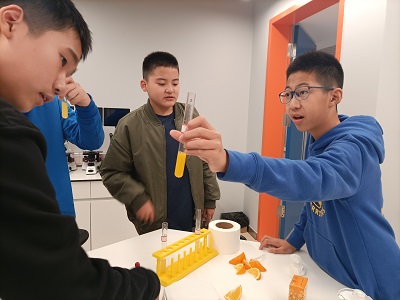
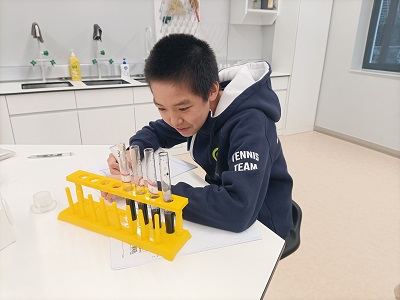
On November 27, seventh-grade students conducted a unique experiment in science class—investigating the difference in vitamin C content between various brands of orange juice and fresh oranges. The purpose of this experiment was to allow students to engage in hands-on activities and, through actual data comparison, gain a deeper understanding of how the nutritional components of food affect health.
Under the guidance of their teacher, students first learned the basic knowledge of vitamin C and its importance to the human body. They discovered that vitamin C helps promote collagen synthesis, boosts immunity, and prevents scurvy, among other benefits. Following this, the students were divided into groups and used the iodine titration method to measure the vitamin C concentration in several common brands of orange juice and fresh oranges available on the market.
The results of the experiment showed that the vitamin C content in fresh oranges was significantly higher than in processed orange juice products. This finding not only helped students recognize the nutritional advantages of natural ingredients but also sparked reflections on their daily eating habits. Many students expressed that they would pay more attention to choosing fresh fruits and vegetables in the future and reduce their reliance on processed foods.
This experiment was not only a vivid biology teaching practice but also a positive guide for students' healthy lifestyle choices, encouraging them to develop good eating habits from an early age. The science group will continue to conduct similar experimental teaching activities to inspire students' interest in learning and cultivate their scientific literacy and health awareness.
(Written by Rongzhang Hu Pictures by Rongzhang Hu Edited by Cong Luo, Judah Kuhn )