-
ABOUT US
-
ACADEMICS
Curriculum Program
Departments
- English
- High School Chinese
- Primary and Junior School Chinese.
- High School Mathematics
- Middle School Mathematics
- Primary School Mathematics
- Music and Fine Arts
- Physical Education
- Physics
- Chemistry
- History and Geography
- Physical Science and Optional courses Department
- Middle School Biology
- High School Biology
- Social Sciences
- Computer Science
- Courses in Primary School
Achievements and Matriculations
College Counseling
Science & Technology Innovation Contest
Subject Competition
-
ARTS
-
ATHLETICS
-
AT SHSID
SHSID ∣ TIMES
PTSA
Club Exhibition
- 龙吟社
- Live 2 Drama
- Choir
- Hip-pop Dance Club
- The Primary School Dance Troupe
- Symposiums Club
- Biology Workshop
- You Shan
- VEX Robotic
- Peking Opera Club
- Baseball Club
- Model United Nations
- The World Scholar’s Cup
- Future Problem Solving Club
- United States Academic Pentathlon
- OM Club
- AMC Club
- Music for Patients
- SHSID Gazette
- Smile Charity
- Cultural Moments
- SciAcademy
- Stem Doge Alliance
- Chinese Debate Club
- IAA
- Mock Trial Club
- Zhengming Club
- Furry Friends
- GT-Racing
- Village Radio
- IMMC Club
- Creative Design and Intelligent Fabrication
- Future City Research Project
- ECOCAP
- AdvocaSEA
- SPDC
- Medishine
- Floorball Club
- Animusic MTC
- Wings Up
- All Booked
- Cyano
- Birding Community
Health and Wellness
Campus Safety
Cafeteria Service
-
ADMINISTRATION
-
ADMISSIONS
-
ALUMNI
Alumni Information
Honors Students
- Class of 2025
- Class of 2024
- Class of 2023
- Class of 2022
- Class of 2021
- Class of 2020
- Class of 2019
- Class of 2018
- Class of 2017
- Class of 2016
- Class of 2015
- Class of 2014
- Class of 2013
- Class of 2012
- Class of 2011
- Class of 2010
- Class of 2009
- Class of 2008
- Class of 2007
- Class of 2006
Who Studied at SHSID
SHS Foundation
-
DOCUMENTS
Understanding Society, Understanding Ourselves: School Course Introduction to Sociology
If growing up is a process of continually asking “Who am I?”, then sociology is a discipline that helps us explore this question. This semester, the new Grade 12 school-based course Introduction to Sociology was officially launched. Beginning from students’ real-life experiences, the course invites them to examine how society shapes individuals, while also reflecting on how individuals participate in and influence society. Here, sociology is not presented as abstract theory, but as a way of thinking—a lens for understanding oneself, others, and the social world.
In this course, students learn foundational sociological perspectives and concepts, but more importantly, they learn how to observe, think, and reflect. In class, students are encouraged to grapple with questions that feel familiar, yet are far from simple:
• To what extent are our choices truly “personal”?
• How do family, school, media, and technology shape our values and identities?
• What social structures lie behind what we take for granted in everyday life?
Course topics include identity, culture and consumption, social inequality, family and generations, technology and society, and youth culture. Through observation, interviews, reflective writing, and small-scale research projects, students gradually develop sensitivity to social issues, strengthen critical thinking and empathy, and gain a clearer understanding of their own position within society.
As a key practical component of the first semester, on January 9 at lunchtime, the two Grade 12 sociology classes jointly planned and presented a student-curated pop-up exhibition.Starting from a personal object, students combined memory, emotion, and sociological perspectives to curate a mini exhibition on identity, memory, and value. Objects were no longer just everyday items, but became entry points for understanding society and the self.
The exhibition was an outcome of nearly a month of learning and curatorial work. Under the supervision of the teacher, students in each class proposed exhibition ideas and voted on their final themes; they then engaged in workshop discussions: defining the theme, categorising objects, and considering how visitors might understand the social meanings embedded in these items. Throughout this process, students learned not only to express their own perspectives but also to listen to others and make collective curatorial decisions. The final exhibition was the result of sustained dialogue, collaboration, and shared reflection.
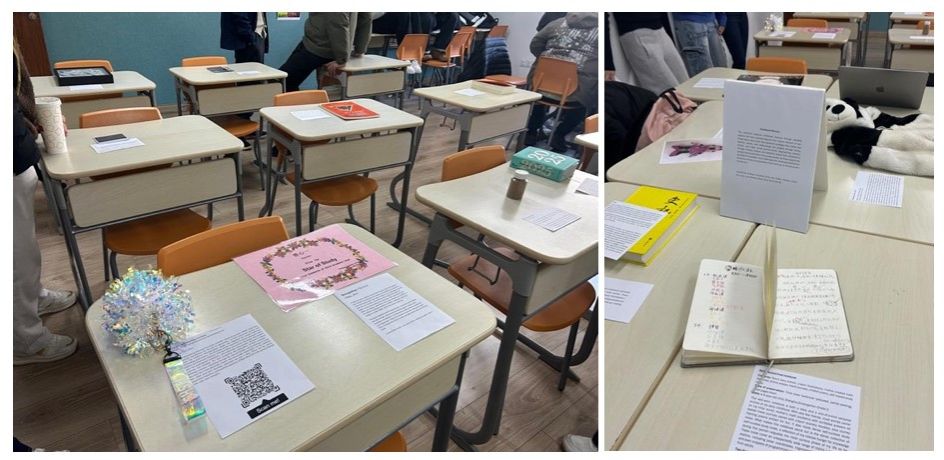
Exhibition Theme I | Valuable Garbage — When “Waste” Carries Emotion and Meaning
The Valuable Garbage exhibition invited visitors to rethink what “value” means. Students displayed objects that had lost their functional or economic value—a failed Polaroid photo, an unplayable CD, middle school math workbooks, flight tickets from the past year, a cheerleading prize souvenir, first certificates from elementary school, sand from Inner Mongolia, a TOEFL test pencil, and a long-unopened book—only to discover that these items carried irreplaceable memories, emotions, and aspects of identity.
Through a sociological lens, students explored how value is redefined across different contexts, and reflected on how we relate to our past, our emotions, and ourselves.
Exhibition Theme II | Childhood Memory — How Childhood Shapes Who We Become
The Childhood Memory exhibition, curated by another group of students, used childhood objects to explore how family, school, and social environments shape personal development. Childhood memories are not merely private experiences, but part of an ongoing process of socialisation that continues to influence identity and values.
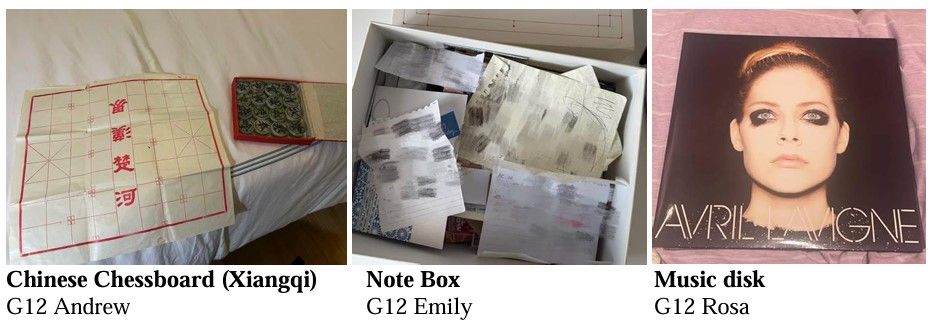
At the personal level, objects point to individual emotional worlds and self-experience, including a treasured childhood album, a diary, an “incomprehensible” copy of Records of the Grand Historian, an old Minnie Mouse doll, and a panda vest. At the family level, objects are embedded in intimate relationships: a LEGO race car, a spoon still in use today, a grandfather’s chess set, a pet corgi, a coin purse, and a broken CD player. At the level of school and community, objects connect to peer interaction and collective memory, such as a wooden sword used in kendo training, a box of notes exchanged among friends, a first-grade class yearbook, and screenshots and comments from the first episode of Boonie Bears.
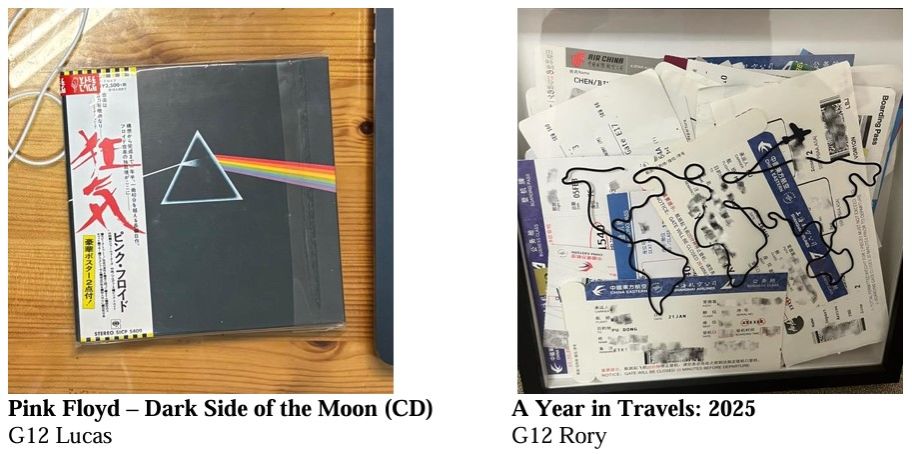
As these objects were revisited in the present, they acquired new meanings. A chess set once played with grandfather in childhood was set up again during the exhibition, generating new shared memories through a friendly game.
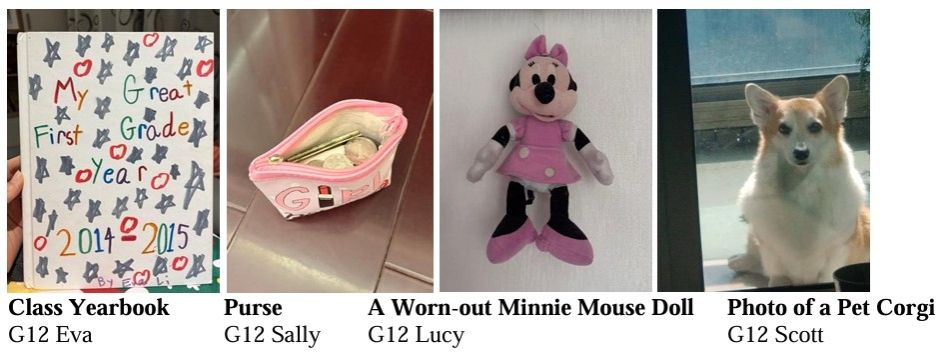
This joint exhibition was not only a display of coursework, but also a dialogue—with one another and with society. Students from the two classes visited each other’s exhibitions and discussed whether objects from childhood memories could also be understood today as “valuable garbage”.
Students learned to transform personal experience into sociological reflection, situating individual stories within broader social contexts. At the same time, the exhibition invited other students as visitors to reflect on their own everyday lives.
As sociology reminds us, personal stories are never isolated. When students learn to understand themselves through sociological language, they are also learning to engage with the world in a more thoughtful and mature way. Introduction to Sociology aims to offer students a capacity that will stay with them long after the course ends: to understand society, to understand others, and to understand themselves more clearly.
(Written/Pictures by Social Sciences Department Reviewed by Qian Zuo)