-
ABOUT US
-
ACADEMICS
Curriculum Program
Departments
- English
- High School Chinese
- Primary and Junior School Chinese.
- High School Mathematics
- Middle School Mathematics
- Primary School Mathematics
- Music and Fine Arts
- Physical Education
- Physics
- Chemistry
- History and Geography
- Physical Science and Optional courses Department
- Middle School Biology
- High School Biology
- Social Sciences
- Computer Science
- Courses in Primary School
Achievements and Matriculations
College Counseling
Science & Technology Innovation Contest
Subject Competition
-
ARTS
-
ATHLETICS
-
AT SHSID
SHSID ∣ TIMES
PTSA
Club Exhibition
- 龙吟社
- Live 2 Drama
- Choir
- Hip-pop Dance Club
- The Primary School Dance Troupe
- Symposiums Club
- Biology Workshop
- You Shan
- VEX Robotic
- Peking Opera Club
- Baseball Club
- Model United Nations
- The World Scholar’s Cup
- Future Problem Solving Club
- United States Academic Pentathlon
- OM Club
- AMC Club
- Music for Patients
- SHSID Gazette
- Smile Charity
- Cultural Moments
- SciAcademy
- Stem Doge Alliance
- Chinese Debate Club
- IAA
- Mock Trial Club
- Zhengming Club
- Furry Friends
- GT-Racing
- Village Radio
- IMMC Club
- Creative Design and Intelligent Fabrication
- Future City Research Project
- ECOCAP
- AdvocaSEA
- SPDC
- Medishine
- Floorball Club
- Animusic MTC
- Wings Up
- All Booked
- Cyano
- Birding Community
Health and Wellness
Campus Safety
Cafeteria Service
-
ADMINISTRATION
-
ADMISSIONS
-
ALUMNI
Alumni Information
Honors Students
- Class of 2025
- Class of 2024
- Class of 2023
- Class of 2022
- Class of 2021
- Class of 2020
- Class of 2019
- Class of 2018
- Class of 2017
- Class of 2016
- Class of 2015
- Class of 2014
- Class of 2013
- Class of 2012
- Class of 2011
- Class of 2010
- Class of 2009
- Class of 2008
- Class of 2007
- Class of 2006
Who Studied at SHSID
SHS Foundation
-
DOCUMENTS
Advancing AI Education in Computer Science Classrooms
As AI education deepens, teachers of the Computer Science Department are actively leveraging interactive platforms to develop lightweight, user-friendly teaching tools that enhance classroom interaction and effectiveness. During the professional develpment session held at the end of December, two teachers shared their experiences integrating AI teaching aids into classroom instruction. Their cases centered on the advanced concept of reinforcement learning, designing both engaging and inquiry-based pedagogical approaches.
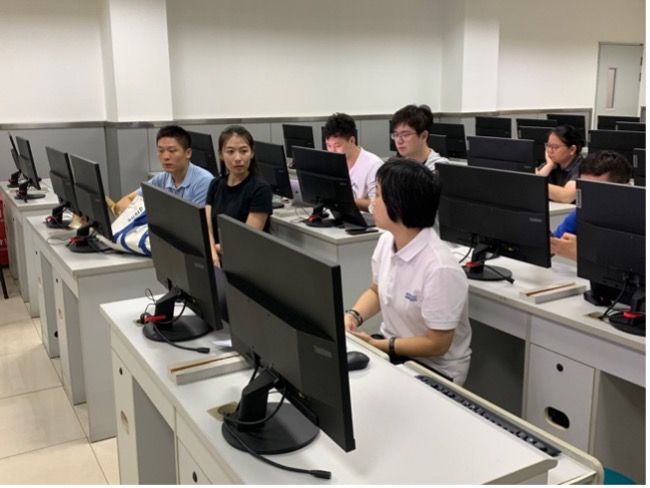
Mr. Yuan independently developed an "Interactive Reinforcement Learning Maze Tool" using the Cursor platform. This tool transforms the abstract algorithm into a visual game environment. Through group collaboration, students place obstacles in a maze, design paths, adjust reward/punishment parameters, and personally "train" AI agents. With real-time data visualization, learners directly observe how strategy adjustments impact scores, thereby grasping core relationships among states, actions, rewards, and optimal policies through learning by doing.
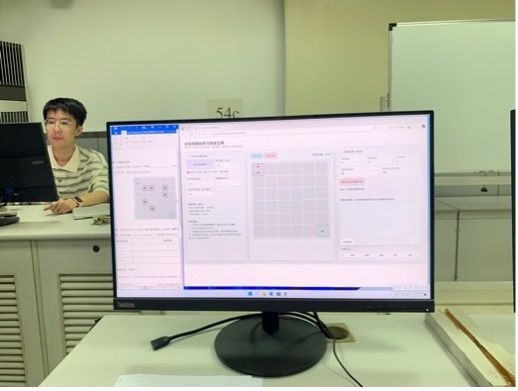
Mr. Xu designed an "Intelligent Recommendation System Inquiry" case. He pre-deployed an interactive web-based teaching aid simulating a "Xiaohongshu" (Chinese social media platform) recommendation interface, enabling students to compare outcomes between AI-generated recommendations and self-defined strategies. By testing approaches like "balanced exploration" and "pure exploitation," learners clearly observed changes in recommendation scores, gaining deep understanding of the core exploration-exploitation tradeoff mechanism in reinforcement learning. This case ingeniously bridges real-life scenarios, effectively lowering comprehension barriers for complex concepts like supervised learning and reinforcement learning.
During the workshop discussion, teachers engaged in lively exchanges on expanding tool functionalities and optimizing instructional design. Participants unanimously agreed that platforms like Cursor and Trae empower educators to rapidly build visual, operable AI teaching tools. These not only significantly reduce technical barriers but also transform teaching aids into learning tools, equipping students with hands-on AI capabilities—from training and demonstration to analysis and iterative optimization—achieving authentic learning by doing.
(Written/Pictures by Computer Science Department Reviewed by Qian Zuo)