-
ABOUT US
-
ACADEMICS
Curriculum Program
Departments
- English
- High School Chinese
- Primary and Junior School Chinese.
- High School Mathematics
- Middle School Mathematics
- Primary School Mathematics
- Music and Fine Arts
- Physical Education
- Physics
- Chemistry
- History and Geography
- Physical Science and Optional courses Department
- Middle School Biology
- High School Biology
- Social Sciences
- Computer Science
- Courses in Primary School
Achievements and Matriculations
College Counseling
Science & Technology Innovation Contest
Subject Competition
-
ARTS
-
ATHLETICS
-
AT SHSID
SHSID ∣ TIMES
PTSA
Club Exhibition
- 龙吟社
- Live 2 Drama
- Choir
- Hip-pop Dance Club
- The Primary School Dance Troupe
- Symposiums Club
- Biology Workshop
- You Shan
- VEX Robotic
- Peking Opera Club
- Baseball Club
- Model United Nations
- The World Scholar’s Cup
- Future Problem Solving Club
- United States Academic Pentathlon
- OM Club
- AMC Club
- Music for Patients
- SHSID Gazette
- Smile Charity
- Cultural Moments
- SciAcademy
- Stem Doge Alliance
- Chinese Debate Club
- IAA
- Mock Trial Club
- Zhengming Club
- Furry Friends
- GT-Racing
- Village Radio
- IMMC Club
- Creative Design and Intelligent Fabrication
- Future City Research Project
- ECOCAP
- AdvocaSEA
- SPDC
- Medishine
- Floorball Club
- Animusic MTC
- Wings Up
- All Booked
- Cyano
- Birding Community
Health and Wellness
Campus Safety
Cafeteria Service
-
ADMINISTRATION
-
ADMISSIONS
-
ALUMNI
Alumni Information
Honors Students
- Class of 2025
- Class of 2024
- Class of 2023
- Class of 2022
- Class of 2021
- Class of 2020
- Class of 2019
- Class of 2018
- Class of 2017
- Class of 2016
- Class of 2015
- Class of 2014
- Class of 2013
- Class of 2012
- Class of 2011
- Class of 2010
- Class of 2009
- Class of 2008
- Class of 2007
- Class of 2006
Who Studied at SHSID
SHS Foundation
-
DOCUMENTS
Primary School Math Department: Pi Day Celebration
March 14 is celebrated around the world as Pi Day (π Day), a date inspired by the widely recognized approximation of the mathematical constant π: 3.14. As one of the most remarkable constants in mathematics, π embodies the intriguing coexistence of precision and infinity. It appears throughout geometry, algebra, physics, and engineering, linking diverse fields through a single elegant idea. To mark this special occasion, the Primary School Math Department of Shanghai High School International Division organized a series of interdisciplinary activities for students from Grades 1 to 5. Designed to extend learning beyond the classroom, these activities encouraged students to explore mathematical ideas through creativity, collaboration, and hands-on experimentation. Through a variety of challenges and projects, students engaged with π in meaningful ways while discovering the beauty, logic, and creativity inherent in mathematics.
Grade 1
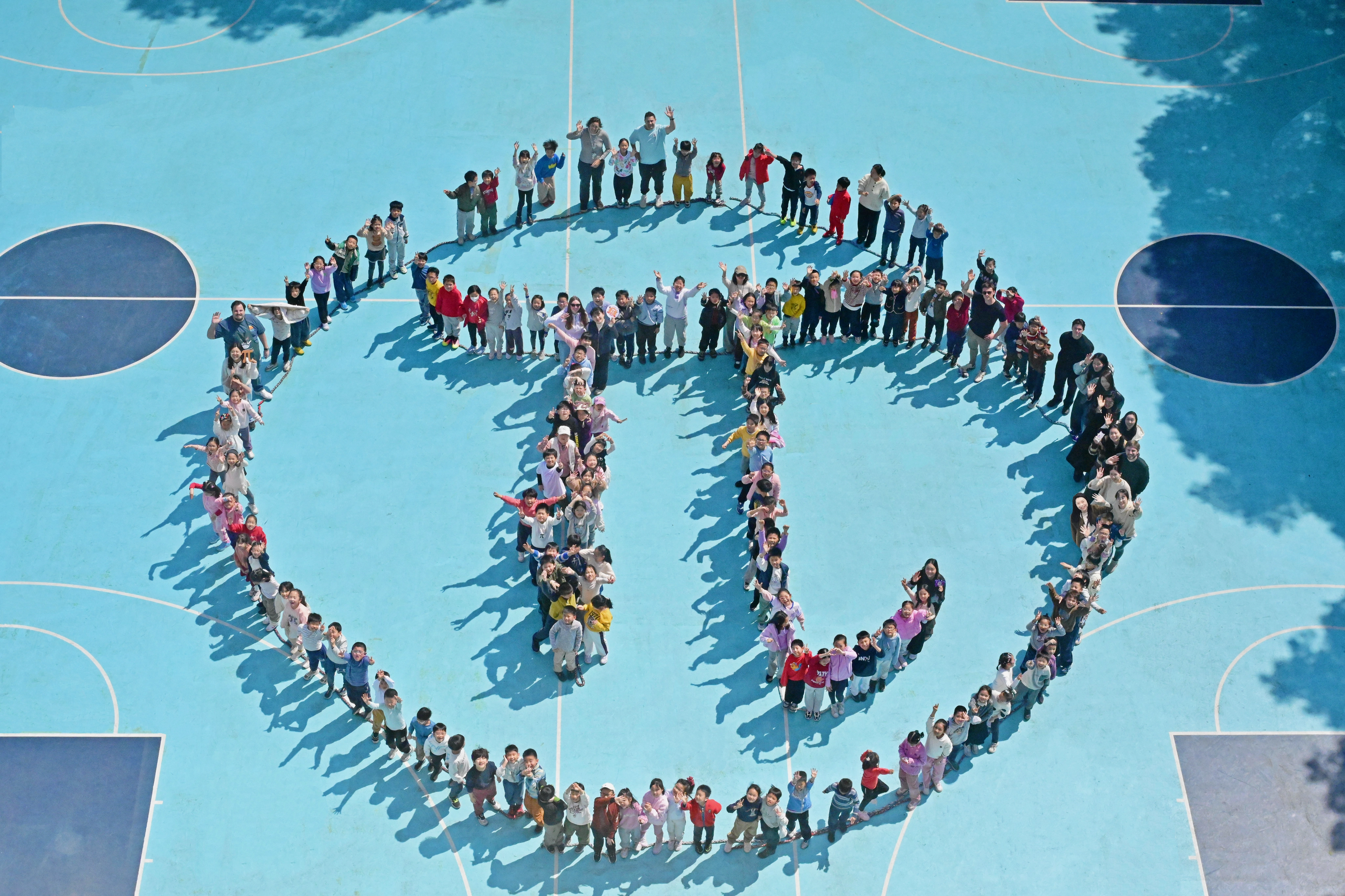
First-grade students embarked on a unique mathematical adventure—they made friends with "π," the magical symbol from the world of mathematics. It was the students' first time getting close to this fascinating number. Faced with π’s "never-ending" tail of decimals, the students were both amazed and captivated. They couldn’t resist competing to recite the digits after the decimal point, seeing who could remember the most. Accompanied by cheerful songs themed around π Day, they gradually came to feel the wonderful "connection" between π and circles. To dive deeper into π’s world, the students also created their own fun flip books. Through this hands-on activity, they came to understand that 3.14 is just π’s "business card," while π truly represents the mysterious relationship between the circumference of any circle and its diameter.
Next, the students became "little observers," setting out to find traces of circles in everyday life. Clock faces, mooncakes, basketballs, doughnuts, coins, cookies—one round object after another made the students exclaim in surprise, "Math is hiding all around us!" When the teacher asked about their favorite round foods, the students eagerly opened up, discussing round cakes and sweet mooncakes in turn. These π-related treats made their impression of π even more vivid and enjoyable. Through sharing and discussion, the students not only deepened their understanding of π and circles but also felt the warmth and approachability of mathematics.
Grade 2
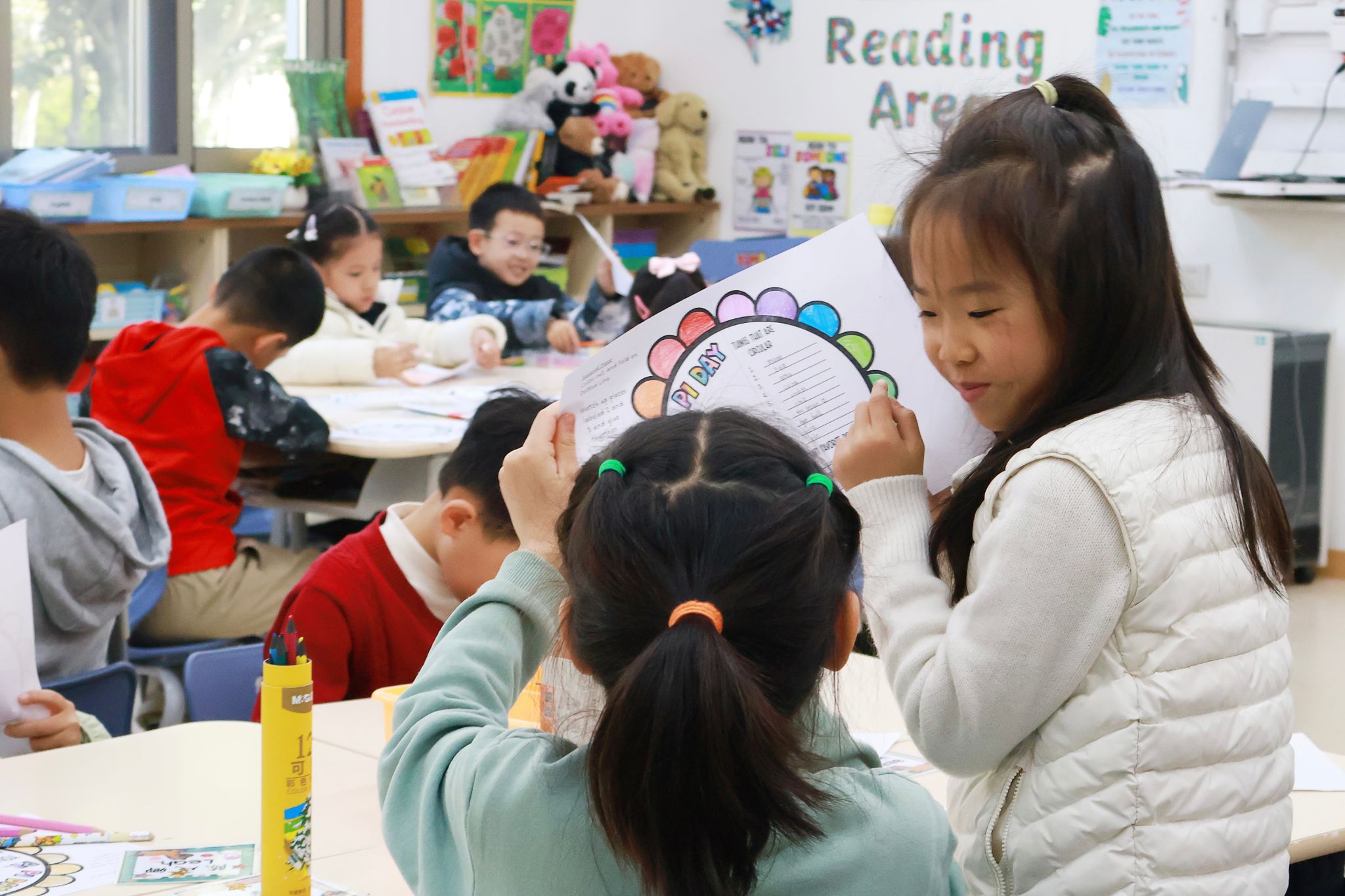
On a second-grade math day, a π Day surprise arrived right on schedule. Before the activity began, the students—full of excitement—transformed into little creators and carefully made their own π Day hats. Colored pencils glided across the paper as bright patterns and bold “π” symbols appeared here and there. With shiny stickers and soft little pom-poms added on, each hat became a unique creation, instantly filling the classroom with joy and playful energy. In class, the “π Skyline” activity officially began. Wearing the hats they had designed themselves, the students gathered eagerly around their tables, their eyes sparkling with excitement as they began their journey to explore the number π. First, they learned the simple meaning of π. Then, using bar graphs, they carefully “built” each decimal digit of π into math “buildings” of different heights. By measuring, coloring, and arranging the bars in order, the columns gradually formed a one-of-a-kind “math skyline,” reflecting the students’ focus and enthusiasm.
Throughout the classroom, bursts of delighted exclamations could be heard. As they worked, the students chatted softly and shared ideas, letting their imaginations run free. They added rivers and parks to their “math city,” blending numbers with creativity in a lively and meaningful way. They also took part in fun challenges, searching for circular objects in the classroom and trying to draw circles freehand. This engaging activity not only helped the students experience the beauty of π in a concrete way, but also allowed them to discover the joy and possibilities of mathematics through hands-on exploration—making this special π Day full of laughter, curiosity, and discovery.
Grade 3
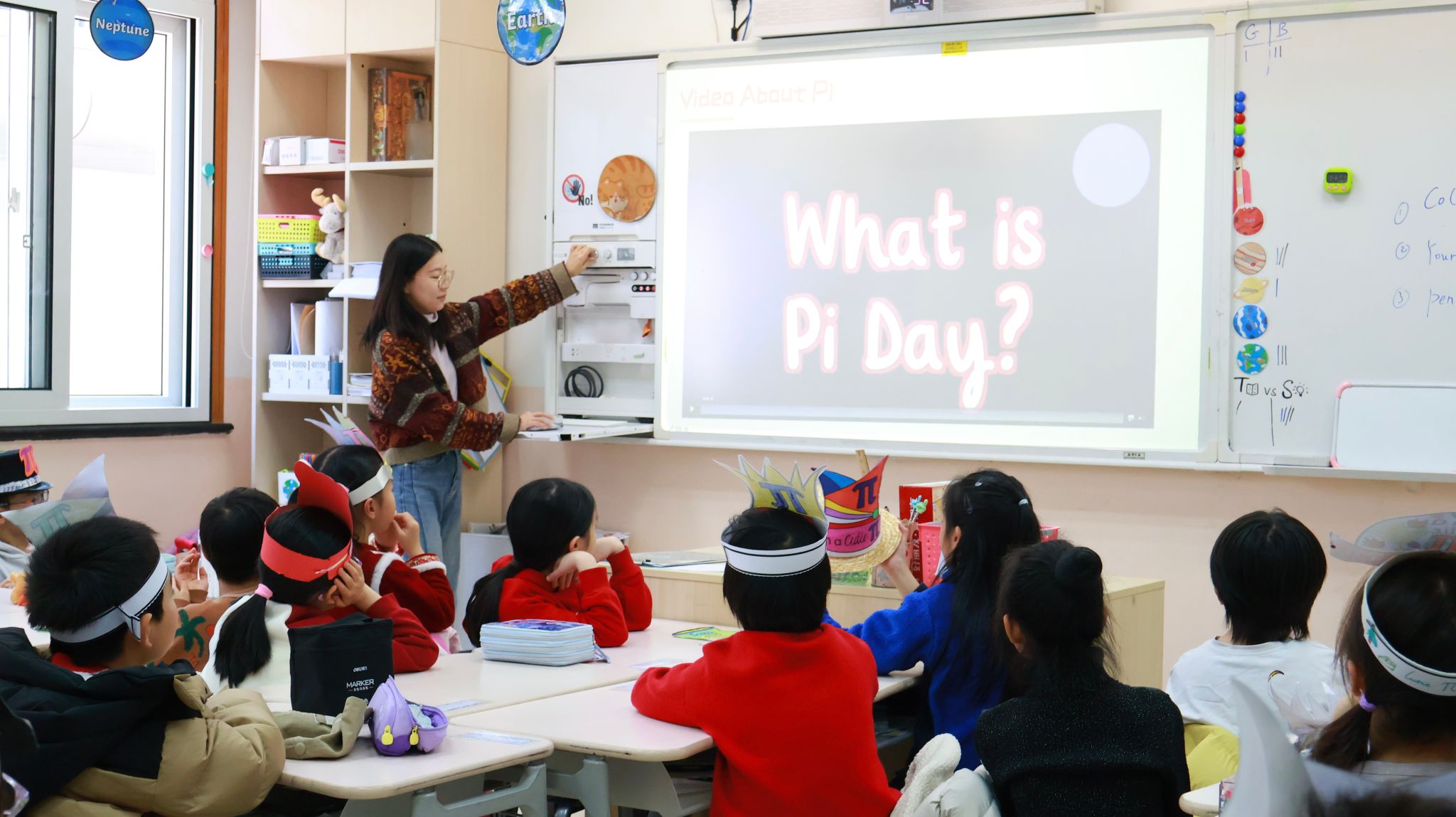
The third-grade math classroom was transformed into a "City Planning Studio" as a fun-filled activity called "π Cityscape" got underway in every class. This time, math was no longer about dull numbers and formulas—instead, it became a tool for creativity, with rulers and colors guiding students into an imaginative world of π. At the start of the activity, each child received a special worksheet. In the center of the page was a large circle, with the first three digits of π—"3.14"—already printed inside. The task that followed was both challenging and exciting: students needed to write out more digits of Π, then use a ruler to measure and draw bars of varying heights around the circle based on each digit. A taller bar for the number 3, a shorter one for 1—and just like that, a city skyline, guided digit by digit by π, took shape in their hands. What excited the students most was the freedom to create. They could choose to color their "skyscrapers" in bright colors, black, or even rainbow shades. They could also let their imaginations soar by adding stars, the moon, clouds, or a beautiful sunset as a backdrop to their city. Every piece of artwork was one of a kind—just like π itself, seen differently through each child's eyes.
Students from the Pudong Campus visited the π Theme Park on Zuchongzhi Road on π Day. Immersed in an interactive scene, they explored the cultural connection between the road name and the mathematical constant π, discovering the fascinating link between math and daily life. They learned that if letters are represented by numbers, the infinite, non-repeating sequence of π can contain a lifetime of stories, inspiring them to appreciate science and innovation in an engaging way.
"Math can be this much fun! " the third graders shared excitedly as they showed off their work. Math becomes approachable and enjoyable, and through hands-on creation, students naturally memorize more and more digits of π. π Day is no longer just a mathematical symbol—it has become a colorful and creative celebration in the hearts of the students.
Grade 4
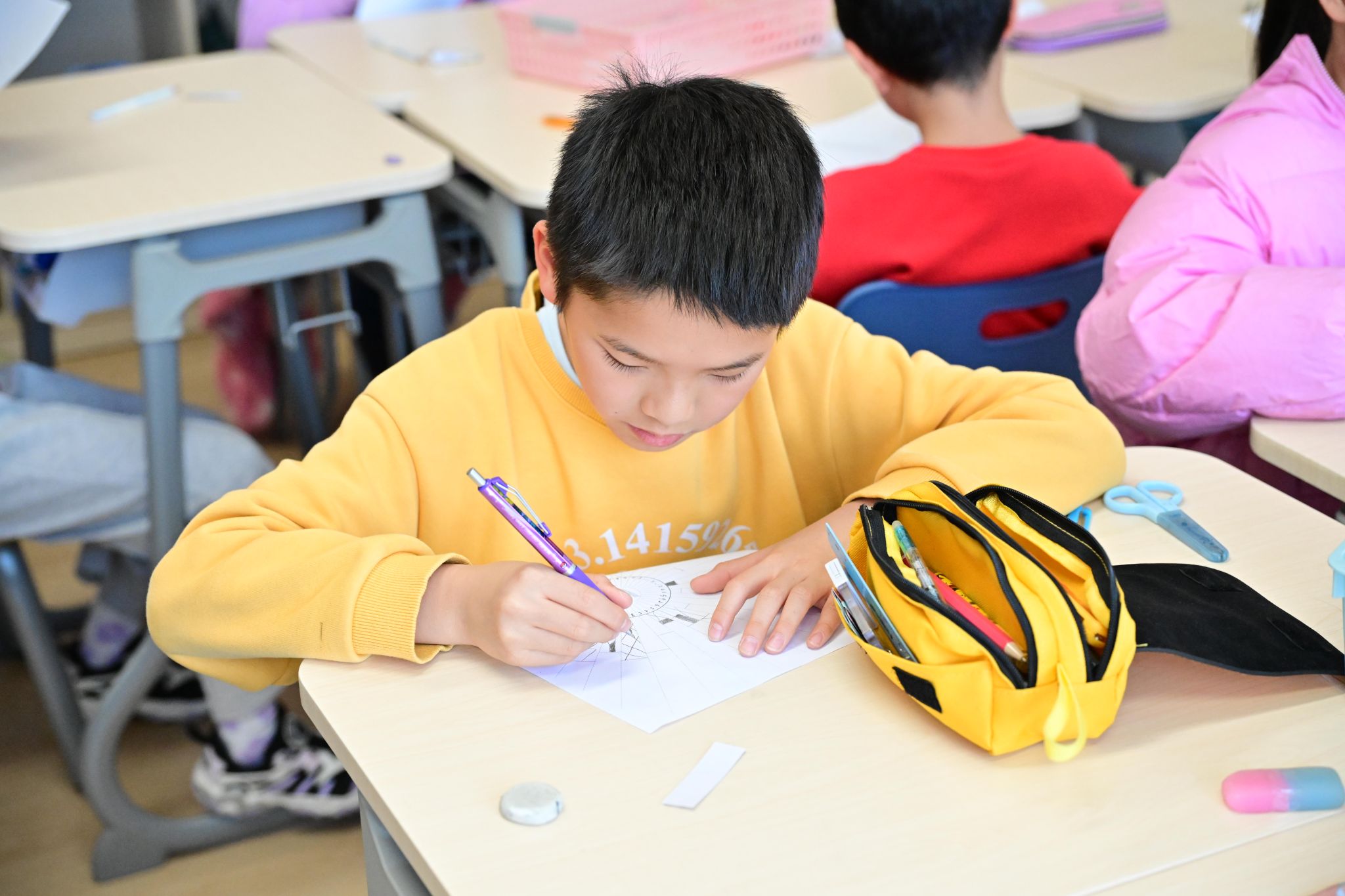
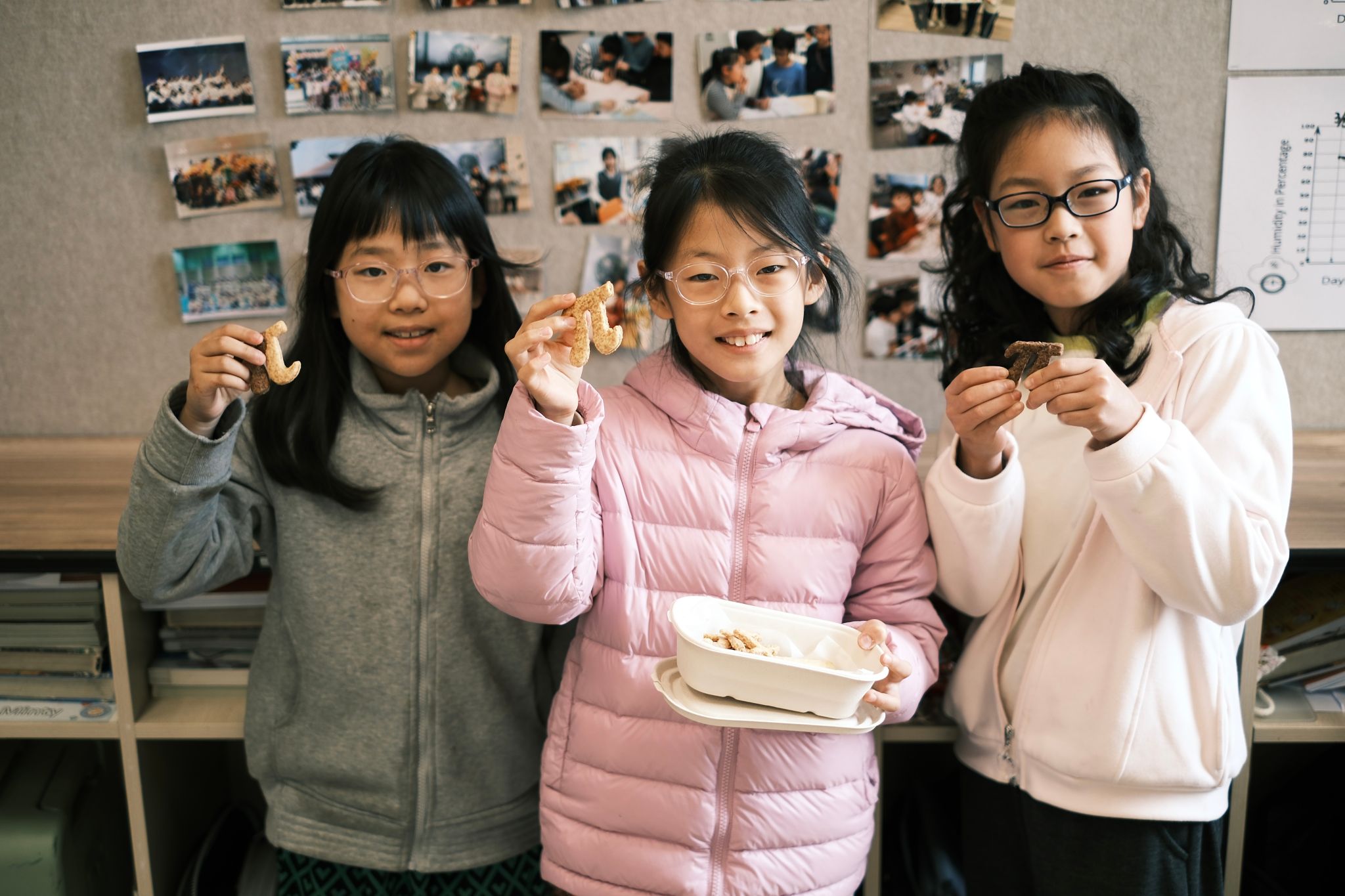
The Grade 4 celebration centered on the theme “Ways to Express π.” Students were encouraged to explore and interpret this famous constant through a wide range of creative forms. During the “Pi Day Challenge”, students selected projects that matched their interests and talents. Some incorporated π into cooking or baking, transforming mathematical inspiration into edible creations. Others translated the digits of π into musical notes, composing melodies that revealed unexpected connections between numbers and rhythm. Creative writing and visual art also provided powerful outlets. Some students wrote poems inspired by the infinite nature of π, while others created paintings and illustrations that turned abstract digits into vivid visual forms. Meanwhile, students who enjoyed logical puzzles challenged themselves with a “π-based Sudoku activity”, arranging digits within a grid through careful reasoning.
Another memorable activity was the “π Dreamcatcher” craft project. Students began by marking the digits 0 through 9 around the edge of a circular paper plate. Following the sequence of π—3.14159…—they connected the numbers with colorful threads, gradually weaving the infinite decimal expansion into an intricate web-like pattern. As the threads crisscrossed the circle, students were able to visualize the rhythm and progression of π’s digits. More importantly, they developed an intuitive understanding of π as a “non-terminating, non-repeating decimal”. By blending mathematics with art and craftsmanship, this activity helped students experience π not only as a numerical constant, but also as a source of aesthetic and intellectual curiosity.
Grade 5
Grade 5 students focused on application and experimentation, drawing on their existing knowledge of circles to explore how mathematics functions in practical design. The activities began with a “Pi Knowledge Quiz”, where students reviewed key concepts related to π, circle formulas, and real-world applications. This lively session helped students consolidate the mathematical ideas they had encountered throughout elementary school and prepared them for the hands-on challenge that followed.
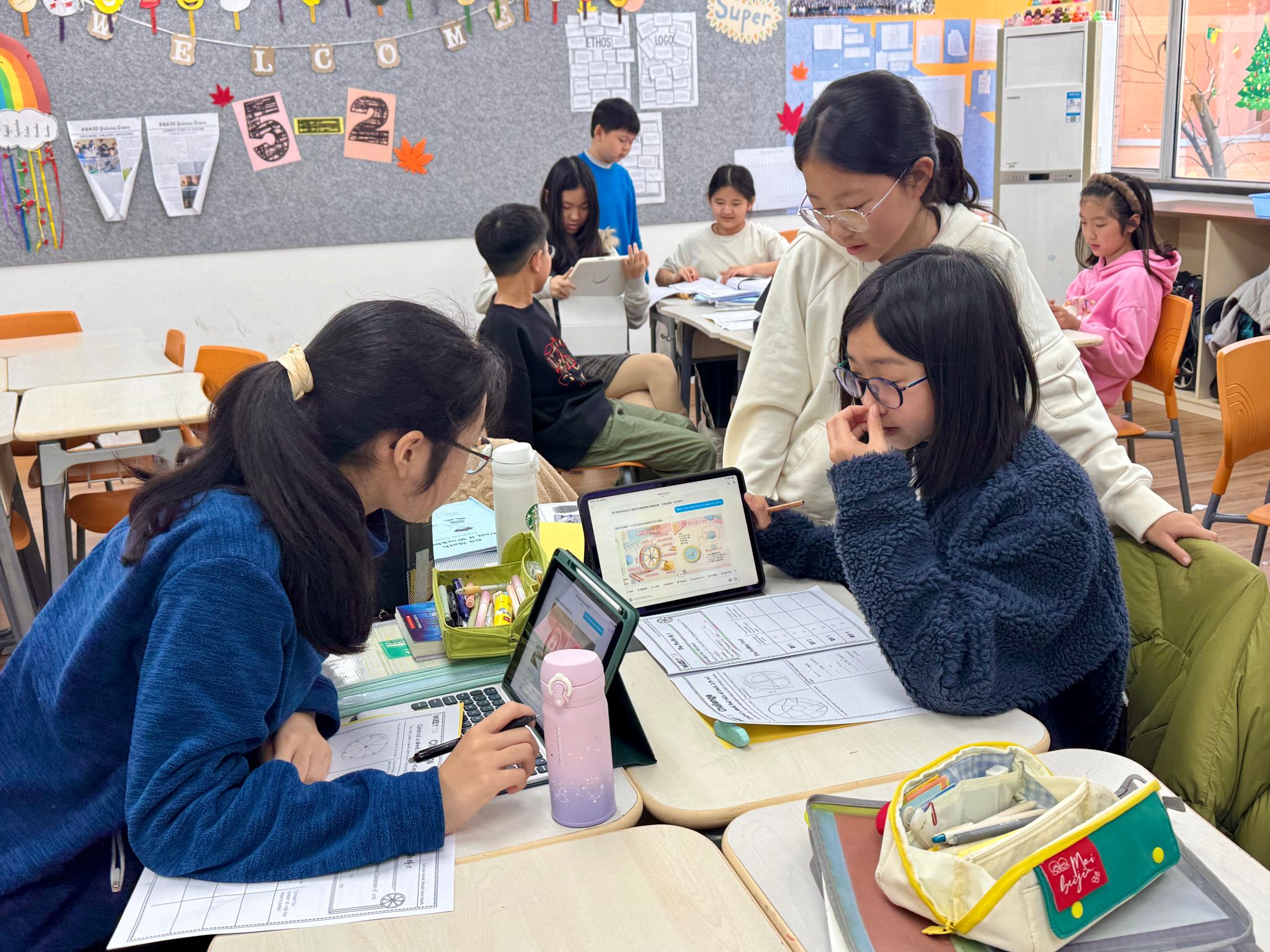
The highlight of the celebration was the rolling wheel design challenge — “Wheel Fun”. Working in teams, students designed and constructed circular wheels using clay and sticks. During the planning stage, some groups experimented with AI-assisted tools to visualize structural designs and consider factors affecting rolling performance, such as diameter, symmetry, and center of gravity. As construction progressed, students repeatedly tested and refined their designs. By strengthening support points and adjusting structural balance, they worked to improve both stability and rolling distance. After several rounds of experimentation and revision, the completed wheels entered the “Rolling Distance Challenge”. On the testing track, a wide variety of wheel designs made their appearance. Some teams opted for larger diameters to achieve longer rolling distances, while others focused on balanced structures to ensure smoother motion. The competition highlighted not only students’ creativity and teamwork but also their growing awareness of how mathematical principles influence engineering outcomes.
The Pi Day celebration provided students with a platform to explore mathematics through creativity, inquiry, and real-world application. By engaging in interdisciplinary projects, students deepened their understanding of π while discovering meaningful connections between mathematics, art, engineering, and logical reasoning. These experiences demonstrated that mathematics is far more than a set of formulas—it is a powerful language for understanding patterns, solving problems, and exploring the world. As students continue their academic journeys, the spirit of curiosity sparked during Pi Day will undoubtedly encourage them to keep questioning, creating, and discovering new possibilities in mathematics and beyond.
(Written by Yuanjing Zhang, Yu Lin, Jiahui Wen, Teng Chen
Pictures by Siying Li, G1-G3 Homeroom Teachers, G4-G5 Math Department
Reviewed by Ms. Zhang Yi, Xumei Ge, Yun Wang, Thea Chen, Lihui Zhang, Xing Ye, Shiyu Wu)