-
ABOUT US
-
ACADEMICS
Curriculum Program
Departments
- English
- High School Chinese
- Primary and Junior School Chinese.
- High School Mathematics
- Middle School Mathematics
- Primary School Mathematics
- Music and Fine Arts
- Physical Education
- Physics
- Chemistry
- History and Geography
- Physical Science and Optional courses Department
- Middle School Biology
- High School Biology
- Social Sciences
- Computer Science
- Courses in Primary School
Achievements and Matriculations
College Counseling
Science & Technology Innovation Contest
Subject Competition
-
ARTS
-
ATHLETICS
-
AT SHSID
SHSID ∣ TIMES
PTSA
Club Exhibition
- 龙吟社
- Live 2 Drama
- Choir
- Hip-pop Dance Club
- The Primary School Dance Troupe
- Symposiums Club
- Biology Workshop
- You Shan
- VEX Robotic
- Peking Opera Club
- Baseball Club
- Model United Nations
- The World Scholar’s Cup
- Future Problem Solving Club
- United States Academic Pentathlon
- OM Club
- AMC Club
- Music for Patients
- SHSID Gazette
- Smile Charity
- Cultural Moments
- SciAcademy
- Stem Doge Alliance
- Chinese Debate Club
- IAA
- Mock Trial Club
- Zhengming Club
- Furry Friends
- GT-Racing
- Village Radio
- IMMC Club
- Creative Design and Intelligent Fabrication
- Future City Research Project
- ECOCAP
- AdvocaSEA
- SPDC
- Medishine
- Floorball Club
- Animusic MTC
- Wings Up
- All Booked
- Cyano
- Birding Community
Health and Wellness
Campus Safety
Cafeteria Service
-
ADMINISTRATION
-
ADMISSIONS
-
ALUMNI
Alumni Information
Honors Students
- Class of 2025
- Class of 2024
- Class of 2023
- Class of 2022
- Class of 2021
- Class of 2020
- Class of 2019
- Class of 2018
- Class of 2017
- Class of 2016
- Class of 2015
- Class of 2014
- Class of 2013
- Class of 2012
- Class of 2011
- Class of 2010
- Class of 2009
- Class of 2008
- Class of 2007
- Class of 2006
Who Studied at SHSID
SHS Foundation
-
DOCUMENTS
Primary School Subjects Department: The "Eggcellent" Egg Drop Design in Grade 3
This September, the third grade students have been learning about the “design process”. The design process is a five step procedure that teaches students how engineers solve problems.
During the classes, students first identified the five steps in this process: 1. Identifying a problem 2. Planning and building a prototype 3. Testing and improving the prototype 4. Redesigning the prototype 5. Communicating results.
Students then discussed everyday inventions around their classroom and identified the problem these inventions were designed to solve.
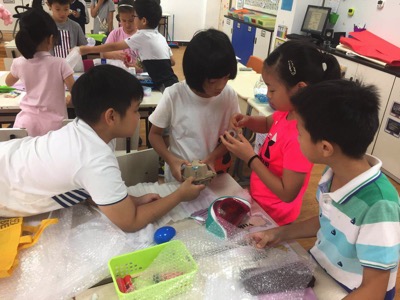
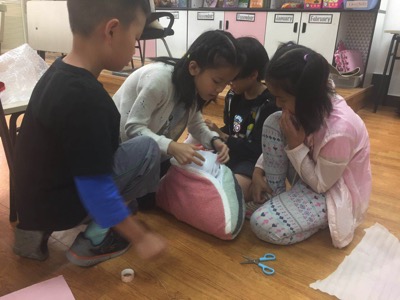
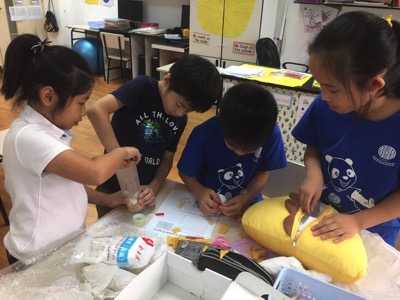
After this, the students were assigned a real world problem to solve: car safety. The students were given an egg to represent their “passenger”. The students’ objective was to build a prototype around their passenger that would keep it safe from a collision - a two meter drop to the ground. Working in groups, students were allowed to bring in a kind of material from home each to create their prototype. Each group was also given a roll of tape and five popsicle sticks. After fifteen minutes, the students tested their prototypes and then thought of ways to improve their prototypes.
The following week, the students completed the design process by redesigning their original prototype based on the results of their first test. The take-away experiences were shared among the students at the end of the second egg drop.
Working as an engineer has been a wonderful experience this September.
(Written by Grace Franoilch Pictures by Grace Franoilch)