-
ABOUT US
-
ACADEMICS
Curriculum Program
Departments
- English
- High School Chinese
- Primary and Junior School Chinese.
- High School Mathematics
- Middle School Mathematics
- Primary School Mathematics
- Music and Fine Arts
- Physical Education
- Physics
- Chemistry
- History and Geography
- Physical Science and Optional courses Department
- Middle School Biology
- High School Biology
- Social Sciences
- Computer Science
- Courses in Primary School
Achievements and Matriculations
College Counseling
Science & Technology Innovation Contest
Subject Competition
-
ARTS
-
ATHLETICS
-
AT SHSID
SHSID ∣ TIMES
PTSA
Club Exhibition
- 龙吟社
- Live 2 Drama
- Choir
- Hip-pop Dance Club
- The Primary School Dance Troupe
- Symposiums Club
- Biology Workshop
- You Shan
- VEX Robotic
- Peking Opera Club
- Baseball Club
- Model United Nations
- The World Scholar’s Cup
- Future Problem Solving Club
- United States Academic Pentathlon
- OM Club
- AMC Club
- Music for Patients
- SHSID Gazette
- Smile Charity
- Cultural Moments
- SciAcademy
- Stem Doge Alliance
- Chinese Debate Club
- IAA
- Mock Trial Club
- Zhengming Club
- Furry Friends
- GT-Racing
- Village Radio
- IMMC Club
- Creative Design and Intelligent Fabrication
- Future City Research Project
- ECOCAP
- AdvocaSEA
- SPDC
- Medishine
- Floorball Club
- Animusic MTC
- Wings Up
- All Booked
- Cyano
- Birding Community
Health and Wellness
Campus Safety
Cafeteria Service
-
ADMINISTRATION
-
ADMISSIONS
-
ALUMNI
Alumni Information
Honors Students
- Class of 2025
- Class of 2024
- Class of 2023
- Class of 2022
- Class of 2021
- Class of 2020
- Class of 2019
- Class of 2018
- Class of 2017
- Class of 2016
- Class of 2015
- Class of 2014
- Class of 2013
- Class of 2012
- Class of 2011
- Class of 2010
- Class of 2009
- Class of 2008
- Class of 2007
- Class of 2006
Who Studied at SHSID
SHS Foundation
-
DOCUMENTS
Grade 8: Service Learning: Broadcast Group
During the last two periods of February 28th’s CAS class, the 7th and 8th graders were ushered to the auditorium to be introduced to one of the newest, and perhaps one of the most impactful, service learning groups. The aptly named Broadcasting Group centers around helping school children living in rural environments, to stay optimistic despite their daily struggles. Essentially, this broadcast group focuses on providing an engaging and captivating extra-curricular activity for these children that call the great hills and mountains their home. Thanks to charity work, schools in rural areas have expanded, but there is still a shortfall of interesting but educational recreation, mainly due to the lack of resources and organization. With this broadcast group, a type of communication device, as well as a fascinating extra-curricular event is established--one that allows every kid in school to learn something new. They’re taught to provide radio broadcast messages and speeches, and then these children are brought to a radio station in Shanghai to air their stories and announcements. In Shanghai alone, there have already been over 1 million listeners of this broadcast. It goes without saying that this group has touched countless people.
Most students seemed a bit dubious when they entered the auditorium, unsure as to why they should care for a Service Learning group like this. And the question arose: why should we care? The presenter, Xin Li, who was one of the main broadcasters and volunteers that took part in lending a hand to the children, says it best: “We’ve constantly been dealt the upper hand.” Through an array of stories or pictures, he shows us how turning a blind eye to these children would be immoral. These kids who have been secluded, who could only dream of having extravagant feasts, who find beauty in the sounds of Mother Nature, are pushing through obstacles daily, dealing with it all on their own. Perhaps the least we could do is provide colorful entertainment to them, he concludes.
He begins the presentation by showing us a collage-type arrangement of pictures, each showing a smiling face of a village child. Xin Li then tells us that a jaw-dropping nine out of ten of these village children have parents working cities away, doing all they can to support their family. This means that these innocent children have to go months, maybe even years, before they can have a face-to-face conversation with their mothers or fathers. He tells us of their struggle with doing something we’d see as mundane-- going to school. Through pictures that speak more than words, we are shown cherubic faces climbing steep steps, walking deserted and stretched-out mud paths, wearing smiles and backpacks like all of this was worth it if they made it to school. These children had to walk three hours from their homes in the mountains just to get to school, often waking up at 5 AM just so they wouldn’t miss the first bell. Xin Li goes on to share with us three stories of their volunteer work. The most moving one was a video, where the broadcast volunteer had went up to two girls, asking what they’d say to their parents if they could speak to them. The first girl says that she wants to thank her parents, because they have put in their all to give her whatever she might want in the future. The second girl all but croaks, voice trembling on the verge of tears, “I miss them.” After that, Xin Li advises us to cherish every moment we spend with our parents, and that we must consider how lucky we are to have our parents by our side.
So what can we do to help? The most fundamental thing we can do is donate to the cause, which can be simply done through our charity fairs or other organized events. In fact, SHSID has already made generous donations to the cause. If students want to do more than donate, they can also choose to give up some of their unneeded household items or other school-related books--anything that might help these children would suffice. For students that would like to get hands-on with the issue, this broadcast group also organizes volunteer trips to these remote locations, to help build these radio stations and workshops. If students are interested in providing shelter for the broadcast group children coming to Shanghai for the educational experience, they can register to have one of these kids live at their home. This would require accompanying them through some of their studies, joining them for the radio broadcast activities, and perhaps even bringing them on a tour around Shanghai, a foreign place for these children. Xin Li concludes his presentation by asking, bright and energetic, if we were willing to help and support this cause. The crowd explodes into an array of shouts, “Yes!”, so we can only hope that more people will be interested in providing a better, more entertaining future for these young children. We hope that more students will step up to provide an experience for those that have been dealt a poor hand at life.
If students are interested in joining the service learning group, make sure to inform your homeroom teacher.
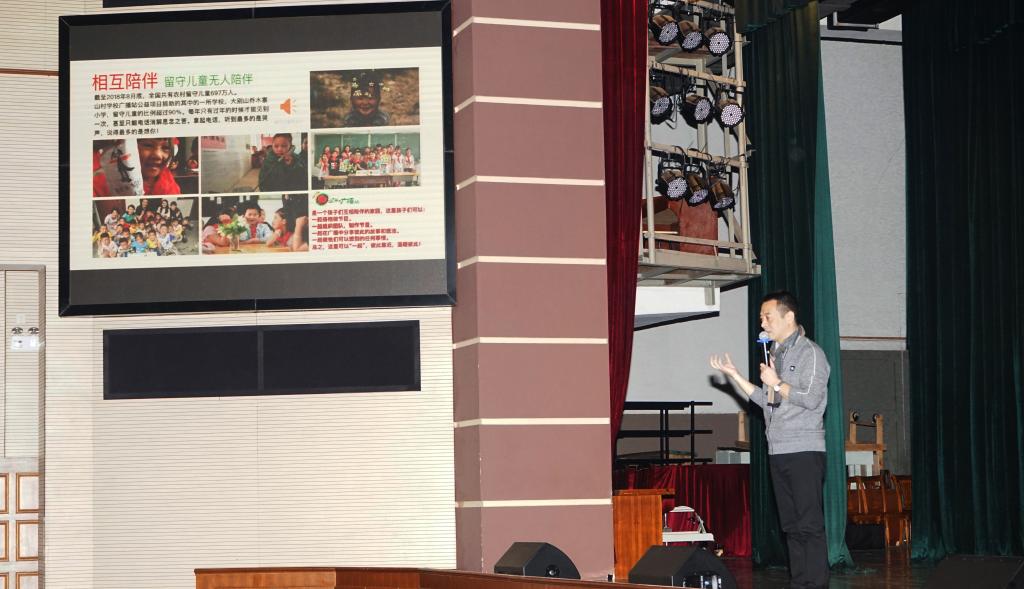
(Written by 8(1) Mimi Yang Pictures by Ms. Xu Jing)