-
ABOUT US
-
ACADEMICS
Curriculum Program
Departments
- English
- High School Chinese
- Primary and Junior School Chinese.
- High School Mathematics
- Middle School Mathematics
- Primary School Mathematics
- Music and Fine Arts
- Physical Education
- Physics
- Chemistry
- History and Geography
- Physical Science and Optional courses Department
- Middle School Biology
- High School Biology
- Social Sciences
- Computer Science
- Courses in Primary School
Achievements and Matriculations
College Counseling
Science & Technology Innovation Contest
Subject Competition
-
ARTS
-
ATHLETICS
-
AT SHSID
SHSID ∣ TIMES
PTSA
Club Exhibition
- 龙吟社
- Live 2 Drama
- Choir
- Hip-pop Dance Club
- The Primary School Dance Troupe
- Symposiums Club
- Biology Workshop
- You Shan
- VEX Robotic
- Peking Opera Club
- Baseball Club
- Model United Nations
- The World Scholar’s Cup
- Future Problem Solving Club
- United States Academic Pentathlon
- OM Club
- AMC Club
- Music for Patients
- SHSID Gazette
- Smile Charity
- Cultural Moments
- SciAcademy
- Stem Doge Alliance
- Chinese Debate Club
- IAA
- Mock Trial Club
- Zhengming Club
- Furry Friends
- GT-Racing
- Village Radio
- IMMC Club
- Creative Design and Intelligent Fabrication
- Future City Research Project
- ECOCAP
- AdvocaSEA
- SPDC
- Medishine
- Floorball Club
- Animusic MTC
- Wings Up
- All Booked
- Cyano
- Birding Community
Health and Wellness
Campus Safety
Cafeteria Service
-
ADMINISTRATION
-
ADMISSIONS
-
ALUMNI
Alumni Information
Honors Students
- Class of 2025
- Class of 2024
- Class of 2023
- Class of 2022
- Class of 2021
- Class of 2020
- Class of 2019
- Class of 2018
- Class of 2017
- Class of 2016
- Class of 2015
- Class of 2014
- Class of 2013
- Class of 2012
- Class of 2011
- Class of 2010
- Class of 2009
- Class of 2008
- Class of 2007
- Class of 2006
Who Studied at SHSID
SHS Foundation
-
DOCUMENTS
Middle School Science Group and Their Study on Pathogen
Middle School Science Group and Their Study on Pathogen
Our science group team began their 3 month experiment of theVietnamdragon fruit in 2014. On 2015, 25th of May, they published a detailed article named “Pathogen Identification and Environmental Effects Analysis of Black Rot Disease of Imported Vietnamese ‘red’ Pitaya” concerning the course and result of their experiment on a science magazine.
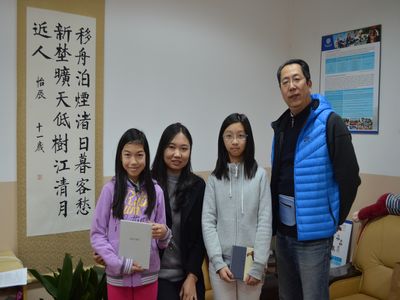
The science group team consists of 3 diligent students and a very responsible teacher. The instructor, Ms. Yao is an expert on plant-affecting bacterium and protist. She was the first one to think of studying the pathogen (Bipolarius Cactivora) that infected the Vietnamese red pitaya. Ms. Yao helped the students to overcome many challenges and difficulties in both writing the report and during the process.
Alicia is a lovely and bright student who has great interest and potential in the field of biology. She was the first member of this experiment, and contributed great working and critical thinking skills in it.
Under Alicia’s persuasion, Yolanda joined the experiment as well. Yolanda is an out-going and smart girl. She’s fascinated by this experiment, and is particularly interested in pathogens, as well as the subject of biology overall.
Last but not least is Ashley Fan. Although she is not longer studying at our school, she contributed and worked as hard as any of the other group members.
Every member in this team played a key role to their group success. With some help from the teacher, Ms. Yao, they were able to assemble an efficient and high quality report on their study. They willingly sacrificed many of their free time for this project. “Even though at the toughest of times we had to drive to school during the weekends to check on our results,” Yolanda had said “I enjoyed the process of learning and working hard with my friends and teacher.”
During this three-month study, they examined major pathogen that causes the black rots on the imported pitaya fromVietnamin different aspects. After carefully devising their plan, they gathered the ingredients needed for the experiment.
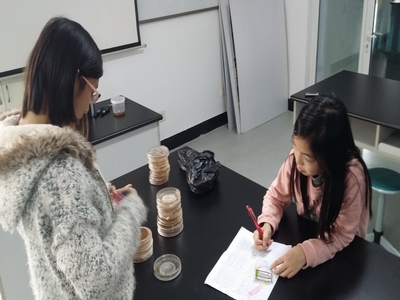
With the infected pitaya ready, they started to proceed according to their plan. They first isolated the fungi from the plant and had it cleansed with sterile water and alcohol numerous times. Then, they transferred the fungi into a PDA culture for it to grow. With a microscope, they studied and recorded the fungus’s hypha, spores and compared it with the characteristic of its active stage.
After the observation, they officially began their several experimental stages. With alcohol, they wiped their equipments and new fruits clean. They planted three to five specks of the fungus, with a diameter 0.6mm, onto each healthy fruit. Then, the fruits are covered with a wrap and placed it under room temperature (25 degree Celsius) with an infected pitaya to see if the infection occurs. They took photos of the pathogen’s growth and recorded its new diameter after each day for a week.
Another experiment followed the previous one immediately. Again, they isolated the fungi from the plant, but this time they placed it in different environments to study which type of surrounding is the most optimistic for this fungi. They placed each sample under different ph value environments, different light and temperatures. With several plates for each type of situations, they had to take notes on the growth of fifteen or so different fungus plates at the same time.
With the recorded information on this disease ready, they started their essay on the evaluation of these fungi in reference of their experiment results. All of the group members, even the teacher, admitted that the writing portion was the most challenging out of this whole experiment. “We tried to carry out an essay on the fungi which are cultivated in different light conditions, but failed. We tried again, but gave up.” (Ms. Yao.) Despite the difficulties in scientific writing, the team worked together as a whole and assembled an essay on this disease which impressed many people.
The groups faced countless challenges and incessant difficulties during this period of time. Because there are no such equipments in school, the group had to find and contact other labs for help for the molecular experiments. Time was also a very big issue for them. Since the group only had free time after school they had to drive back and forth between their houses and school to check on the progress, even on the weekends. On one occasion, the plate containing the fungi was smashed and thrown away, causing them to lose the data and discard that portion of the study.
Despite the trouble brought by this experiment, the group members were all very happy and proud of their accomplishments. “The part I enjoyed the most,” Alicia stated “was when we injected the mycelium (the hypha of the fungus) into the fruits to check if it will be affected by this disease when placed together with an infected Vietnam Red Dragon Fruit.”
This seemingly insignificant project contributes a lot to our world. “This project,” Ms. Yao said “will give others some clues of finding an environmental friendly way to prevent the disease or reduce the economic loss brought by it. In the meantime, the discovery of light having the ability to regulate the production of pigments in fungi is also a hot topic in the scientific world.” For that matter, Alicia also said that they were interested and wanted to help other people to solve the problem of decaying food.
All successful researches require precision, logic and reasoning as well as unyielding spirits. These girls and teacher worked very hard and spent a lot of time for this experiment. Their hard work behind the six paged report may be oblivious to the ones who read it, but they most defiantly deserve to be praised for their achievements and hard work on their magnificent report.
(Written by Rachel Wu &Teresa Ma Picture by Jerry)