-
ABOUT US
-
ACADEMICS
Curriculum Program
Departments
- English
- High School Chinese
- Primary and Junior School Chinese.
- High School Mathematics
- Middle School Mathematics
- Primary School Mathematics
- Music and Fine Arts
- Physical Education
- Physics
- Chemistry
- History and Geography
- Physical Science and Optional courses Department
- Middle School Biology
- High School Biology
- Social Sciences
- Computer Science
- Courses in Primary School
Achievements and Matriculations
College Counseling
Science & Technology Innovation Contest
Subject Competition
-
ARTS
-
ATHLETICS
-
AT SHSID
SHSID ∣ TIMES
PTSA
Club Exhibition
- 龙吟社
- Live 2 Drama
- Choir
- Hip-pop Dance Club
- The Primary School Dance Troupe
- Symposiums Club
- Biology Workshop
- You Shan
- VEX Robotic
- Peking Opera Club
- Baseball Club
- Model United Nations
- The World Scholar’s Cup
- Future Problem Solving Club
- United States Academic Pentathlon
- OM Club
- AMC Club
- Music for Patients
- SHSID Gazette
- Smile Charity
- Cultural Moments
- SciAcademy
- Stem Doge Alliance
- Chinese Debate Club
- IAA
- Mock Trial Club
- Zhengming Club
- Furry Friends
- GT-Racing
- Village Radio
- IMMC Club
- Creative Design and Intelligent Fabrication
- Future City Research Project
- ECOCAP
- AdvocaSEA
- SPDC
- Medishine
- Floorball Club
- Animusic MTC
- Wings Up
- All Booked
- Cyano
- Birding Community
Health and Wellness
Campus Safety
Cafeteria Service
-
ADMINISTRATION
-
ADMISSIONS
-
ALUMNI
Alumni Information
Honors Students
- Class of 2025
- Class of 2024
- Class of 2023
- Class of 2022
- Class of 2021
- Class of 2020
- Class of 2019
- Class of 2018
- Class of 2017
- Class of 2016
- Class of 2015
- Class of 2014
- Class of 2013
- Class of 2012
- Class of 2011
- Class of 2010
- Class of 2009
- Class of 2008
- Class of 2007
- Class of 2006
Who Studied at SHSID
SHS Foundation
-
DOCUMENTS
University of Notre Dame
University of Notre Dame
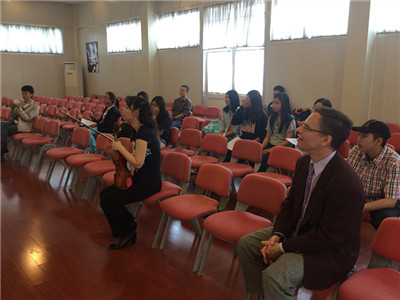
On October 10th, faculty members from the University of Notre Dame visited SHSID and offered a college lecture in the music center during lunch. “Notre Dame” conjures images of a grumpy old hunchback scampering about a cathedral in feudal France may come to mind. The University of Notre Dame, located in South Bend, Indiana, is one of the largest Catholic research universities in the United States. It was founded by Father Edward Sorin on November 26, 1842 as an all male institution. It began to enroll female undergraduates in 1972.
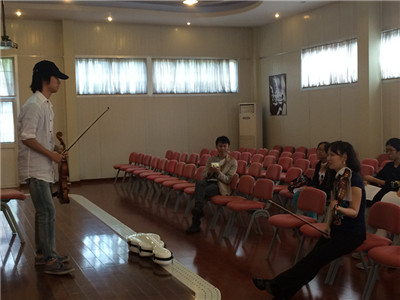
The information session on October 10th, 2014 on the campus of SHSID started unlike any other. Yido Ho from grade 11 began by playing Csardas for Professor Tricia Park, the resident violin specialist at Notre Dame. Constructive critiques, though slightly distressing, immediately followed the performance. Professor Park commented on techniques regarding the positioning of the bow to create sounds that better suit the melancholy nature of this song. Professor Park even demonstrated personally for Yido the importance of articulation and intonation, and how even the slightest change, such as shifting the elbow, could affect the entire piece. She concluded her critique by commending the efforts for this student and reminding him to be more careful when he plays in order achieve the full desired effects.
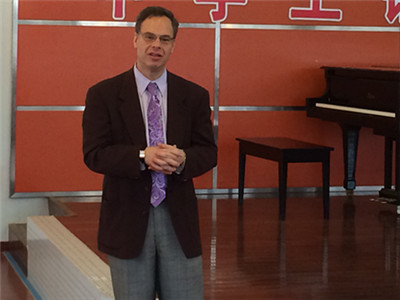
Professor Peter Smith, the Chair of Music at the University of Notre Dame followed this with a presentation on applying to the music department of Notre Dame, and also the effects of music on everyday life. He reminded students not to forget the importance that music plays in their individual lives, whether they’re considering it as a full time career or simply as an interest. He says that at Notre Dame, it’s very common for students to take on double majors, for example music and medicine, and excel at both of them. In fact, it’s even advantageous for the student in the admissions process to demonstrate proficiency at both.
The session ended with a Q&A period with the two faculty members. Professor Park shared a personal story about how she started playing professionally at the age 16. Just as with any other college major, there’s no more powerful motivator than simply interest. It’s very easy to tell whether a student truly enjoys an instrument by the way they play. In high school, if students are interested in a future in music, they would benefit from playing an instrument. In applying to the music department, one would have to submit an audio recording of a piece that would be graded by a faculty of the music department. That being said, a background in music theory would also be good.
(Written byChris Lin; Photo by Zhang Nan)